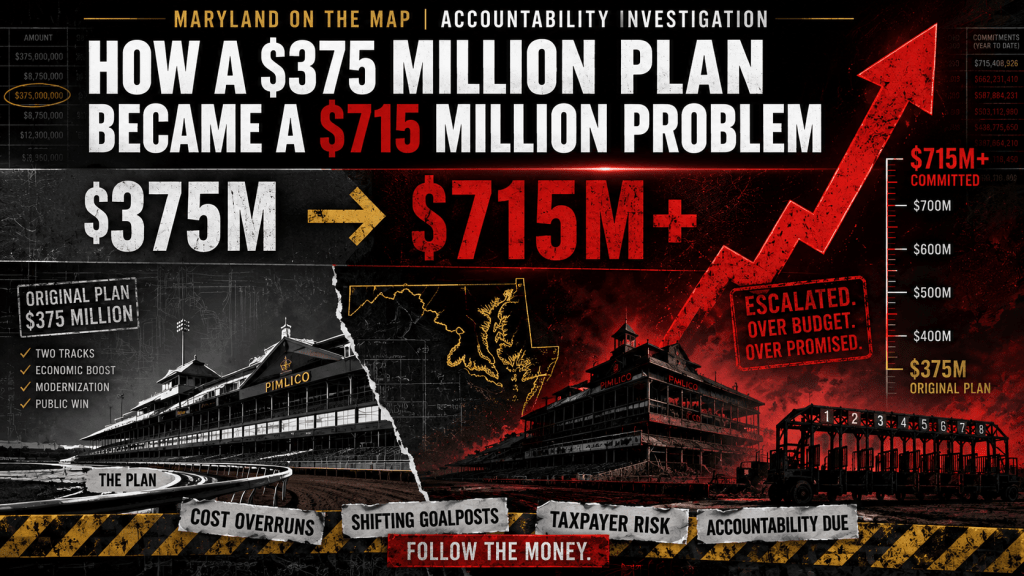
Maryland didn’t plan to spend $715 million on horse racing. It planned to spend $375 million — and made five escalating decisions, without public cost-benefit analysis at any step, that got it here. This is the documented sequence.
By Michael Phillips | MDBayNews | Maryland on the Map
The documented escalation — $375M to $715M+ in five decisions
Before Churchill Downs. Before the Preakness IP. Before the NBC deal and the Sunday date and the Memorial Day positioning. Before any of it — there was a simpler plan.
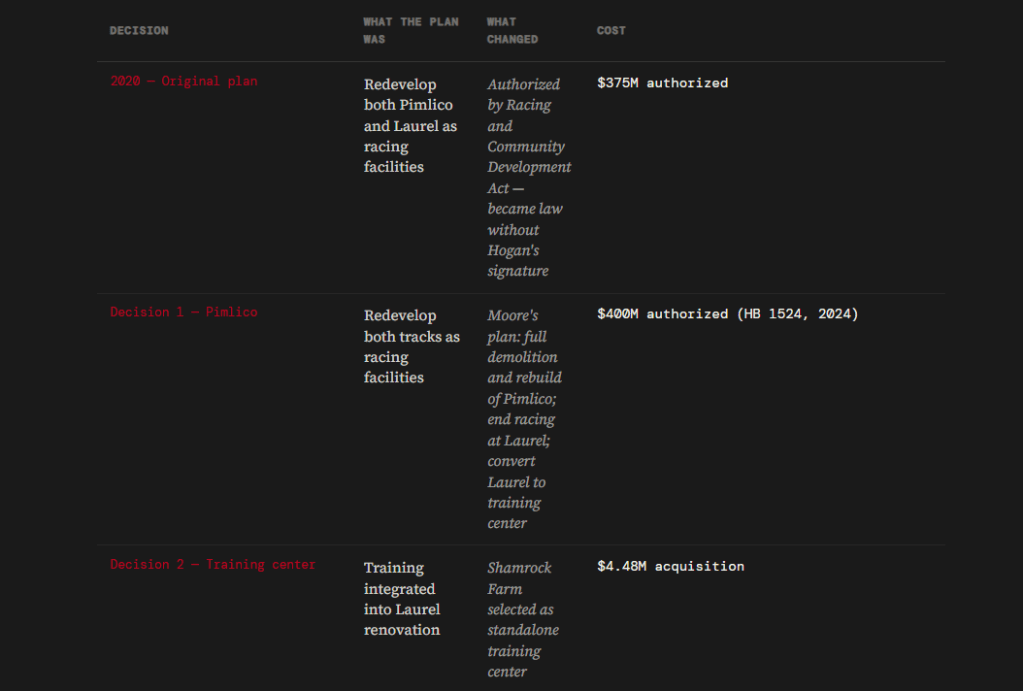
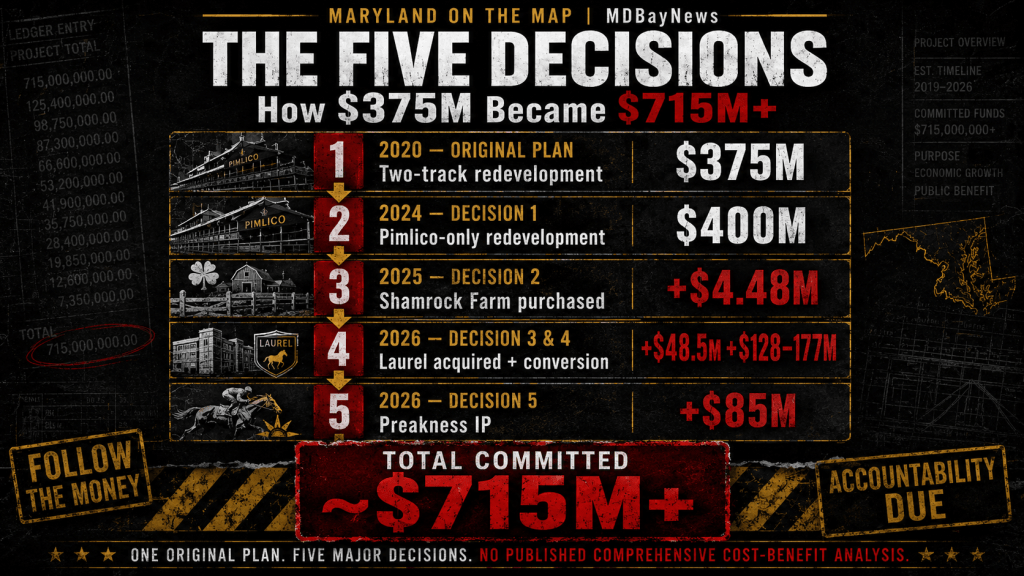
In May 2020, Governor Larry Hogan allowed the Racing and Community Development Act to become law without his signature. The Maryland Stadium Authority was authorized to issue up to $375 million in bonds to redevelop both Pimlico Race Course and Laurel Park. The money would be repaid by lottery and casino proceeds already designated to subsidize the racing industry. Both tracks would be redeveloped. Both would continue operating as racing facilities. Pimlico would remain the home of the Preakness. Laurel would be transformed into, as The Racing Biz described it at the time, “the rest-of-the-year epicenter of Maryland racing.” Total authorized cost: $375 million.
That plan failed. What replaced it cost nearly twice as much — and still doesn’t have a published cost-benefit analysis, transparent projections, or measurable success metrics. Senator Steve Hershey has been asking for all three since August 7. No one has provided them.
How the Original Plan Failed
The 2020 plan was already collapsing before Wes Moore took office in January 2023. The Maryland Stadium Authority reported to the legislature in January 2023 that the $375 million authorization was insufficient — construction costs had escalated, required agreements between parties hadn’t been executed, and the projected costs far exceeded the initial estimates.
Alternative concepts outlined in the MSA’s January 2023 report were “more affordable than other proposals” — but still $160 million over the original $375 million budget. Even the scaled-back versions exceeded what had been authorized. Construction at Pimlico was expected to begin in summer 2023. It didn’t. Demolition hadn’t happened. The required agreements weren’t in place.
“Based on the prolonged program confirmation process, current agreement execution status, and level of design effort still required prior to advancing to the construction phase, this timetable is no longer realistic.”
Maryland Stadium Authority — January 2023 report to the Maryland Legislature
Moore inherited a failed plan, an exhausted authorization, and two deteriorating tracks. That is not his fault. What he did next is his responsibility — and it has never been publicly justified with the kind of transparent accounting Senator Hershey is now demanding.
Moore inherited a failed plan, an exhausted authorization, and two deteriorating tracks. That is not his fault. What he did next is his responsibility.
Decision One — Rebuild Pimlico, End Racing at Laurel
Decision 1 of 5
Full demolition and reconstruction of Pimlico — racing at Laurel ends permanently
The 2020 plan called for redevelopment of both Pimlico and Laurel as racing facilities — the original legislation allocated at least $180 million to Pimlico and at least $155 million to Laurel, with both continuing as racing venues. Moore’s administration made a fundamentally different choice: fully demolish and rebuild Pimlico as the sole Maryland racing destination, end racing at Laurel permanently, and convert Laurel into a training facility.
“The legislature in 2020 had passed the Racing and Community Development Act to make Pimlico a viable long-term home for the Preakness while transforming Laurel into the rest-of-the-year epicenter of Maryland racing.”
— The Racing Biz, April 2022
In 2024, the Maryland legislature passed HB 1524 authorizing $400 million in bonds — $25 million more than the entire original authorization for both tracks — for Pimlico reconstruction alone. Demolition of the existing Pimlico structures began July 24, 2025.
Maryland now owns a 332-acre farm in Carroll County that it cannot use as a training facility.
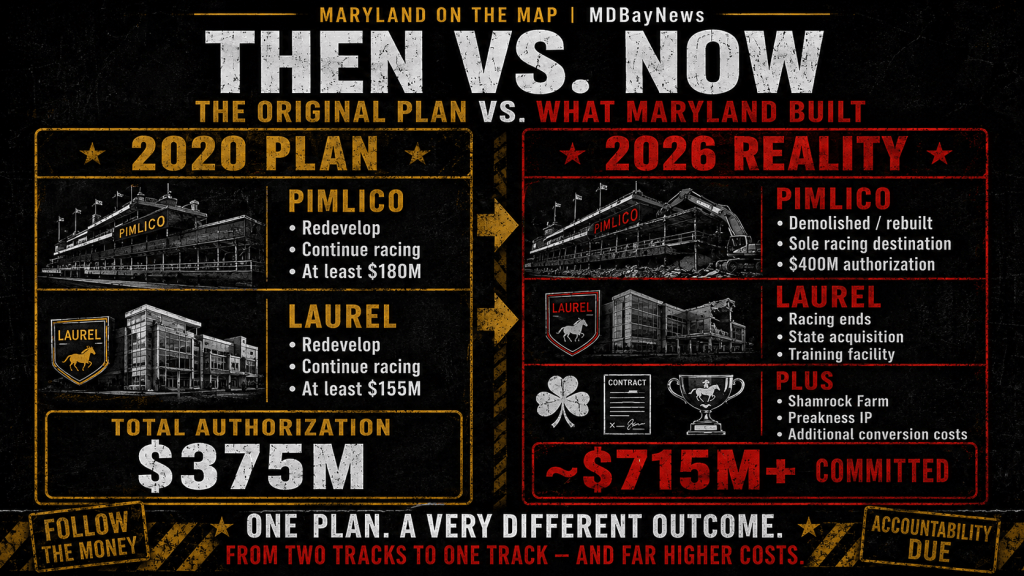
The rationale for concentrating all racing at a rebuilt Pimlico rather than maintaining two operating tracks has not been publicly cost-justified. The MSA’s position is that the existing structures were too deteriorated for viable renovation of the original scope — that may be accurate. But a decision of this magnitude should come with a public engineering assessment, a cost comparison between the two approaches, and a transparent accounting of why the more expensive single-track approach was chosen over the two-track original. None of that has been released publicly.
This decision also had a consequence: it required a standalone training facility to replace Laurel’s training operations — which is what led directly to the Shamrock Farm fiasco.
Decision Two — Shamrock Farm: $4.48 Million for a Farm Maryland Couldn’t Use
Decision 2 of 5
Shamrock Farm selected as training center — purchased, then abandoned
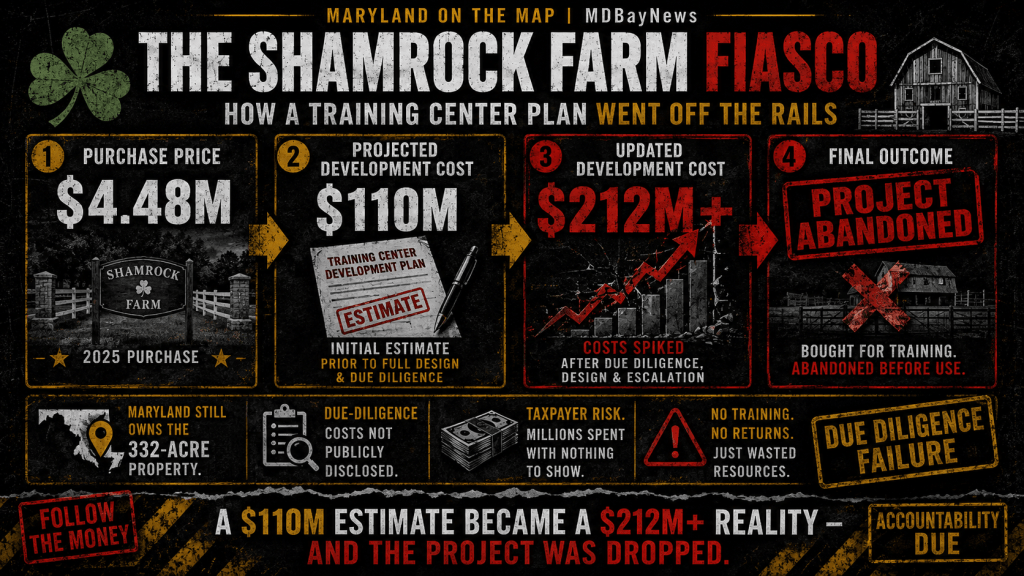
With Laurel’s training operations ending, Maryland needed a new training center. The Maryland Thoroughbred Racetrack Operating Authority selected Shamrock Farm in Carroll County — 332 acres — as the site. The Board of Public Works approved the acquisition. Maryland paid $4.48 million and took title in October 2025.
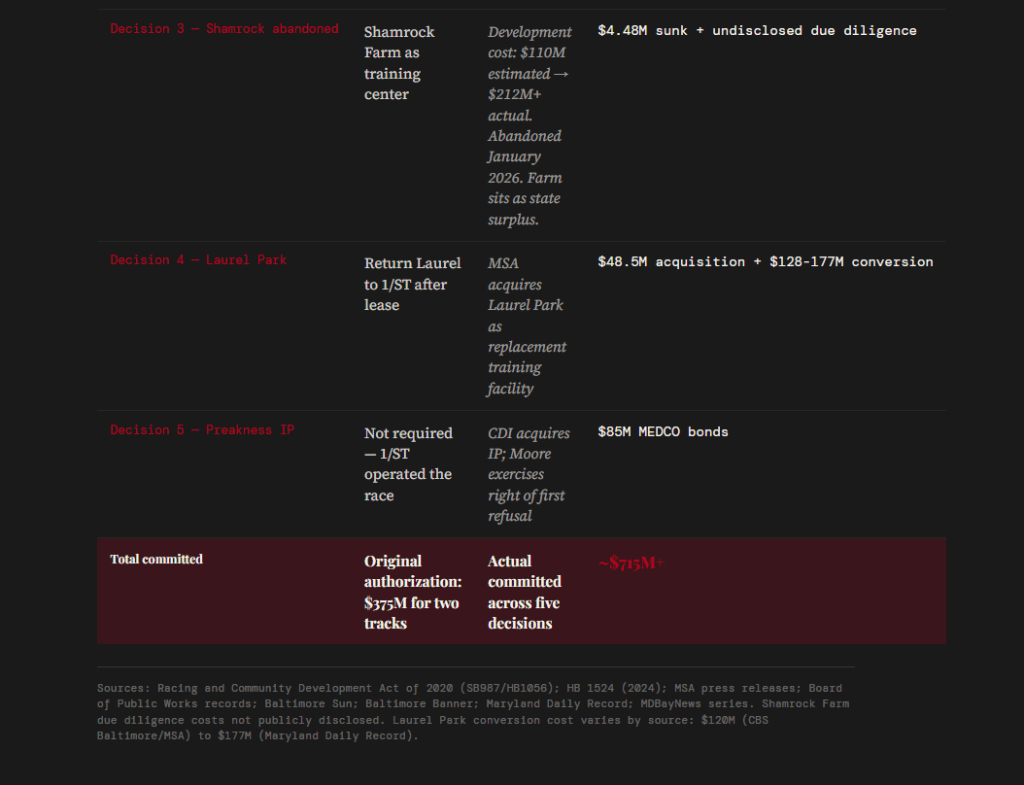
The development cost estimate for Shamrock Farm was $110 million. After months of due diligence, the actual cost came in at more than $212 million — nearly double the estimate. The MSA Board voted to abandon the project in January 2026. Maryland now owns a 332-acre farm in Carroll County that it cannot use as a training facility. Carroll County is seeking the right of first refusal to buy it back. The due diligence costs have not been publicly disclosed.
A Carroll County delegate called it explicitly “a mistake.” It was also a due diligence failure — the same category of failure documented in this series regarding the CDI intellectual property purchase. The same administration that didn’t research CDI’s acquisition history before writing an $85 million check also bought a training center site without adequate due diligence on what it would cost to build. The pattern is consistent.
Decision Three — Buy Laurel Park After Shamrock Failed
Decision 3 of 5
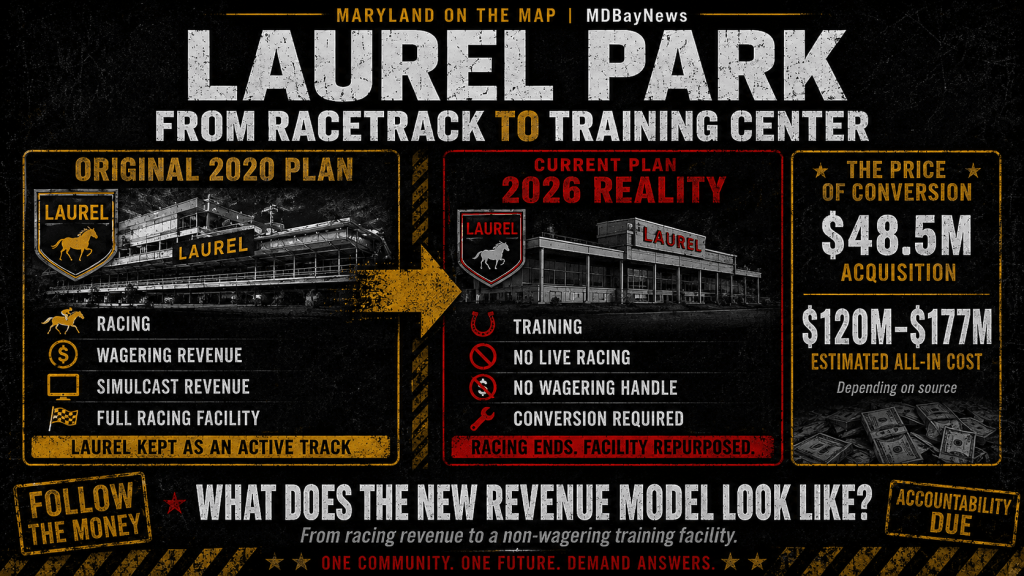
Laurel Park acquired as replacement training facility — $48.5M plus conversion costs
With Shamrock Farm abandoned and no training center, Maryland needed a new plan. Rather than seeking a private-sector solution, the MSA negotiated the purchase of Laurel Park outright. Maryland had been leasing the facility from The Stronach Group since January 1, 2025, as a temporary racing facility during Pimlico’s demolition. Under the original lease terms, racing at Laurel would have ended permanently at the conclusion of the lease and the facility would have been returned.
Instead, the MSA announced in January 2026 it would acquire Laurel Park for $48.5 million — described in the MSA’s own press release as saving “roughly $50 million” compared to Shamrock Farm development costs. That framing is accurate on acquisition price alone. It is not the full picture.
Laurel Park is a full racing facility — grandstand, stabling, track infrastructure — that requires significant conversion to function as a training center. The MSA’s own projections put total Laurel Park costs at approximately $120 million, including acquisition and upgrades. The Maryland Daily Record reported the all-in figure closer to $177 million. Either figure represents substantial new spending on a facility Maryland originally planned to lease temporarily and return to its owner.
Decision Four — End Racing at Laurel as a Revenue Source
Decision 4 of 5
Laurel Park converted to training use — wagering revenue eliminated
This consequence of Decision One deserves its own accounting. The 2020 plan kept Laurel Park as a full racing facility — generating wagering handle, simulcast fees, and racing day revenue that helped offset the industry subsidy costs. Moore’s plan permanently ended racing at Laurel.
Maryland eliminated a major source of ongoing racing revenue and replaced it with a training facility that generates no wagering income.
Maryland eliminated a major source of ongoing racing revenue and replaced it with a training facility that generates no wagering income. The $400 million Pimlico reconstruction must now carry the entire weight of Maryland’s racing revenue model. All wagering handle, all simulcast fees, all racing day revenue — concentrated at one track, on one schedule, dependent on one facility opening on time and operating as designed.
The revenue model for repaying the bonds under this concentrated approach has not been publicly released. Senator Hershey asked for it on August 7. It has not been provided.
Decision Five — Exercise the Preakness IP Right of First Refusal
Decision 5 of 5
$85M MEDCO bonds for Preakness intellectual property
On April 21, 2026, Churchill Downs announced it had acquired the Preakness intellectual property from 1/ST Racing for $85 million. On June 18, Moore exercised Maryland’s right of first refusal under Maryland Code Ann. Bus. Reg. §11-520(d), matching the price.
This decision has been covered extensively in this series — the bad faith question, the CDI championship series announced 46 days later, the governance gaps, the strategic failures. In the context of the full spending history, the IP purchase carries additional weight: it was the fifth major financial decision in a sequence that had already escalated from $375 million to more than $630 million, with no published cost-benefit analysis at any step.
The 2020 plan didn’t require Maryland to own the Preakness IP. 1/ST Racing operated the race and Maryland hosted it. CDI’s attempted acquisition created a new condition that required a new response. Moore’s response was $85 million in MEDCO revenue bonds — five days before a primary election, without a governance plan, and while CDI’s competing championship series was already in active development.
The Question No One Has Answered
Each of the five decisions described above may have been individually defensible. Full Pimlico reconstruction may be more cost-effective than renovation over a 30-year horizon. Ending racing at Laurel may concentrate resources more efficiently. Buying Laurel Park may be cheaper than Shamrock Farm. Exercising the IP right of first refusal may have been necessary to prevent CDI from eventually relocating the race.
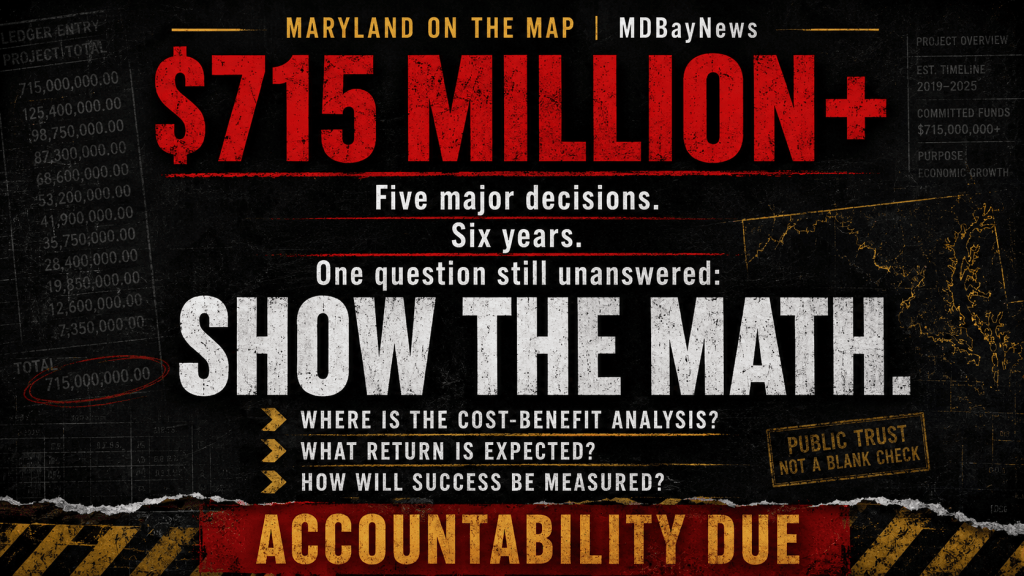
Maryland committed $715 million across five major decisions over six years without once releasing a public accounting of why each option was chosen over its alternatives.
The problem is not that these decisions were made. The problem is that none of them came with published cost-benefit analysis, transparent projections, or measurable success metrics at the time they were made. Maryland committed $715 million across five major decisions over six years without once releasing a public accounting of why each option was chosen over its alternatives, what the expected return is, or how success will be measured.
“Good economic development investments are built on measurable assumptions, transparent projections, and accountability. If Maryland’s $85 million acquisition of the Preakness and $400 million redevelopment of Pimlico are truly economic development investments, then they should be evaluated like every other public investment. Show Marylanders the projections. Show us the expected return. Show us how success will be measured. Taxpayers deserve more than promises, they deserve transparency.”
Sen. Steve Hershey (R), Senate Minority Leader — @SenatorHershey, X, August 7, 2026
Hershey was asking about the Preakness IP purchase and the Pimlico reconstruction. The same questions apply to Shamrock Farm, to the Laurel Park acquisition, to the decision to end racing at Laurel, and to the decision to concentrate all Maryland racing at a single rebuilt facility.
Maryland on the Map
This series has documented CDI’s conduct, Maryland’s strategic failures, and the problems no one considered before the Preakness press conference. This article documents something different — not what CDI did to Maryland, but what Maryland did to itself.
Maryland’s accountability problem is not new. It is structural.
A six-year sequence of escalating financial commitments, each made without the transparency Senator Hershey is now demanding, turned a $375 million redevelopment plan for two racing tracks into a $715 million open question. The CDI series exclusion, the Sunday handle problem, the Memorial Day conflicts — those are real, and they are recent. The due diligence failure at Shamrock Farm, the five-decision escalation, and the absence of any public cost-benefit analysis across any of the decisions predate all of them.
Maryland’s accountability problem is not new. It is structural. And it has been building since before Wes Moore took office — which makes it no less his responsibility to finally provide the transparency the public has never received.
Maryland on the Map Series — Full Coverage
mdbaynews.com/category/series/maryland-on-the-map/
Sources
Racing and Community Development Act of 2020 (SB987/HB1056), Maryland General Assembly, became law May 7, 2020 without Governor Hogan’s signature; BloodHorse, “Bill to Renovate Pimlico, Laurel Park Passes into Law,” May 8, 2020; The Racing Biz, “No turning back: New law pushes Maryland industry on Pimlico-Laurel project,” April 29, 2022, including original $180M Pimlico/$155M Laurel allocation; Maryland Stadium Authority, January 2023 report to the Maryland Legislature on Pimlico and Laurel Park redevelopment; Baltimore Sun, “Plans for Pimlico and Laurel Park’s renovations are bogged down and hundreds of millions over budget,” February 3, 2023; Maryland General Assembly, HB 1524 (2024), authorizing $400 million for Pimlico reconstruction; Maryland Stadium Authority press release, “Announces Demolition of the Pimlico Facility,” July 29, 2025; Maryland Stadium Authority press release, “Announces Intent to Acquire Laurel Park,” January 21, 2026, including “roughly $50 million” savings framing; CBS Baltimore, “Maryland to redevelop Laurel Park into thoroughbred horse racing center,” April 21, 2026, including $120M total cost figure; Maryland Daily Record, Laurel Park acquisition reporting, 2026, including $177M total cost figure; Past The Wire, Shamrock Farm purchase price ($4.48 million) and title transfer date (October 6, 2025); Baltimore Banner, Shamrock Farm development cost ($212M+) and abandonment reporting, 2026; Board of Public Works, Shamrock Farm and Laurel Park acquisition approvals; Sen. Steve Hershey, @SenatorHershey, X, August 7, 2026; MDBayNews, Maryland on the Map series, April–August 2026.


Leave a Reply