By Michael Phillips | Sports & Whatever
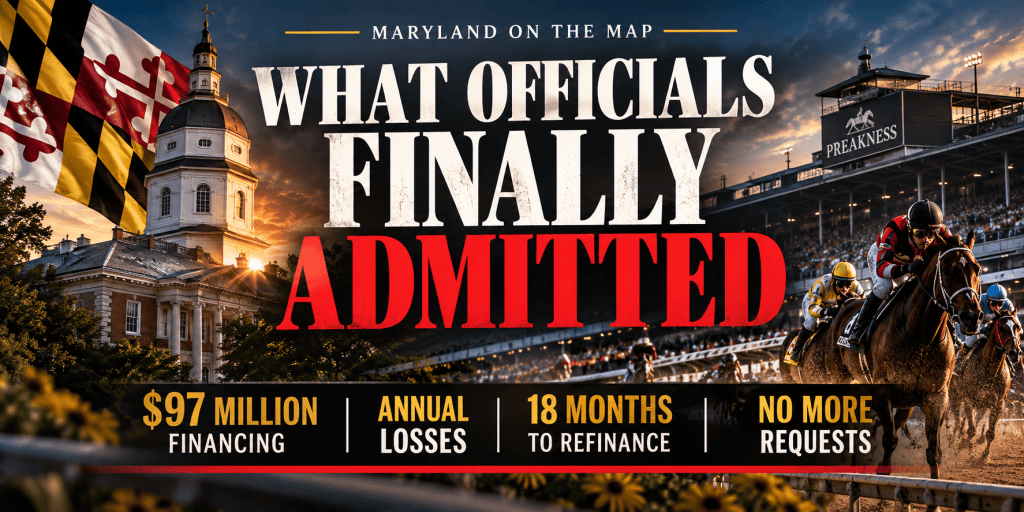
In a single House Appropriations Committee briefing on September 16, Maryland officials confirmed more about the true financial picture of the state’s horse racing investment than any press conference had. A MEDCO official linked CDI’s series to its failed Preakness bid. The MJC loses money throughout the year. MEDCO borrowed $97 million — not $85 million — in unrated debt. And officials say they don’t intend to seek more state money.
This series has been documenting the Preakness situation since August 3 — the CDI championship series exclusion, the bad faith question, the spending escalation, the 16 documented problems, the regulatory silence. In each case, the information came from public records, SEC filings, trade press, and legislative documents that Maryland’s own officials declined to address in press conferences.
On September 16, in a briefing before the House Appropriations Committee, officials said what they hadn’t said before. Not everything — Senator Hershey’s demand for projections, expected returns, and measurable success metrics remains unanswered. But the five admissions below represent the most candid public accounting of Maryland’s horse racing investment since the first dollar was committed.

Admission 1 — Sadowski Links CDI Series to the Failed Bid
MDBayNews published “Blindsided, Again” on August 3, 2026, raising the question of whether CDI’s championship series exclusion of the Preakness was a deliberate response to Maryland’s exercise of its right of first refusal. The article cited O’Rourke’s confirmation that the series discussions were “underway for some time” before Maryland’s check cleared, and asked whether CDI’s acceptance of $85 million constituted good faith under Maryland Code Ann. Bus. Reg. §11-520(d).
On September 16, MEDCO CEO Tom Sadowski gave a legislative committee the direct answer.
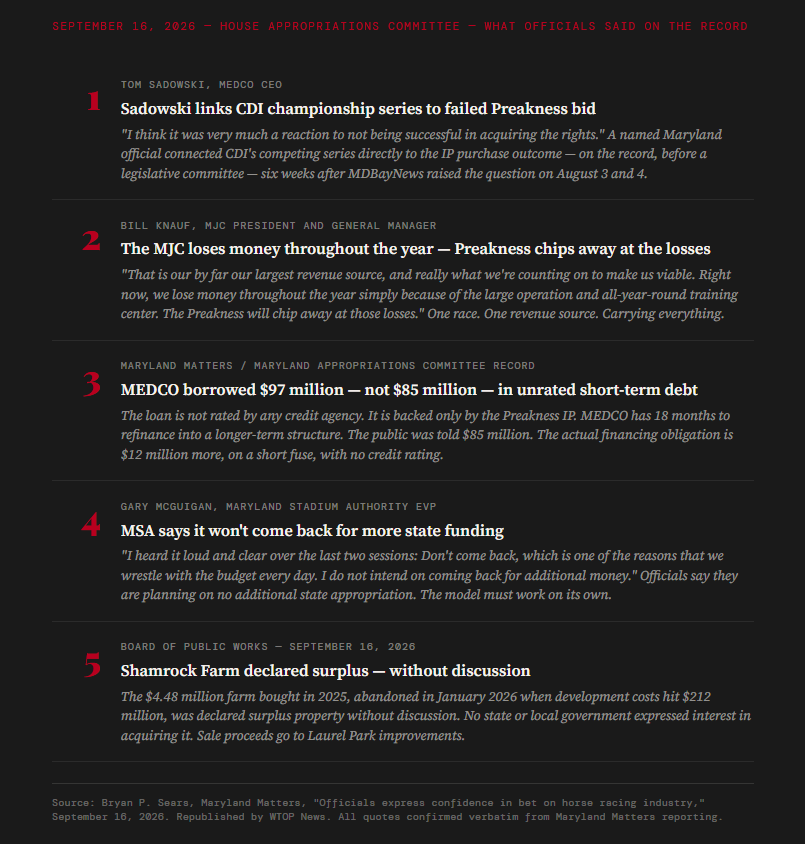
“I think it was very much a reaction to not being successful in acquiring the rights.”
— Tom Sadowski, CEO and Executive Director, Maryland Economic Development Corp., House Appropriations Committee, September 16, 2026
That is a named Maryland official — the head of the quasi-governmental agency that financed the IP purchase — telling a legislative committee that CDI’s competing series was, in his view, a direct response to losing the Preakness IP bid. Not speculation. Not a fringe allegation. The word he used was “reaction.” The implication is clear. The distinction matters: this publication will use his word, not a stronger one.
MDBayNews raised the bad faith and retaliation question in published articles on August 3 and August 4, 2026 — six weeks before Sadowski confirmed it before the General Assembly. The series also named AG Anthony Brown as the appropriate party to examine CDI’s conduct under §11-520(d). As of September 17, the AG’s office has not responded to MDBayNews’s comment request.
“The word he used was ‘reaction.’ The implication is clear. The distinction matters: this publication will use his word, not a stronger one.”
Admission 2 — The MJC Loses Money Throughout the Year
The “Pimlico Has No Plan for the Other 364 Days” article, published August 8, argued that the new facility’s entire financial model was being staked on a single Sunday in May. MJC president Bill Knauf confirmed that argument to a legislative committee on September 16.
“That is our by far our largest revenue source, and really what we’re counting on to make us viable. Right now, we lose money throughout the year simply because of the large operation and all-year-round training center. The Preakness will chip away at those losses.”
— Bill Knauf, President and General Manager, Maryland Jockey Club, House Appropriations Committee, September 16, 2026

Read that carefully. The MJC’s president told a legislative committee that the organization loses money throughout the year and is counting on the Preakness to chip away at those losses. Not to generate profit. Not to fund expansion. To chip away at annual operating losses from the year-round training center Maryland built to replace Shamrock Farm. Knauf did not say the Preakness covers all losses — he said it will chip away at them. That distinction may matter for bond repayment projections that haven’t been released.
“We lose money throughout the year. The Preakness will chip away at those losses.”
— Bill Knauf, MJC President, House Appropriations Committee
There is additional context worth noting. Earlier reporting indicates that Maryland horsemen contribute approximately $5 million annually toward debt service, and the horsemen’s organization carries responsibility for covering operating losses of the nonprofit racing operator. That changes the taxpayer exposure picture somewhat — the losses are not borne by the public alone. But it does not change the core financial model: the Preakness is the primary revenue event, and it is expected to chip away at, not eliminate, annual operating losses.
“The Preakness is the primary revenue event, and it is expected to chip away at, not eliminate, annual operating losses.”
Admission 3 — $97 Million, Unrated, 18 Months
The public has been told consistently that Maryland paid $85 million for the Preakness intellectual property. That figure is accurate for the purchase price. It is not accurate for the financing obligation.

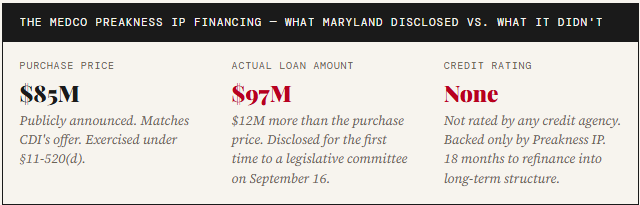
MEDCO has issued rated debt in other transactions — S&P BBB-minus and Fitch AA-plus on other series, per The Bond Buyer’s July reporting — making the absence of a rating on the Preakness financing notable. Whether that reflects the nature of the short-term instrument, the underlying collateral, or a deliberate structural choice has not been publicly explained.
MEDCO has 18 months from the July 31 closing date to secure longer-term financing. That deadline falls in early 2028 — the same window when the new Pimlico is expected to open, the Preakness moves to Memorial Day Sunday, and the investment is supposed to begin generating the revenue needed to justify its total cost. The refinancing clock and the facility opening timeline are running in parallel. If either slips, the other is under pressure.

Records reviewed by the Baltimore Sun in May 2026 showed the annual debt service cost on the Pimlico bonds had already risen — from approximately $17 million to as much as $29 million per year — meaning taxpayers pay substantially more each year to build essentially the same facility envisioned in earlier plans. That figure is the annual carrying cost on the Pimlico bonds alone, paid every year regardless of whether the Preakness generates sufficient revenue. It nearly doubled before the facility opened.
“The refinancing clock and the facility opening timeline are running in parallel. If either slips, the other is under pressure.”
Admission 4 — MSA Says It Won’t Come Back for More
Maryland Stadium Authority EVP Gary McGuigan told the committee directly what no press conference had said: the legislature has made clear it will not appropriate additional funds for horse racing, and he is not coming back to ask.
“I heard it loud and clear over the last two sessions: Don’t come back, which is one of the reasons that we wrestle with the budget every day. I do not intend on coming back for additional money.”
— Gary McGuigan, EVP Capital Projects Development, Maryland Stadium Authority, House Appropriations Committee, September 16, 2026
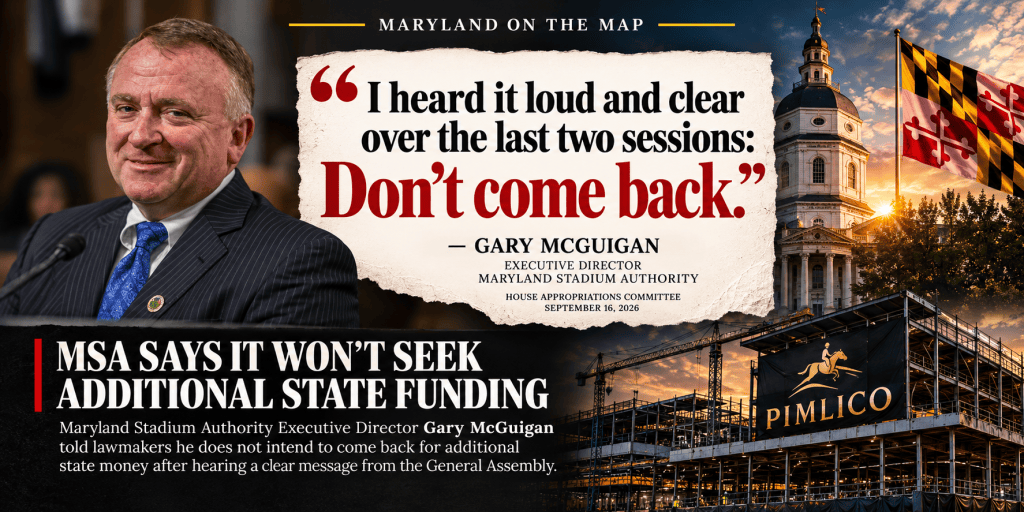
McGuigan described what he has heard from legislators and stated his own intention clearly. He cannot legally bind future legislators or administrations — no committee briefing can do that. But a senior MSA official saying publicly that he does not intend to return for additional funding is the clearest signal Maryland has sent that the investment model must stand on its own. The existing commitments: $400 million in Pimlico bonds, $97 million in MEDCO notes for the IP, $4.48 million in Shamrock Farm sunk costs, and Laurel Park’s all-in estimated cost of $177 million — which includes both the $48.5 million acquisition and conversion costs within that figure.
“For now, officials say they are planning on no additional state appropriation.”
For now, officials say they are planning on no additional state appropriation. The Preakness must chip away at annual MJC losses. The $97 million note must refinance successfully. The 18-month clock is running.
Admission 5 — Nobody in Government Wanted Shamrock Farm

The Board of Public Works approved, without discussion, a request to declare Shamrock Farm surplus property on September 16. The farm can be sold as early as next year to a private buyer or developer. Proceeds will go to Laurel Park improvements. No state or local government agency expressed interest in acquiring it through the government clearinghouse process before the surplus declaration.
MDBayNews documented the Shamrock Farm failure in “How a $375 Million Plan Became a $715 Million Problem” — published August 12. The $4.48 million acquisition, the $212 million development cost discovery, the January 2026 abandonment. The September 16 surplus declaration confirms the final chapter: no government body expressed interest through the clearinghouse process; it can now be sold to a private buyer or developer, and the proceeds go to cover costs at Laurel Park — the facility Maryland bought because Shamrock failed.
It is worth noting that the Shamrock Farm failure had already drawn unusually blunt public criticism months before the surplus declaration. Senate President Bill Ferguson said in May that the due diligence on the Shamrock Farm purchase was “clearly” insufficient, that he wished the state had not purchased the property, and that the purchase had set the state backward. The Senate president’s public rebuke preceded the September 16 disposal — meaning the surplus declaration was not a surprise to anyone following the record, and was not merely MDBayNews characterizing the purchase as a failure.
The Board approved the surplus declaration without discussion.
What This Means for the Coalition
Knauf’s acknowledgment that the MJC loses money throughout the year and is counting on the Preakness to chip away at those losses makes the independent coalition argument more urgent, not less. If one event is the primary revenue source, the financial model’s vulnerability is obvious: anything that diminishes Preakness revenues — Derby winners skipping, a competing championship series attracting top horses, Sunday handle lower than Saturday — puts the entire operation under pressure.
Belmont Park reopened September 18 after a roughly $550 million reconstruction — and the CDI/NYRA championship series now launches in 2027 with a freshly rebuilt Belmont as one of its anchor venues. Maryland is competing against a renovated rival facility that anchors a competing series, while its own facility won’t be fully complete until 2028. The independent coalition MDBayNews proposed in August becomes more viable, not less, as the competitive stakes clarify.
The coalition path — still unannounced. Private development — quietly underway.
More racing days mean more revenue days. A domestic coalition — Keeneland, Del Mar, Oaklawn, Woodbine — with Maryland as the anchor spreads the financial risk across a racing calendar rather than concentrating it on one Sunday. Gilligan Racing LLC, announced August 19, is building a new independent track in Marion County, Florida — the Horse Capital of the World — for the same structural reasons Maryland rebuilt Pimlico. Their track is still in site selection. Maryland’s coalition is still unannounced. Both windows are still open. One call changes the equation for both parties. MDBayNews has asked Maryland’s racing authorities whether they have contacted Gilligan Racing. No response has been received.
One note in partial credit: MEDCO has issued a Request for Expressions of Interest for six parcels of vacant land adjacent to the Pimlico site — inviting private developers to propose commercial development of the property around the track. That is a step toward the year-round destination model MDBayNews outlined in August. It has not been announced in any press conference.
The DC International revival, the Maryland Day Stakes, the year-round Palio plaza programming — none of these have been announced. The facility is being built for year-round use. The financial model, as Knauf described it before the General Assembly, depends on one event doing what a full calendar should be doing.
What Still Hasn’t Been Said

Senator Hershey asked on August 7 for projections, expected returns, and measurable success metrics. None have been provided. It is worth noting he raised this concern in May — before the CDI series exclusion, before the press conference, before any of it. “This is a significant public investment,” Hershey told the Baltimore Sun in May 2026, “and we should be honest about the fact that its success is not guaranteed.” That was the accountability question before the crisis. It remains the accountability question after the committee briefing.
The officials who briefed the Appropriations Committee expressed confidence. David Richardson of the Maryland Thoroughbred Horsemen’s Association called it “an incredible moment.” Knauf said the NBC deal “puts the value in the Preakness.” McGuigan said he doesn’t intend to come back for more money.
“Confidence is not a financial model.”
One accountability question the committee briefing raised without answering: officials cited the six-year NBC agreement as evidence that the Preakness retains commercial value, but Maryland Matters explicitly noted that the financial terms of that deal were not released — making it impossible for lawmakers or taxpayers to measure how much revenue it actually contributes to the model. A deal whose value can’t be independently assessed isn’t evidence of financial health. It’s a claim.
Confidence is not a financial model. On September 16, Maryland told the General Assembly what it had been unwilling to tell the public. The $97 million financing obligation is now on record. The annual operating losses are now on record. The link between CDI’s series and the IP purchase outcome is now on record. Officials’ intention not to seek additional funding is now on record.
The projections, the expected return, the NBC deal’s financial terms, and the measurable success metrics are still not on record. Senator Hershey’s question stands.
Maryland on the Map Series — Full Coverage
“The Bet That Already Lost” · “Blindsided, Again” · “Nine Minutes” · “The Hand They’re Not Playing” · “What CDI Does With Tracks It Owns” · “What Moore Announced” · “Pimlico Has No Plan for the Other 364 Days” · “What Maryland Didn’t Consider” · “How a $375M Plan Became a $715M Problem” · “The Commission Was Silent” · “The Coalition Maryland Hasn’t Called Yet”
Sources: Bryan P. Sears, Maryland Matters, “Officials express confidence in bet on horse racing industry,” September 16, 2026, republished by WTOP News September 17, 2026; Board of Public Works, September 16, 2026, Shamrock Farm surplus declaration; The Bond Buyer, “Maryland buys the Preakness,” July 31, 2026; Todd Karpovich, Baltimore Sun, “Maryland gambles $500M on horse racing as industry shrinks, costs rise,” May 2, 2026, including annual debt service figures, Sen. Hershey quote, and Senate President Ferguson’s Shamrock Farm statement; Todd Karpovich, Baltimore Sun, “Maryland is spending big on horse racing. But the competition is changing,” September 2026; AP, Belmont Park reopening coverage, September 18, 2026; Maryland Matters, “State finalizes deal to buy rights to Preakness for $85 million,” July 31, 2026; Governor’s office press release, July 31, 2026; Sen. Steve Hershey, @SenatorHershey, X, August 7, 2026; Maryland Stadium Authority, mdstad.com; MDBayNews, Maryland on the Map series, August 3 – September 2026; Gilligan Racing LLC / FTBOA announcement, August 19, 2026; Maryland Code Ann. Bus. Reg. §11-520(d).


Leave a comment