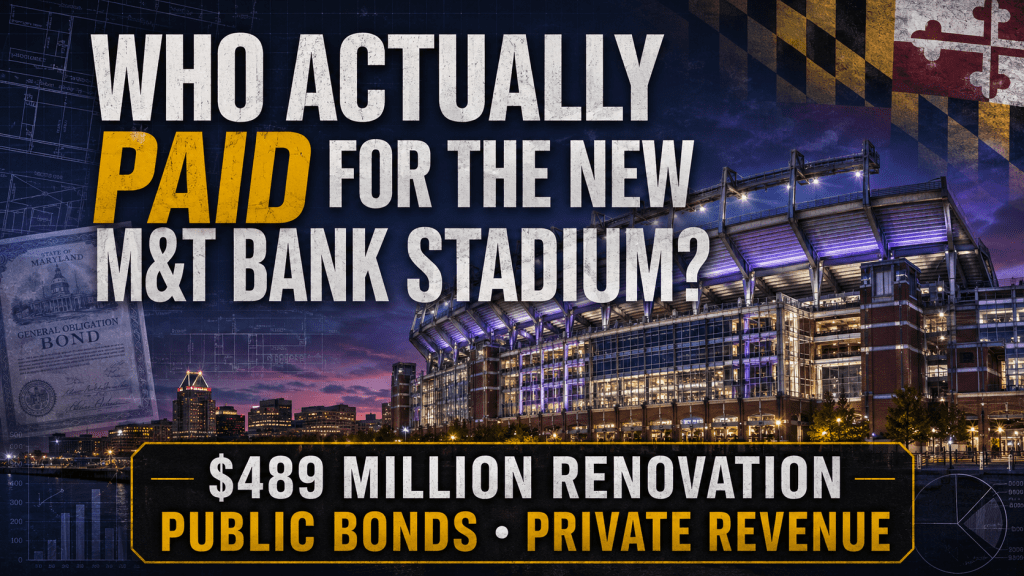
The Ravens unveiled the finished version of their stadium this month. Three years of construction, a new North Plaza, an open-air music venue, an indoor sports bar built into the old parking deck, and a final price tag of $489 million. Team President Sashi Brown thanked “the folks in Annapolis and the good residents of Maryland” for making it possible. He wasn’t exaggerating. Most of that money came from the state.
The project wrapped in mid-August, timed to Saturday’s preseason opener against the Philadelphia Eagles, the first game where fans see the finished building. Behind the ribbon-cutting is a financing structure that runs through a 2022 state law, a lease renewal, and a cost overrun that required a second round of state approval last year.
How the Money Was Authorized
“The team pays no rent, and under the agreement’s revenue provisions, essentially all money generated by the stadium belongs to the Ravens.”
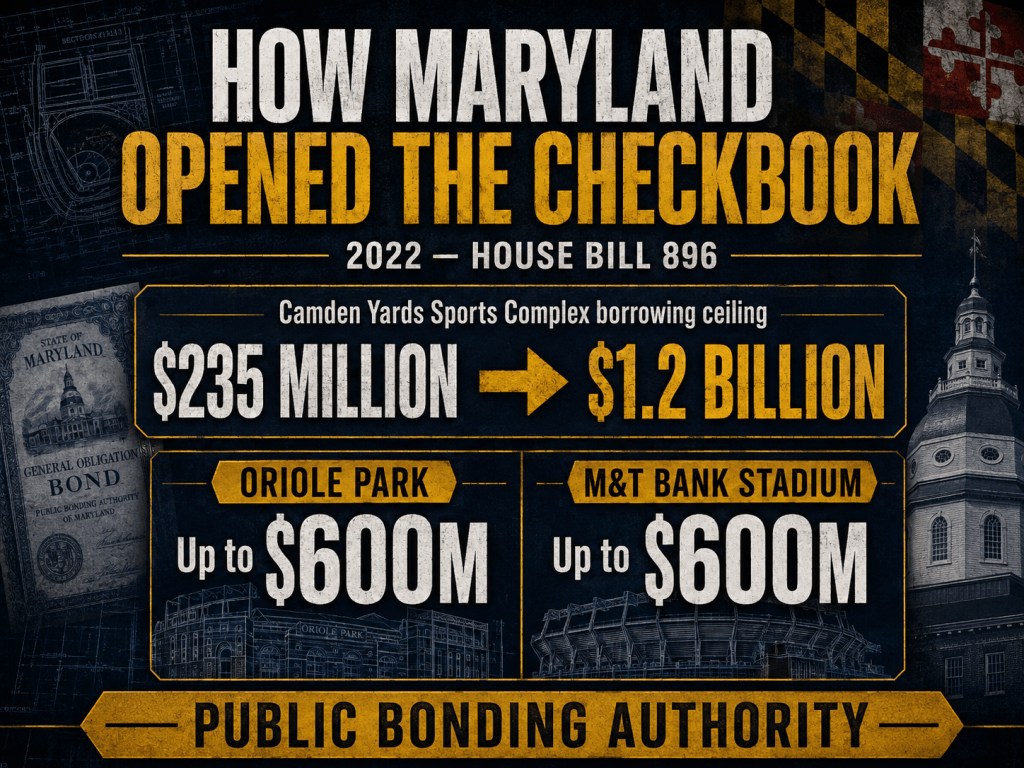
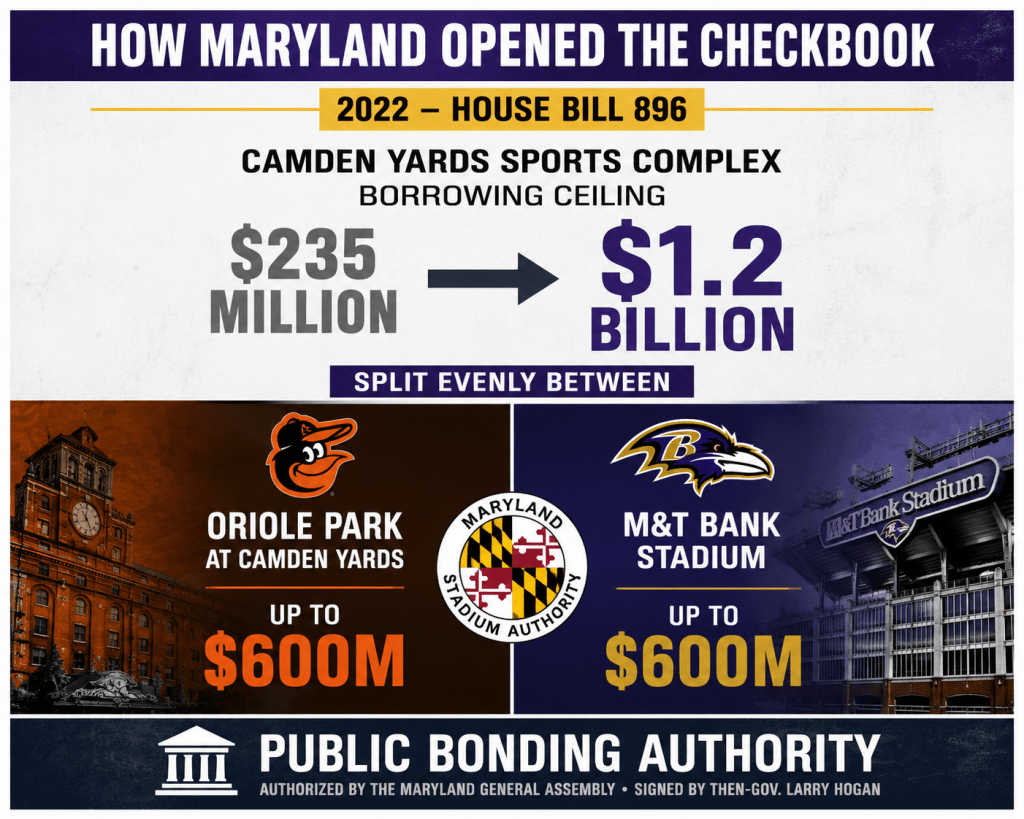
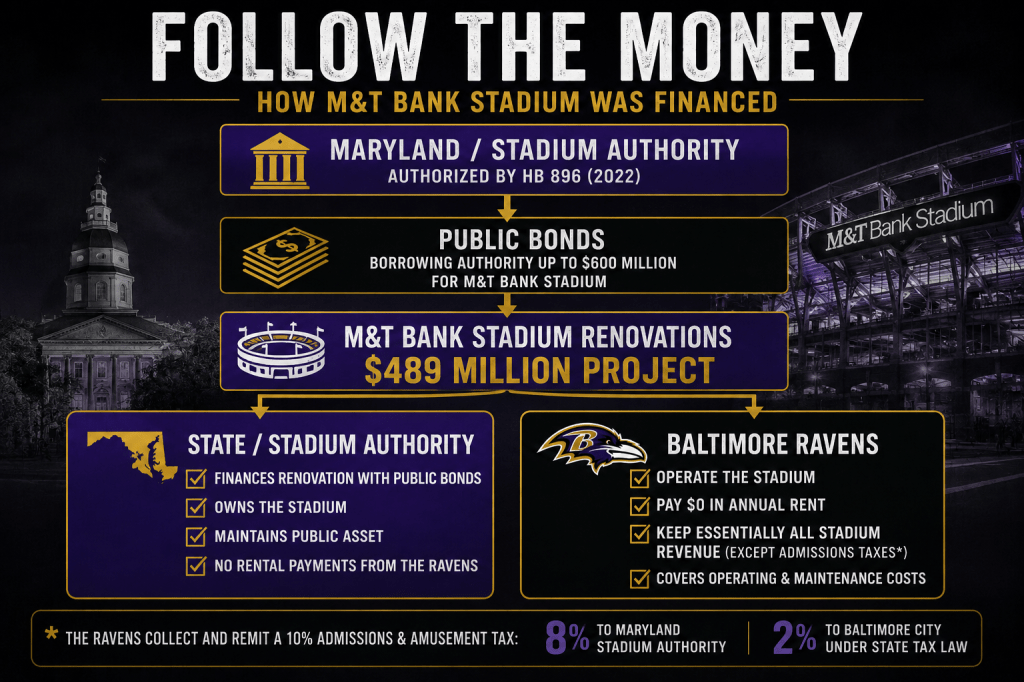
In April 2022, the General Assembly passed House Bill 896, raising the debt ceiling the Maryland Stadium Authority could carry for the Camden Yards Sports Complex from $235 million to $1.2 billion, split evenly between Oriole Park at Camden Yards and M&T Bank Stadium. Then-Gov. Larry Hogan signed it. The law tied any bond issue to a matching lease commitment from the team, so the money wouldn’t go out the door without the Ravens agreeing to stay put.
That came on January 4, 2023, when the Board of Public Works unanimously approved a new 15-year lease, keeping the Ravens at M&T Bank Stadium through the 2037 season with two five-year options that could extend it to 2047. The lease itself, on file with the Stadium Authority, spells out the terms plainly: the team pays no rent, and under the agreement’s revenue provisions, essentially all money generated by the stadium belongs to the Ravens. It covers operating and maintenance costs instead, which ran about $11 million in 2022 and were expected to climb roughly 6% a year. The one carve-out is a 10% admissions and amusement tax on tickets, which the lease requires the Ravens to collect and remit to the state. A separate state tax statute caps the Stadium Authority’s share of that tax at 8% of gross receipts and limits any local add-on so the combined rate can’t top 10%, meaning Baltimore City collects the remaining 2 points.
The Overrun
“The state agreed to reimburse the Ravens up to $35 million, leaving the team’s net contribution at roughly $20 million.”
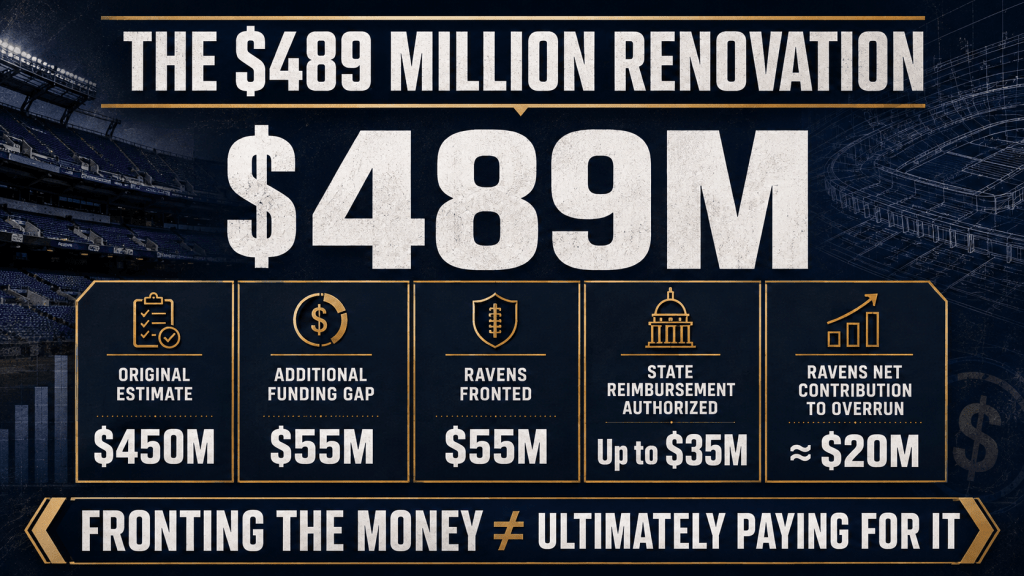
The Ravens announced the renovation in December 2023 with an estimated cost of $450 million. By early 2025, that number had grown to $489 million, a $55 million gap the Stadium Authority attributed to rising construction costs, design changes and revised schedules.
The state didn’t cover the difference outright. Under a funding memorandum the Stadium Authority signed with the Ravens on February 26, 2025, the team agreed to front the full $55 million. Of that, the state agreed to reimburse the Ravens up to $35 million from bonds the authority planned to issue in 2026, leaving the team’s net contribution at roughly $20 million. The Board of Public Works approved the arrangement as part of a larger $646.8 million batch of state projects.
Comptroller Brooke Lierman was the only member of the three-person board to vote against extending the related bonds that day. Her objection wasn’t to the stadium project itself. It was to how long organizations were being given to spend money the state had already allocated. “I was taught in school that a deadline is a deadline,” she said, arguing agencies shouldn’t request capital funding years before they’re ready to use it.
What Taxpayers Got, and Kept
“Annual rent paid by the Ravens to play in the state-owned stadium: zero.”
A quick accounting of where the money sits:
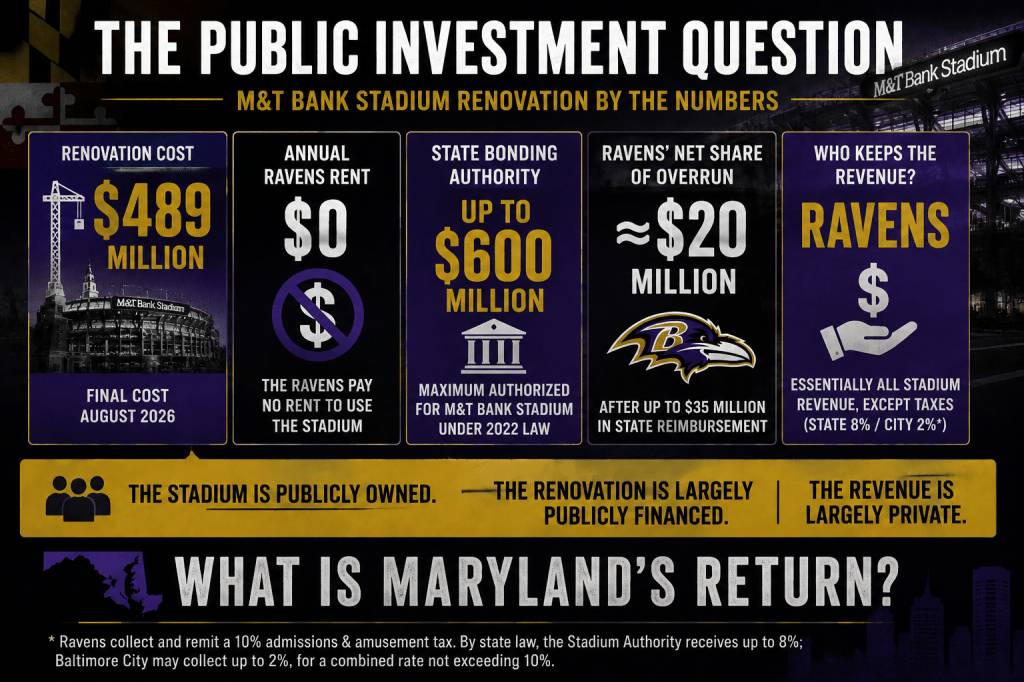
State bonding authority for M&T Bank Stadium: capped at $600 million under the 2022 law.
Original renovation estimate: $450 million, announced December 2023.
Final cost: $489 million.
Ravens’ net contribution to the overrun: about $20 million, after up to $35 million in state reimbursement.
Annual rent paid by the Ravens to play in the state-owned stadium: zero.
Share of ticket and event revenue the Ravens keep under the lease: all of it, aside from a 10% admissions and amusement tax, split 8% to the Stadium Authority and 2% to Baltimore City under state tax law.
“The arithmetic is simply what it looks like when a state-owned stadium is renovated almost entirely with public bonds while the team occupying it pays no rent and keeps the resulting revenue.”
None of this required the Ravens to break any promise or the state to do anything it hadn’t already authorized in 2022. The arithmetic is simply what it looks like when a state-owned stadium is renovated almost entirely with public bonds while the team occupying it pays no rent and keeps the resulting revenue. In the months before completion, the Ravens hosted a D.C. United-Inter Miami soccer match in March, a Morgan Wallen concert in July, and two BTS shows in August that drew more than 140,000 fans combined, a stadium attendance record. That’s the year-round venue strategy Brown described when the lease was signed in 2023, and it’s now generating revenue on a building taxpayers financed.
“Whether the public’s return matches its investment is a separate question from whether the project got built.”
Craig Thompson, the Stadium Authority’s chairman, framed the completed project as a public investment paying off. “The importance of investing in our public assets and investing in our future,” he said at the August 14 unveiling. Whether the public’s return matches its investment is a separate question from whether the project got built, and it’s one the Stadium Authority’s own agreements don’t really answer.
Sources: Maryland General Assembly, House Bill 896 (2022), signed by then-Gov. Larry Hogan; the fully executed “Agreement Relating to Football Stadium at Camden Yards Sports Complex” between the Maryland Stadium Authority and the Baltimore Ravens Limited Partnership, dated January 4, 2023, obtained directly from the Maryland Stadium Authority’s Stadium Use Agreements page; the “Memorandum of Agreement Regarding Funding for Capital Works Projects” dated February 26, 2025, also from the Stadium Authority’s Stadium Use Agreements page; Maryland Tax-General Article §4-105, governing admissions and amusement tax rate caps for the Stadium Authority and local governments; Maryland General Assembly Department of Legislative Services fiscal notes on HB 624 (2017) and SB 324 (2025), confirming the Stadium Authority imposes the maximum 8% rate at both Camden Yards stadiums, limiting Baltimore City to the remaining 2%; baltimoreravens.com, “Ravens’ Transformational Three-Year Renovation Project at M&T Bank Stadium Is Complete,” August 14, 2026; CBS News Baltimore reporting on the February 2025 Board of Public Works meeting and Comptroller Brooke Lierman’s dissenting vote; The Baltimore Banner and Sportico reporting on the 2023 lease terms and 2025 cost overrun; the Center Square, reporting on 2022 stadium operating and maintenance costs disclosed at the January 2023 Board of Public Works meeting.


Leave a Reply