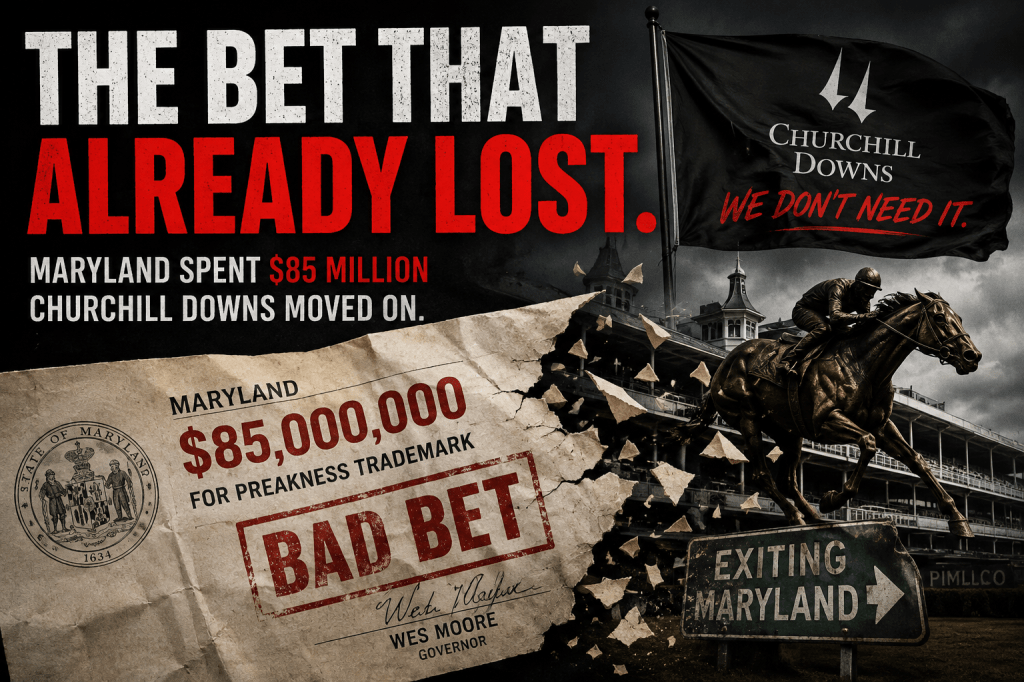
Governor Moore spent $85 million in state revenue bonds to keep Churchill Downs at the table. Churchill Downs took the money, built a competing championship series without the Preakness, and announced it is leaving Maryland entirely.
By Michael Phillips | MDBayNews
Breaking — August 3, 2026
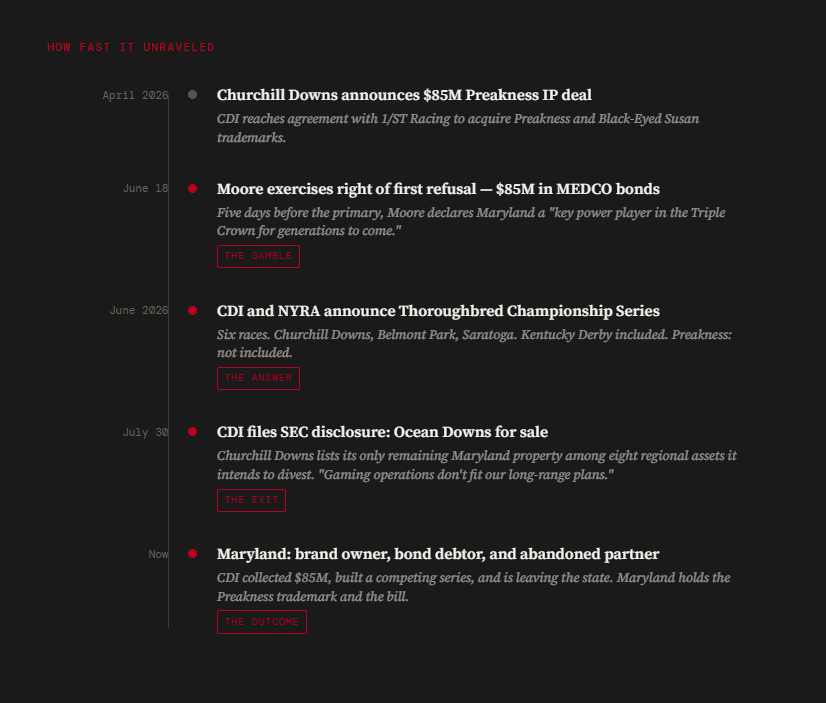
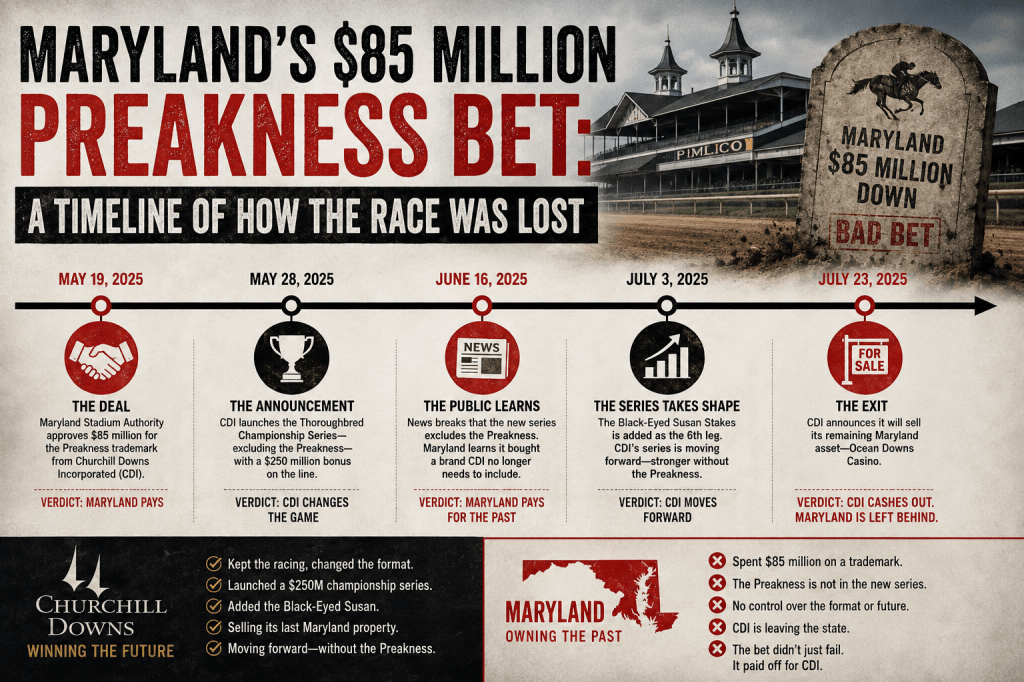
This morning, Churchill Downs Incorporated and the New York Racing Association jointly announced the Thoroughbred Championship Series — a six-race season-long competition for three-year-old Thoroughbreds launching in 2027. The series will be broadcast nationally on NBC and FOX. It will be held across Churchill Downs, Belmont Park, and Saratoga Race Course. The Preakness Stakes is not included. Maryland Jockey Club president and general manager Bill Knauf, reached by BloodHorse for comment on the new series’ potential impact on the Preakness, declined to respond. The announcement came 46 days after Maryland committed $85 million in state revenue bonds to acquire the Preakness brand.
When Governor Wes Moore’s administration committed $85 million in state revenue bonds to acquire the Preakness Stakes’ intellectual property in June, he framed it as a masterstroke — Maryland securing its position as a “key power player in the Triple Crown for generations to come.”
Churchill Downs had a different read on who held the leverage. Within weeks of Maryland’s purchase, CDI announced it was building its own championship series — without the Preakness. Then it filed with the SEC to sell its only remaining Maryland property and walk out the door.
The bet didn’t just fail to pay off. It paid off for CDI.
The bet didn’t just fail to pay off. It paid off for CDI.
Prior Coverage
MDBayNews reported in June that Maryland’s IP acquisition raised fundamental questions about operational competency and governance — who would actually run the race, under what structure, and what the liability exposure looked like if it underperformed. Those questions remain unanswered. The circumstances around them have gotten worse. See: “The Governor Bought a Horse Race,” Maryland on the Map, June 2026.
The Series That Left Maryland Out
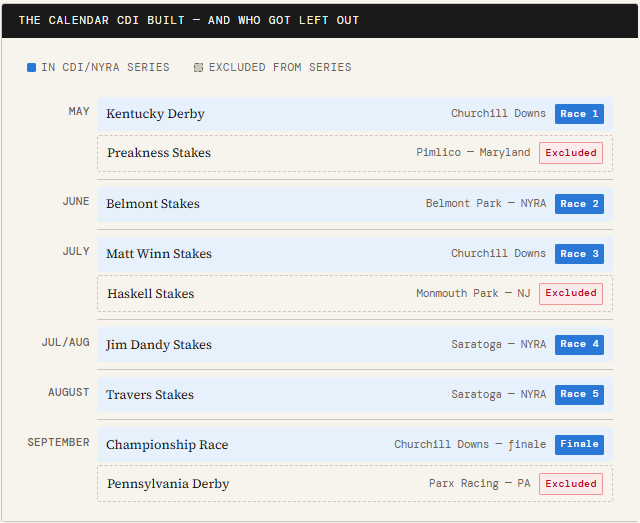
The Thoroughbred Championship Series, announced jointly by Churchill Downs Inc. and the New York Racing Association, will launch in 2027. It unites six premier races across Churchill Downs, Belmont Park, and Saratoga Race Course, with the Kentucky Derby and Belmont Stakes as centerpieces. The stated goal: crown America’s top three-year-old Thoroughbred.
Maryland paid $85 million to own a brand CDI just made optional.
The Preakness Stakes — Maryland’s newly acquired, $85-million-dollar asset — is not part of it. The series that will define three-year-old racing for the next generation was designed, announced, and finalized without Maryland at the table. It will air nationally on NBC and FOX — the two largest broadcast networks in the country. Maryland’s race has no equivalent deal.
Moore’s June announcement declared Maryland would shape “the future of the Preakness” and remain central to Triple Crown racing. CDI’s response was to build a new structure that doesn’t need the Triple Crown — or the Preakness — to function. The series doesn’t replace the Triple Crown formally. It doesn’t have to. It only needs to matter more.
Racing industry observers were blunt about what this means. As one prominent handicapper noted publicly: Maryland racing gets “screwed in the process” while the Triple Crown — “the only event that resonates with the general public and mainstream media” — is structurally sidelined in favor of a privately controlled series.
The Exit: Ocean Downs
Six weeks after Maryland completed its IP purchase, Churchill Downs Inc. filed a Form 8-K with the Securities and Exchange Commission. In it, CDI disclosed it had completed a comprehensive review of its operational portfolio and concluded that regional gaming properties no longer fit its long-range plans.
Among the eight properties CDI intends to sell: Ocean Downs Casino and Racetrack in Berlin, Maryland — a 167-acre Eastern Shore facility with 900 slot machines, 17 table games, a harness racing track, and a year-round simulcast operation that has been part of Maryland’s racing ecosystem since 1949.
CDI is not a company in distress. It reported record Q2 revenue before listing the properties. This is not a fire sale — it is a strategic reallocation. Churchill Downs has decided that Maryland is not part of its future. It collected $85 million from the state, announced a competing championship series, and is now divesting its remaining in-state footprint.
What Maryland Actually Spent
The Preakness IP purchase was not made in isolation. It is the final entry in a multi-year public spending campaign on Maryland thoroughbred racing — a campaign whose full tab has never been assembled in a single accounting. Here it is.
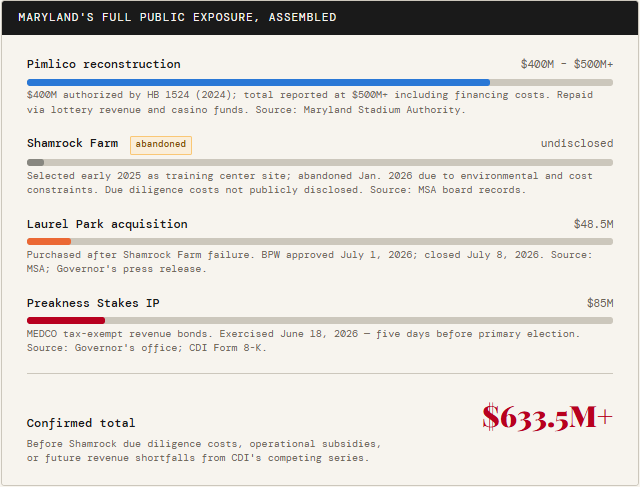
Maryland’s total public exposure — thoroughbred racing, 2024–2026
| Pimlico reconstruction | $400M authorized by the Maryland legislature in Stadium Authority bonds (2024). Total public commitment reported at more than $500M when financing and ancillary costs are included. Financed through bonds to be repaid largely with state lottery revenue and casino funds. Source: HB 1524; Baltimore Sun, May 2026; Maryland Stadium Authority. |
| Shamrock Farm — selected, then abandoned | Carroll County farm selected in early 2025 by the Maryland Thoroughbred Racetrack Operating Authority as the site for a new thoroughbred training center. MSA gained right of entry in March 2025 and commenced due diligence. After months of review, it was determined non-viable due to environmental and cost constraints. Acquisition never completed; due diligence costs not publicly disclosed. A training center site was announced, promoted, and abandoned. Source: Maryland Stadium Authority project records, January 2026. |
| Laurel Park acquisition | $48.5M. After Shamrock Farm failed, MSA negotiated with MEDCO and 1/ST Laurel LLC to acquire Laurel Park as the replacement training facility. Approved by MSA Board April 20, 2026. Approved by Board of Public Works July 1, 2026. Sale closed July 8, 2026. Maryland now owns Laurel Park. Source: Maryland Stadium Authority; Governor’s press release, April 20, 2026. |
| Preakness Stakes IP | $85M in MEDCO tax-exempt revenue bonds. Exercised June 18, 2026 — five days before the primary election. Acquires trademarks and associated rights to the Preakness Stakes and Black-Eyed Susan Stakes from 1/ST Maryland LLC. Source: Governor’s press release; CDI Form 8-K, June 18, 2026. |
| Confirmed total | $633.5M+ in public funds and bond obligations — before Shamrock Farm due diligence costs, before operational subsidies, and before any future shortfall in Preakness revenues triggered by CDI’s competing championship series. |
$633.5 million-plus in public commitments now rests on an industry landscape that changed within weeks.
Each expenditure, taken alone, had a stated rationale. The reconstruction: preserve a historic Baltimore institution. The training center: attract year-round thoroughbred activity. Laurel Park: salvage the training center plan after Shamrock failed. The IP: protect the brand from corporate control. Taken together, they represent a cascade of public commitments, each one made to shore up the one before it, piling onto a foundation that CDI just undermined with a press release.
The fee structure argument — that buying the IP was preferable to paying escalating annual licensing costs — remains technically valid in isolation. But it assumed a future in which the Preakness retained its commercial value as a Triple Crown race. CDI’s new series erodes that assumption directly. A brand is worth what the market says it’s worth. The market, in the form of the sport’s two most powerful operators, just said the Preakness is optional.
What Maryland Was Promised vs. What It Got
Moore’s commitments vs. the documented outcome
| Promised | “Key power player in the Triple Crown for generations to come.” |
| Delivered | Ownership of a brand excluded from the sport’s new championship structure, announced within weeks of the purchase. |
| Promised | Maryland shapes the future of the Preakness and horseracing. |
| Delivered | CDI and NYRA designed the sport’s next era in a room Maryland wasn’t in. Haskell, Pennsylvania Derby also excluded. |
| Promised | Managed “in the best interest of our racing community and taxpayers.” |
| Delivered | No governance plan. No operational model. Private contractors hired to run the event. No accounting of bond liability if revenues decline. |
| Promised | Partnership with Churchill Downs and other industry leaders. |
| Delivered | CDI listed its only Maryland property for sale, filed an SEC disclosure, and is exiting the state. |
The Governance Question, Still Unanswered
As MDBayNews reported in June, the Moore administration’s own press release quietly disclosed that the state would not be running the Preakness itself. The Maryland Jockey Club has retained Oak View Group for sponsorship and KO Productions for event production — private contractors hired to do the work the state cannot do.
That arrangement — government risk, private execution — hasn’t changed. What has changed is the competitive landscape those contractors will operate in. Oak View and KO Productions will now be selling a race that CDI’s new series is specifically designed to overshadow.
No governance plan has been released. No operational model. No accounting of what happens to the $85 million bond obligation if Preakness revenues decline as the Thoroughbred Championship Series grows.
Someone Already Had the Answer
In May — two months before Moore exercised the right of first refusal, and two months before CDI announced the Thoroughbred Championship Series — MDBayNews published a structural proposal for fixing exactly this problem.
Prior Coverage
May 7, 2026 “The Preakness Doesn’t Need the Derby Winner. It Needs a Reason to Matter.“
MDBayNews proposed a four-race qualifying structure: Santa Anita Derby (West Coast), Kentucky Derby, and Preakness Stakes as qualifiers feeding into a Belmont Stakes national championship, with a points pathway for consistency. The argument: the Preakness needed a structural role in the sport’s future, not dependency on whether a Derby winner chose to show up. mdbaynews.com
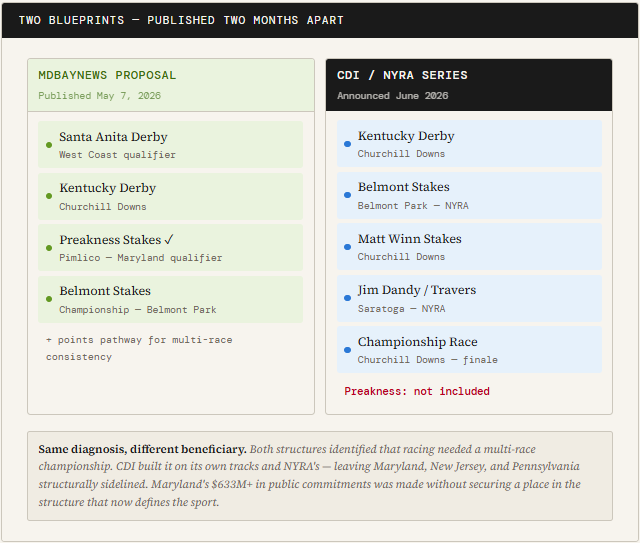
The Thoroughbred Championship Series CDI just announced is structurally similar — a multi-race qualifying campaign culminating in a championship finale, built to crown America’s top three-year-old. The core diagnosis was correct: American racing needed a championship structure, not a sequence. CDI read the same landscape, reached the same conclusion, and built the solution on their own terms and their own tracks.
The administration framed the IP purchase as the finish line. CDI treated it as the starting gun.
The difference is which races qualify and where the championship is held. In the MDBayNews proposal, the Preakness was a gateway — win it, earn a Belmont ticket, stay relevant regardless of what happened at Churchill Downs three weeks earlier. In CDI’s version, the Preakness is absent. The Haskell is absent. The Pennsylvania Derby is absent. Every race not held at a CDI or NYRA track is structurally irrelevant to the title.
Maryland’s governor had two months, a $450 million public investment in Pimlico, and a moment of genuine leverage — the IP purchase — to demand a seat at the table where this structure was being designed. Instead, the administration framed the IP purchase as the finish line. CDI treated it as the starting gun.
The reform was obvious. The window was open. Maryland bought a trademark and called it a strategy.
Maryland bought a trademark and called it a strategy.
Maryland on the Map
This series has documented a consistent pattern in the Moore administration’s approach to major economic and infrastructure commitments: announcements timed to political cycles, promises that outrun execution, and a gap between what is declared and what is delivered.
The Key Bridge contractor was fired. Energy costs are rising. The Blueprint for Maryland’s Future faces a structural funding shortfall. And the governor’s signature pre-primary achievement — owning the Preakness brand — has been answered by the sport’s most powerful operator with a competing series, an SEC filing, and a moving truck.
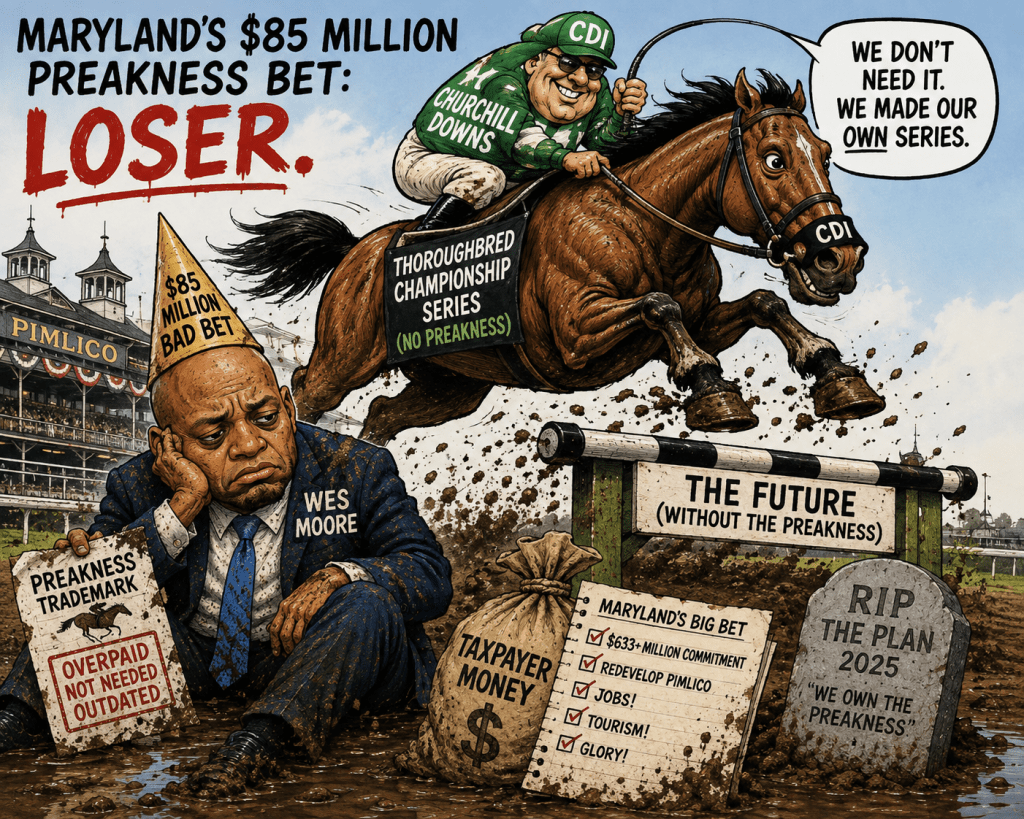
Moore bet $85 million that owning the Preakness IP would keep Maryland central to the sport’s future. Churchill Downs answered the bet before the ink was dry. On August 3, 2026 — the day CDI and NYRA made that answer official — the Maryland Jockey Club declined to comment. That silence is its own statement.
Moore bet $85 million that owning the Preakness would keep Maryland central to racing. Churchill Downs answered before the ink was dry.
Maryland holds the brand. CDI holds the winning hand.
Sources: Maryland Stadium Authority project records and press releases, including the January 20, 2026 MSA Board of Directors vote on Shamrock Farm and the April 20, 2026 announcement of the Laurel Park acquisition; Maryland General Assembly, HB 1524 (2024), authorizing $400 million in Stadium Authority bonds for Pimlico reconstruction; Governor Wes Moore’s office, press release and letter to 1/ST Maryland LLC and Churchill Downs Inc., June 18, 2026, announcing exercise of right of first refusal under Maryland Code Ann. Bus. Reg. §11-520(d); Churchill Downs Incorporated, Form 8-K filed with the Securities and Exchange Commission, June 18, 2026, confirming Maryland’s IP acquisition, and Form 8-K filed July 30, 2026, disclosing the planned divestiture of Ocean Downs Casino and Racetrack and seven other regional gaming properties; Churchill Downs Incorporated and New York Racing Association, joint announcement of the Thoroughbred Championship Series, June 2026; Baltimore Sun and Tribune News Service, “Maryland Gambles $500M on Horse Racing as Industry Shrinks, Costs Rise,” May 2026; Blood Horse, Daily Racing Form, and Horse Racing Nation, reporting on the CDI/NYRA championship series announcement, August 3, 2026; MDBayNews, Maryland on the Map series: “The Most Exciting Two Minutes vs. The Most Exclusive Weekend in Sports” (April 12, 2026), “Maryland’s $400 Million Question” (April 13, 2026), “Maryland Spent $450 Million. Churchill Downs Bought the Crown Jewel. Moore Wasn’t Invited.” (April 30, 2026), “Derby Winners Are Skipping the Preakness. Maryland Is Spending $400 Million on It Anyway.” (May 6, 2026), “The Preakness Doesn’t Need the Derby Winner. It Needs a Reason to Matter.” (May 7, 2026), “Did Churchill Downs Give Wes Moore Buyer’s Remorse?” (May 9, 2026), “Maryland Is Trying to Buy Back a Race It Never Should Have Lost” (May 14, 2026), “The Governor Bought a Horse Race” (June 20, 2026); Maryland Daily Record, reporting on Ocean Downs divestiture, July 30, 2026.


Leave a Reply