
By Michael Phillips | MDBayNews
Baltimore has not hosted a Major League Baseball All-Star Game since Bill Clinton’s first term. That drought may be nearing its end.
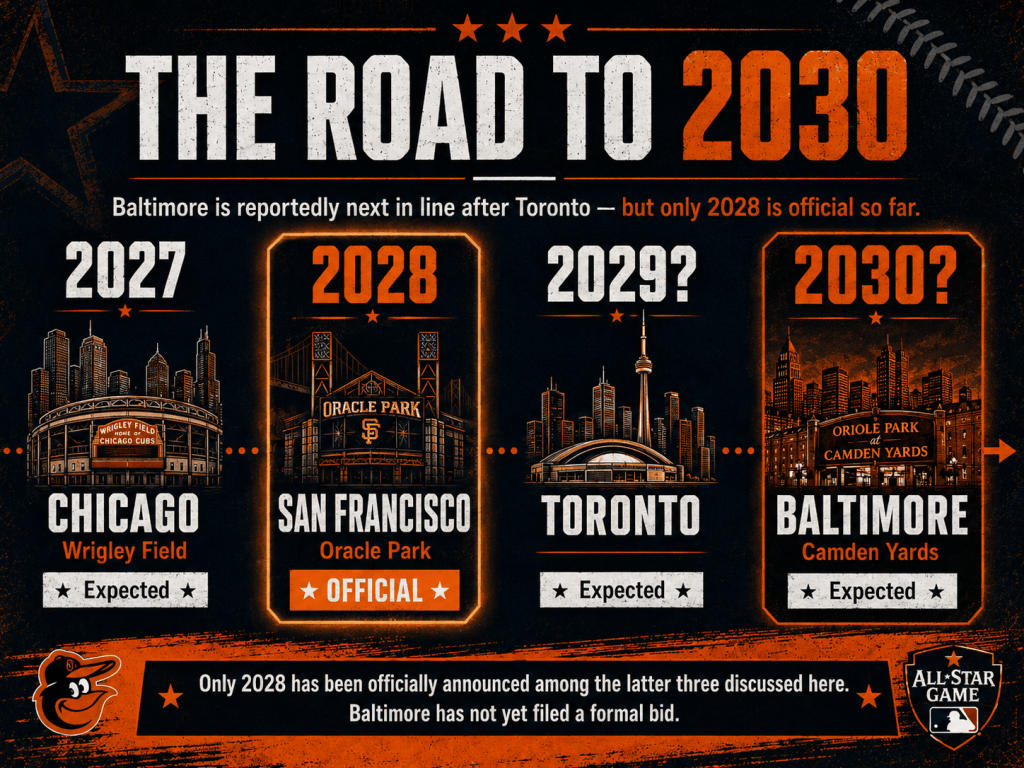
USA Today’s Bob Nightengale, a veteran MLB reporter whose past reporting on future All-Star sites has often preceded MLB’s formal announcements, reported Friday that the Orioles are expected to land the 2030 All-Star Game at Camden Yards. The report came the same morning MLB made official what had been rumored for weeks: the San Francisco Giants will host the 2028 game at Oracle Park. According to Nightengale’s reporting, the Chicago Cubs have 2027, the Giants have 2028, the Toronto Blue Jays are expected to get 2029, and Baltimore is expected to follow in 2030.
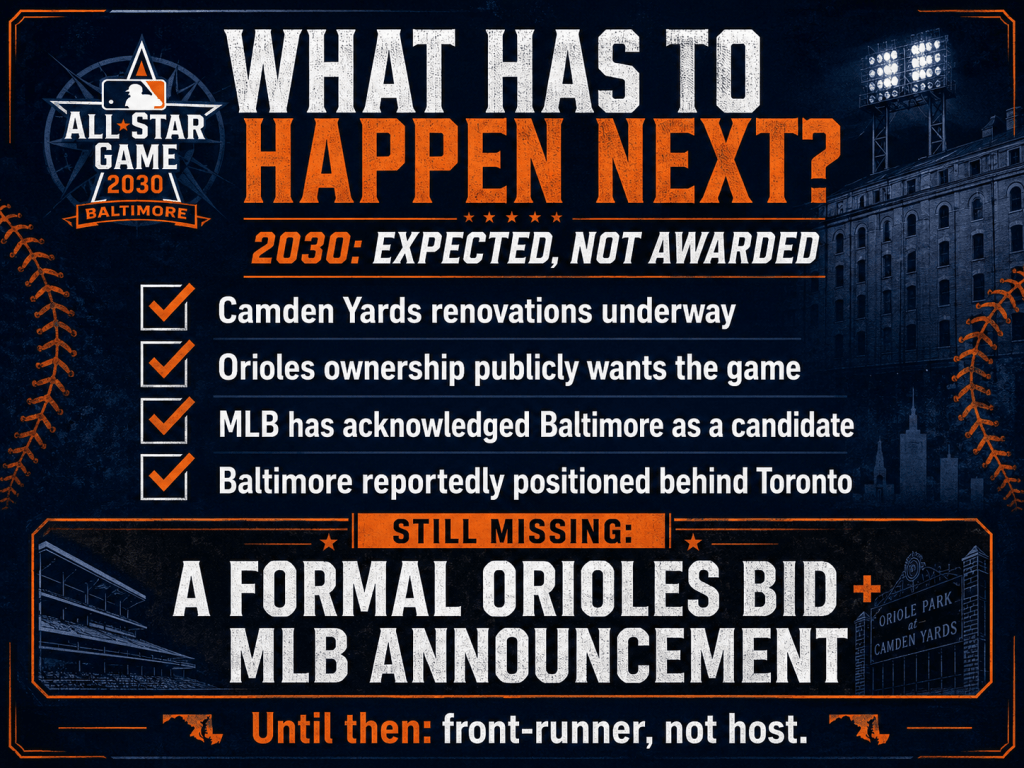
Nothing is official yet on the Orioles’ end. MLB has not announced a 2030 host, and as of this summer, the team had not even formally submitted a bid. But the pieces are lining up in a way they haven’t in more than three decades, and Baltimore boosters have reason to pay attention.
Why now
The case for Baltimore rests on three things: seniority, a freshly renovated ballpark, and an ownership group that wants the game badly.
“The case for Baltimore rests on three things: seniority, a freshly renovated ballpark, and an ownership group that wants the game badly.”
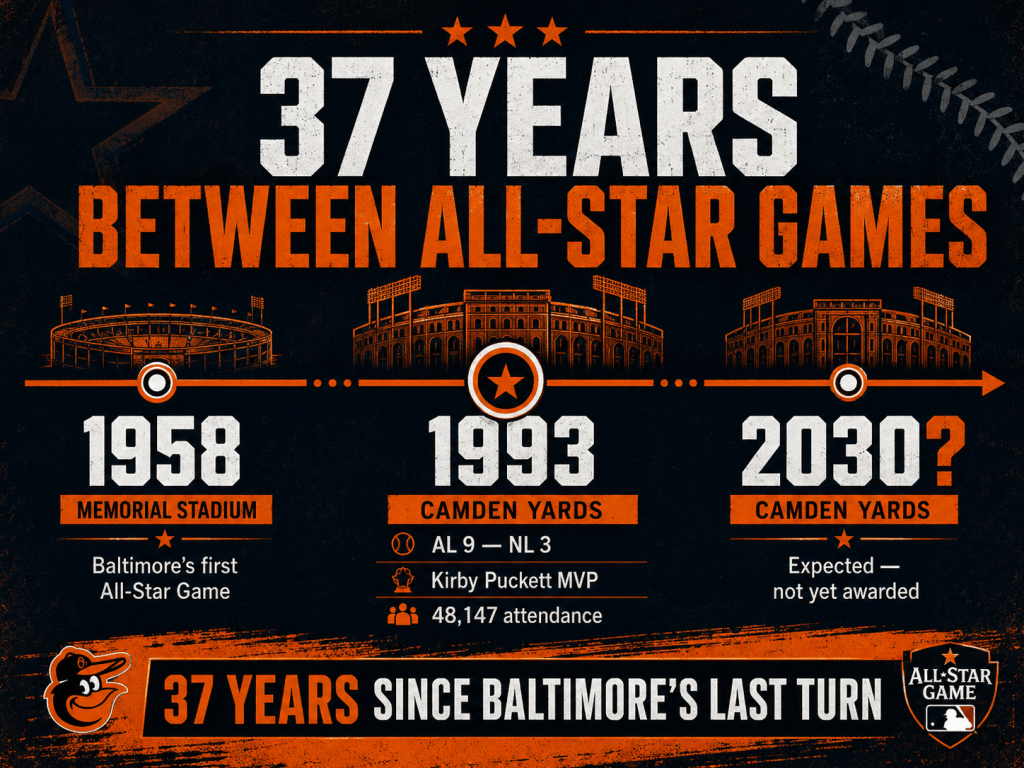
Camden Yards last hosted the Midsummer Classic on July 13, 1993, when the American League beat the National League 9-3 in front of 48,147 fans. Kirby Puckett won MVP. The ballpark was barely a year old at the time, having opened in April 1992. If the Orioles do host in 2030, it will be 37 years later, and only the third time in franchise history. Baltimore’s other All-Star Game came in 1958 at Memorial Stadium.
“If the Orioles do host in 2030, it will be 37 years later, and only the third time in franchise history.”
Since then, teams with far less tenure have hosted multiple times. The Seattle Mariners and Pittsburgh Pirates have each hosted twice since Baltimore’s turn in 1993. The Orioles are one of just a handful of clubs that have gone three decades or longer without the game.
Meanwhile, the ballpark itself has changed. In December 2023, the state and the Orioles signed a long-term lease that unlocked up to $600 million in state bond financing for Camden Yards upgrades, authorized by the General Assembly in 2022. Of that, roughly $305 million has been issued so far, according to the governor’s office, funding a new videoboard, sound system, chiller plant, and the Right Field Flag Court social space, among other improvements. The state’s announcement of the $135 million first phase called it the largest renovation at the ballpark since it was built in 1992.

Orioles owner David Rubenstein has made no secret of wanting the game back. Commissioner Rob Manfred said last year that Baltimore is among the cities MLB is actively considering for a future All-Star Game. Gov. Wes Moore was more direct about it in March, telling reporters at Orioles Opening Day: “The All-Star Game needs to be in Baltimore.”
Not a done deal
A few caveats are worth stating plainly, in the spirit of not getting ahead of the story.
- The Orioles have not filed a bid with MLB. Team president of business operations Catie Griggs told The Baltimore Banner in July that the club is giving the idea more serious consideration heading into the offseason but has not submitted a formal application.
- MLB requires thousands of hotel rooms across multiple nearby properties, and compared to many cities with pro teams, Baltimore has fewer hotel rooms and less hospitality space overall. At least one prominent Inner Harbor hotel, the Sheraton, has closed in recent years, and the Harborplace redevelopment is expected to leave part of downtown under construction for much of this decade.
- A state planning document called “Moonshots,” obtained by the Banner through a records request, specifically referenced the 2029 game as Maryland’s target, not 2030. Nightengale’s reporting now suggests Toronto gets 2029 and Baltimore slides to 2030, a reminder that state wish lists and MLB’s actual sequencing don’t always match.
- Baltimore already has one recent example of a bid that didn’t pan out. The city submitted a 55-page application to host matches in the 2026 FIFA World Cup and did not make the final list of U.S. host cities.
None of that rules out 2030. It just means the smart move is treating this as a strong expectation, not a lock, until MLB says otherwise.
“The smart move is treating this as a strong expectation, not a lock, until MLB says otherwise.”
The economic pitch, and the skepticism that should come with it
“Independent economists who have actually gone back and checked hotel occupancy and taxable sales data, rather than relying on pre-event press releases, tell a different story.”
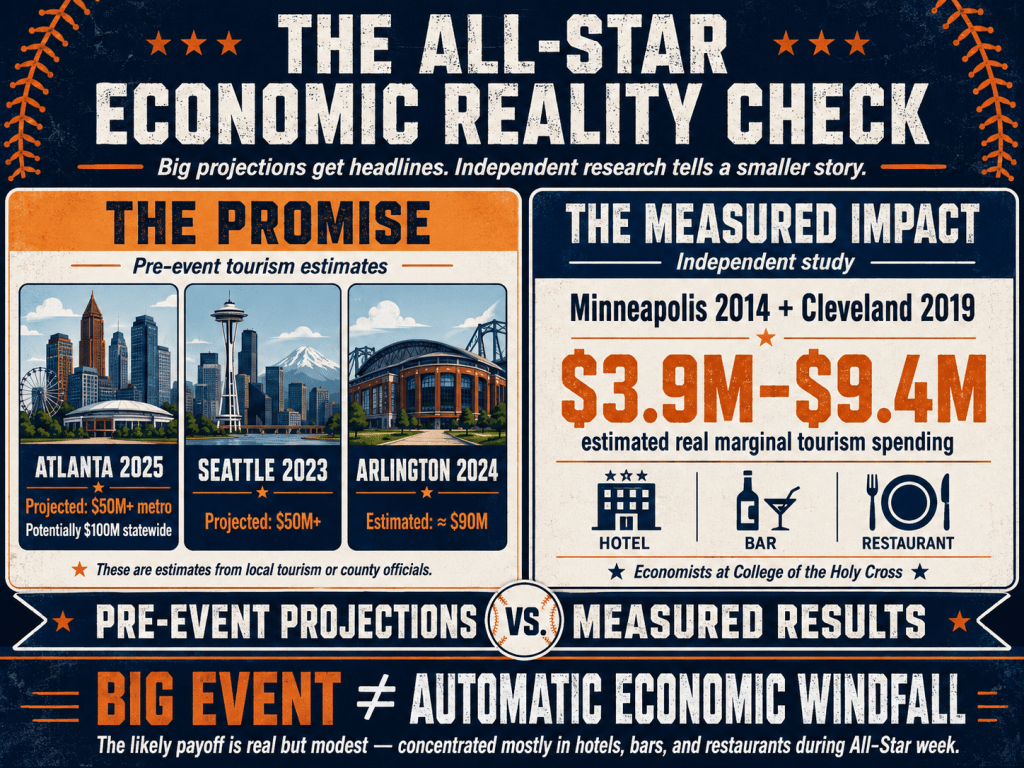
Whenever a city angles for an All-Star Game, someone puts a dollar figure on it, and Baltimore’s boosters will do the same here. It’s worth noting that the touted numbers from recent hosts were pre-event estimates, not verified results, even for games that have already been played.
- Atlanta’s 2025 game, last July, carried preliminary estimates of at least $50 million for the metro area and potentially $100 million statewide, according to county tourism officials.
- Seattle’s 2023 All-Star Week was pegged beforehand at a minimum of $50 million. Arlington’s 2024 game carried pre-game estimates of around $90 million from local tourism officials.
None of those three figures were followed by an independent post-event study confirming the number actually materialized.
“The touted numbers from recent hosts were pre-event estimates, not verified results, even for games that have already been played.”
Independent economists who have actually gone back and checked hotel occupancy and taxable sales data, rather than relying on pre-event press releases, tell a different story. A study of the 2014 Minneapolis and 2019 Cleveland All-Star Games, led by economists including Victor Matheson of the College of the Holy Cross, found those two games generated somewhere between $3.9 million and $9.4 million in real marginal tourism spending, a small fraction of the figures cities and MLB typically circulate beforehand. The same researchers dismissed the widely repeated claim that Georgia lost $100 million when MLB pulled the 2021 game from Atlanta over the state’s voting law, calling it “pure fiction with no basis in economic data.”
MLB itself stopped issuing official economic impact estimates for the All-Star Game after 2021, following years of pushback from economists, which means the $50 million to $100 million figures floated for Atlanta in 2025 came from local tourism and county officials rather than the league.
“The honest expectation is a real but modest boost, mostly concentrated in hotels, bars, and restaurants during All-Star week, not the transformative windfall that press releases tend to promise.”
That gap between the promotional number and the researched number isn’t unique to baseball. It’s the same pattern MDBayNews readers may recall from Baltimore’s World Cup bid, where boosters cited a potential $480 million in net benefits that the city never got the chance to test, because the bid failed. If Baltimore does land the 2030 game, the honest expectation is a real but modest boost, mostly concentrated in hotels, bars, and restaurants during All-Star week, not the transformative windfall that press releases tend to promise.
What it would mean either way
Set the dollar figures aside, and there’s still something to the argument John Moag, who chaired the Maryland Stadium Authority from 1995 to 1999, made about 1993: for a few days, the city gets the sport’s full attention. All-Star week now includes the Home Run Derby, the amateur draft, the Futures Game, a fan festival, and a red carpet event, a much bigger footprint than the single game Baltimore hosted in 1993. Camden Yards’ walkable downtown setting, one of the things that made the ballpark famous when it opened, would again be part of the pitch to a national television audience.
“For a few days, the city gets the sport’s full attention.”
For now, Baltimore is the expected next stop after Toronto, according to reporting that has been reliable on this topic before. Whether that becomes official will depend on a bid the Orioles haven’t yet filed, and on an MLB process that has surprised host cities before.
Sources: This report draws on Bob Nightengale’s Aug. 14, 2026 reporting for USA Today on future MLB All-Star Game hosts; Major League Baseball’s Aug. 14, 2026 announcement awarding the 2028 game to the San Francisco Giants; The Baltimore Banner’s July 9, 2026 report “The Orioles want to host an All-Star Game. Landing one is a different story.”; the Office of Governor Wes Moore’s press release on Camden Yards renovation funding; prior Banner and Baltimore Sun reporting on the Orioles’ December 2023 lease agreement and the $600 million state bond authorization under HB896 (2022); Baltimore’s 2017 FIFA World Cup host-city bid materials as reported by the Banner and a 2021 op-ed from the Baltimore-Maryland 2026 bid committee; Baumann, Matheson, Stephenson and Murray’s study on the economic impact of the MLB All-Star Game (College of the Holy Cross); and Baseball Almanac’s compilation of All-Star Game economic impact estimates, 2002-2021.


Leave a Reply