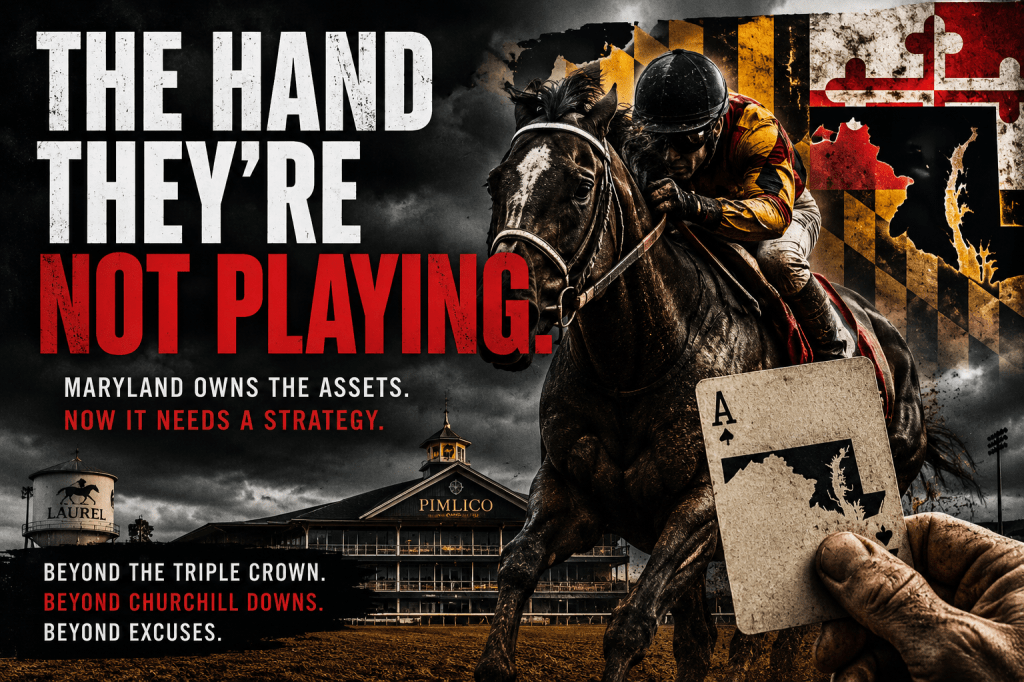
Maryland’s Preakness Strategy: A Blueprint Beyond the Triple Crown
Maryland owns the assets, the history, and the window. What it needs is a strategy — and someone willing to make the calls before 2028 arrives without one.
By Michael Phillips | MDBayNews | Maryland on the Map
A note from MDBayNews
We have been critical of the decisions that led Maryland here. That coverage stands.
But we do not want this investment to fail. Rooting against the Preakness is rooting against Maryland — and rooting against the taxpayers carrying $633 million in public commitments on its behalf.
What follows is not more criticism. It is the most complete accounting we can offer of what Maryland owns, what it has done before, and what a realistic path forward looks like. We hope someone in Annapolis is reading it — and making the calls.
— MDBayNews
What Maryland actually owns — the complete portfolio, assembled for the first time
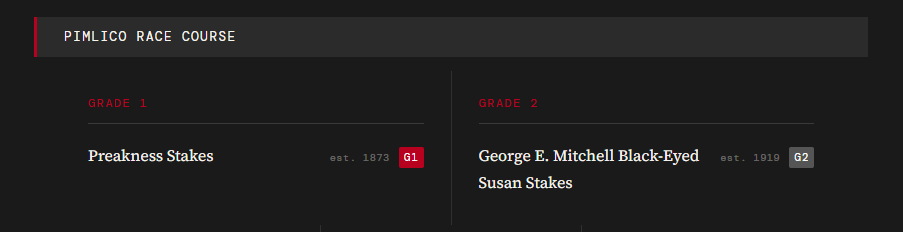
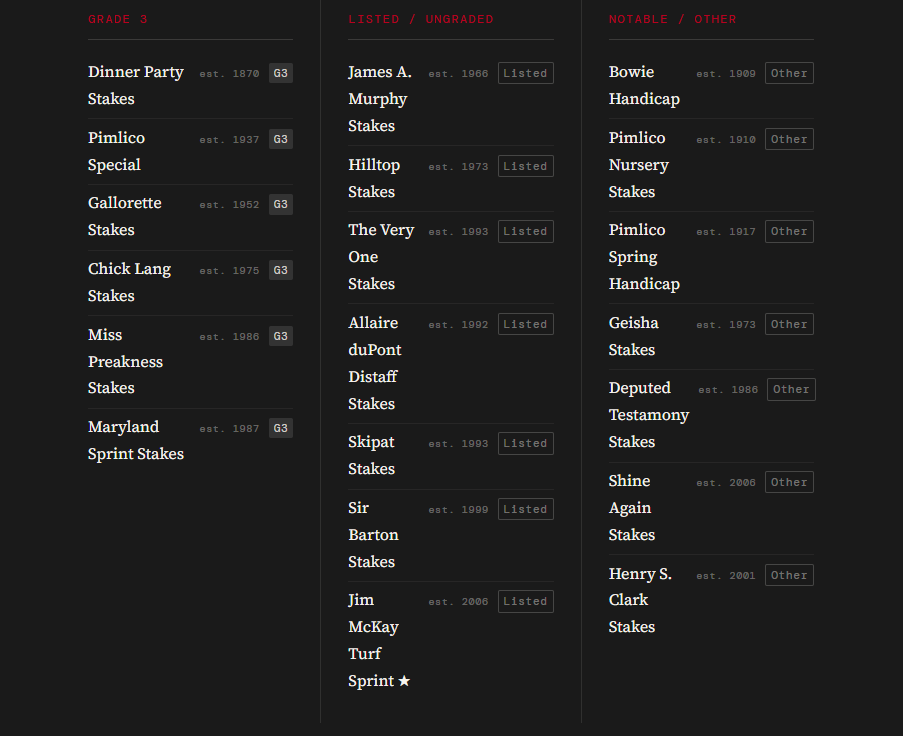
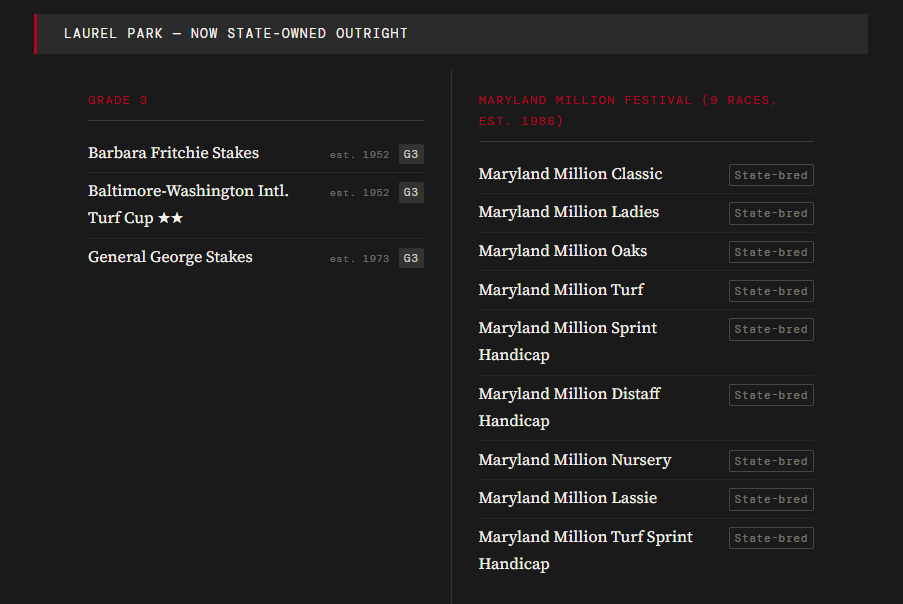
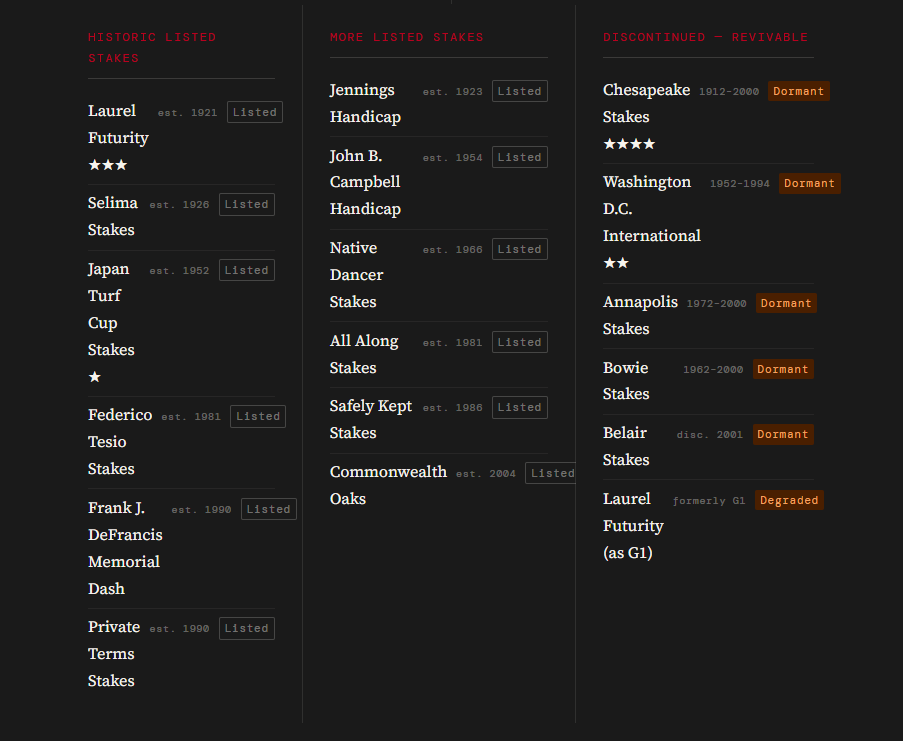
★ International connection already exists ★★ Successor to Washington D.C. International ★★★ Formerly Grade 1 ★★★★ 88-year history, discontinued by 1/ST in 2000
This is the most complete public accounting of Maryland’s racing portfolio across both state-owned facilities. Most of it is running below its historical grade, dormant, or unconnected to any strategic framework. CDI and NYRA built a six-race championship series. Maryland is sitting on more than 50 races and has presented no structure connecting any of them.
Two days ago, Churchill Downs and NYRA restructured American thoroughbred racing around themselves and left Maryland out. MDBayNews covered the announcement and the accountability questions it raised. Today, CDI confirmed that the series was in development before Maryland wrote the $85 million check — and left one door open for Maryland to join. Understanding what that door costs is the starting point for everything else in this piece.
“Maryland owns the assets, the history, and the window. What it needs is a strategy.”
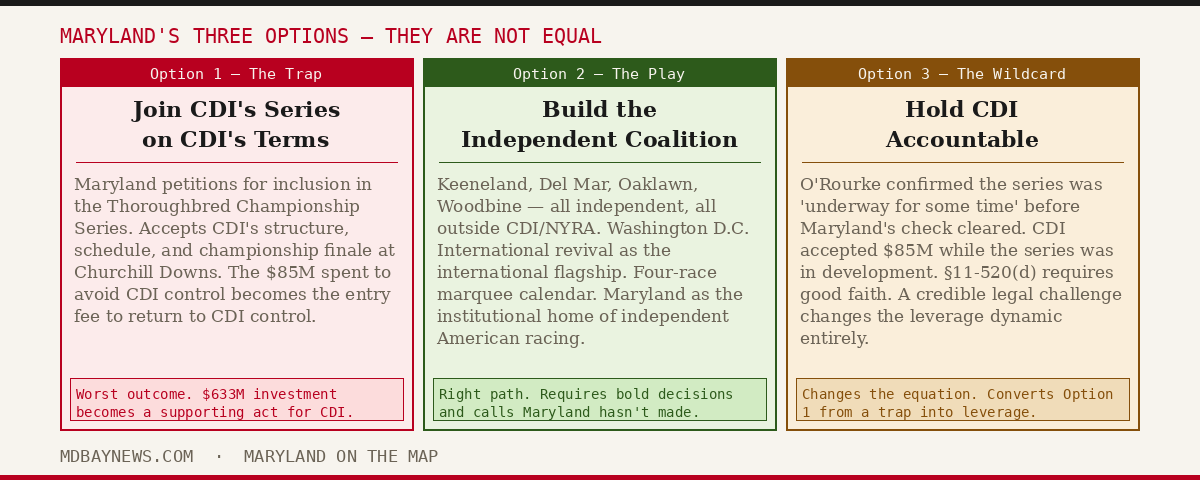
Maryland’s Three Options — and Why One Is a Trap
Maryland now faces three distinct paths. They are not equal.
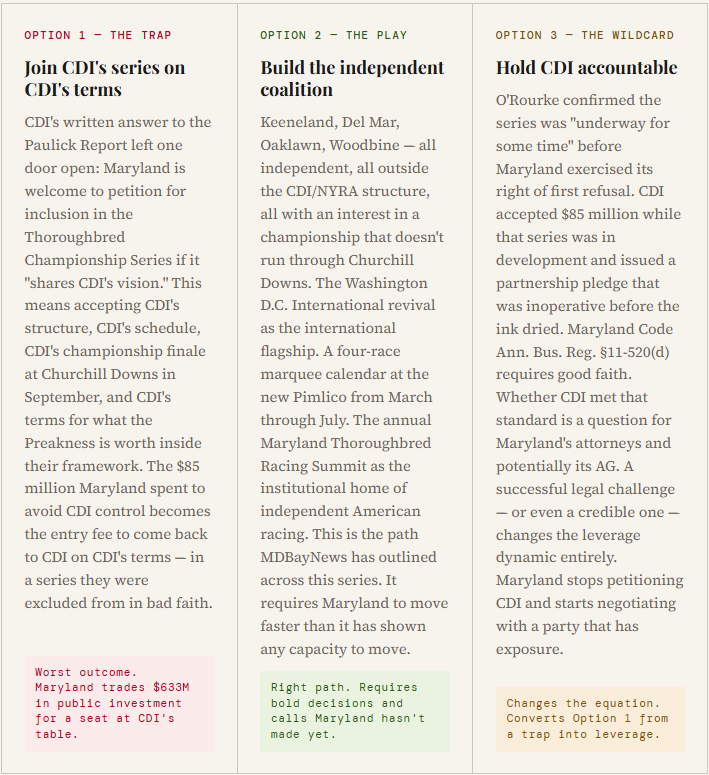
Options 2 and 3 are not mutually exclusive. Maryland can pursue the independent coalition while simultaneously holding CDI legally accountable. In fact, a credible bad faith claim strengthens the coalition play — it signals to Keeneland, Del Mar, and Oaklawn that Maryland is a serious actor willing to fight for its interests, not a passive state government waiting to be invited somewhere.
“Option 1 is the path of least resistance and the worst possible outcome.”
Option 1 is the path of least resistance and the worst possible outcome. It is also, if Maryland does nothing, the path it will end up on by default — because CDI’s door is the only one currently open, and standing in the hallway costs money every day the Preakness sits without a broadcast deal, a championship pathway, or a strategic framework.
The rest of this piece is about what Option 2 actually looks like — and what it requires Maryland to build before 2028.
The Preakness: Domestic Anchor, Not Triple Crown Dependency
“The Preakness becomes the anchor of a domestic national coalition.”
The conventional frame — save the Preakness as a Triple Crown race — is the wrong frame now. The CDI/NYRA announcement makes that clear. A race that earns no championship series points, has expired broadcast rights, and sits between two races that do earn points is structurally diminished regardless of its history.
The better frame: the Preakness becomes the anchor of a domestic national coalition. Maryland stops trying to be relevant to CDI’s structure and builds a competing one.
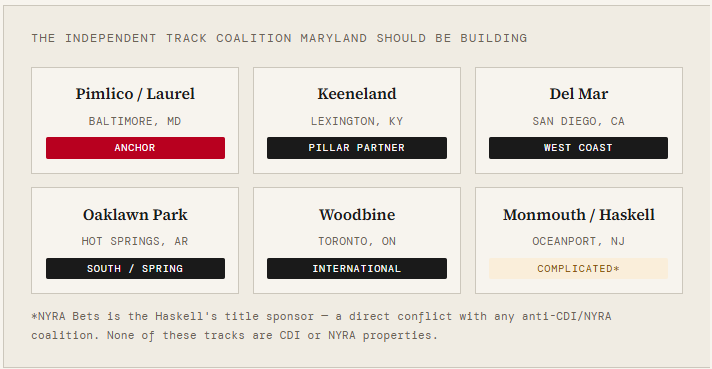
Keeneland in Lexington is not a CDI or NYRA property — it is a private nonprofit and one of the most respected institutions in the sport. Del Mar is an independent nonprofit. Oaklawn Park is privately owned and financially stable. Woodbine in Toronto is fully independent with international credibility. None of them are in the Thoroughbred Championship Series. All of them have an interest in a championship structure that doesn’t run through Churchill Downs.
A Preakness-anchored series connecting these tracks — with a points system and a championship finale — is a legitimate national product covering every region CDI/NYRA doesn’t control. It requires Maryland to make calls it has not yet made, negotiate agreements it has not yet sought, and present a structure it has not yet designed. Keeneland is the pillar. Start there.
They’ve Done This Before: The Washington D.C. International
“Maryland built a world-class international race once. It has the template, the facility, and the name. It let the race die. It doesn’t have to stay dead.”
Here is what the current coverage is missing entirely.
The Washington D.C. International Stakes debuted at Laurel Park in 1952. It was structured as a prestigious invitational — international horses competing on American soil for a major purse and global prestige. Queen Elizabeth II attended. The race directly inspired the concept that became the Breeders’ Cup. It ran continuously through 1994, when it was discontinued after the track changed hands. Its diminished successor — the Baltimore-Washington International Turf Cup, now a G3 — still runs at Laurel Park today, a ghost of what the original was.
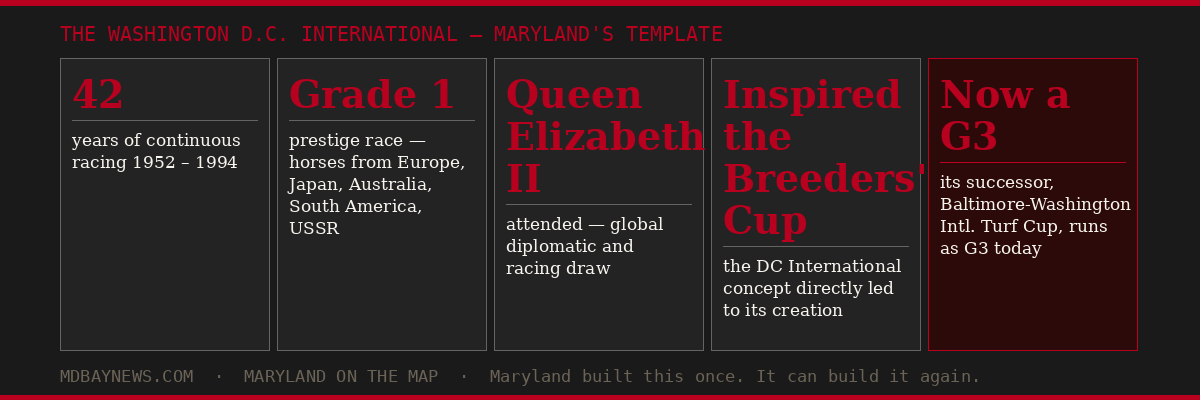
Maryland built a world-class international race once. It has the template. It has the Laurel Park facility, now state-owned outright. The name — the Washington D.C. International — is not currently in active use as a major stakes race. Maryland can revive it.
The international invitational model works because European and Japanese horses are not chasing the Thoroughbred Championship Series. They’re chasing global ranking points, breeding value, and the prestige of winning on foreign soil. The Japan Cup draws the world’s best horses not because it offers the largest purse, but because winning it means something globally. Maryland has a race name with 42 years of international history behind it, a new Pimlico facility coming that can host at world-class level, and date flexibility that no longer exists under the Triple Crown sequence.
The Jim McKay Turf Sprint, already running at Pimlico, already carries an automatic entry to the July Cup G1 at Newmarket. The international infrastructure is partially built and being ignored.
The Four-Race Calendar
Maryland doesn’t need two tracks. It needs four marquee events organized across a single calendar at one world-class facility — each with a distinct audience, a distinct strategic purpose, and no conflict with CDI’s series or the Breeders’ Cup.
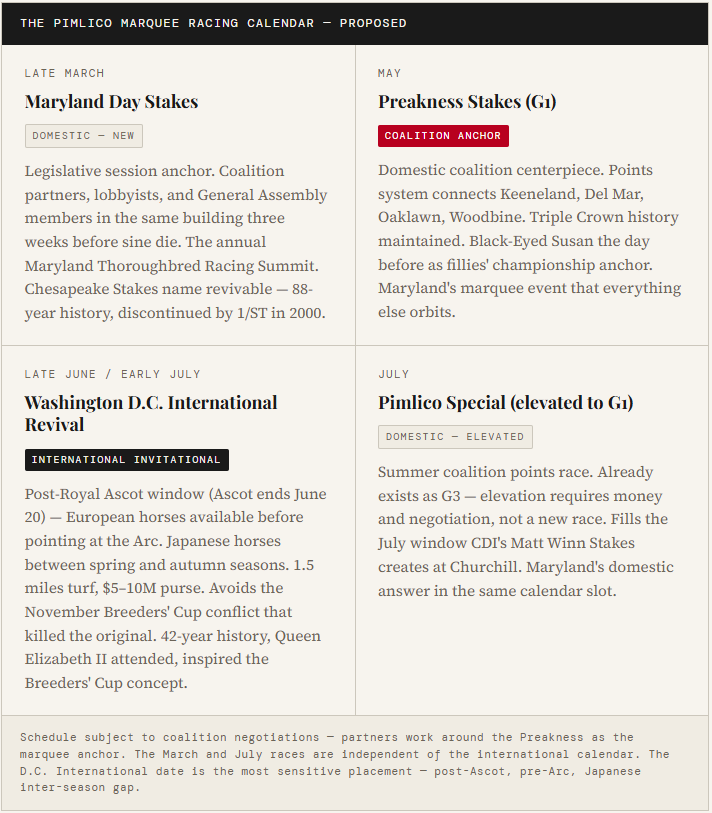
“Maryland doesn’t need two tracks. It needs four marquee events organized across a single calendar.”
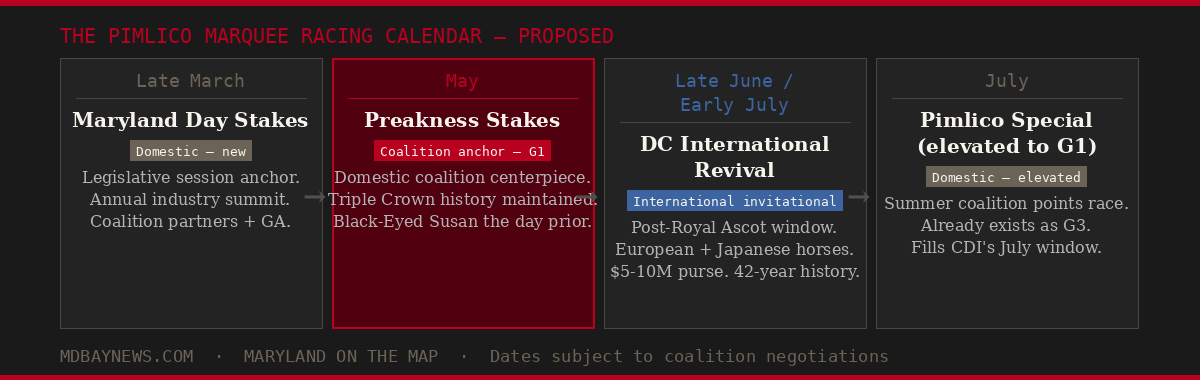
Four distinct events. Four distinct audiences. No conflict with the Breeders’ Cup (late October), the Arc (early October), Melbourne Cup (November), or CDI’s championship series (May through September at their own tracks). March through July is Maryland’s window and Maryland’s alone.
The Maryland Day Summit: More Than a Race
The March race is the most strategically important addition on the calendar — not because of the horses, but because of who it puts in the same building.
The Maryland General Assembly runs January 14 through April 13 — 90 days, sine die at midnight. A marquee racing event in late March, three weeks before adjournment, lands at the exact moment racing legislation has maximum political salience. Every bill affecting the Maryland Jockey Club, the coalition’s operating structure, broadcast rights, or purse funding is still alive on the floor. Every lobbyist in Annapolis has a reason to be in Baltimore that week. Every coalition partner — Keeneland, Del Mar, Oaklawn, Woodbine — sends representatives to a facility that has a 1,000-seat event space, a hotel, and a public plaza designed for exactly this kind of gathering.
“The annual Maryland Thoroughbred Racing Summit could become the neutral home of independent American racing.”
What Maryland is describing, whether it knows it or not, is the institutional infrastructure for an annual Maryland Thoroughbred Racing Summit — the neutral home ground of independent American racing. CDI can’t host it. NYRA can’t host it. They’re the parties the independent coalition is organizing against. Keeneland could host it, but it doesn’t have the Preakness brand, the 150-year history, or a new world-class facility opening in 2028.
Maryland has all three. And the new Pimlico was designed for it.
What the New Pimlico Actually Contains
This is where the strategic picture changes from aspiration to infrastructure. The new Pimlico — currently under construction, expected to open for Preakness 152 in 2027 with full completion in 2028 — is not being built as a racetrack with a grandstand. It is being built as a year-round destination.
The site plan includes: a new state-of-the-art clubhouse with both turf and dirt tracks; stables for 700 horses; a 1,000-seat event space; a hotel to be built by a private partner; a 2,000-car parking garage; veterinary facilities; structured parking; and a public “Palio” plaza designed for concerts, performing arts, festivals, and open-air markets during Preakness week and year-round. The facility is authorized for more than 100 live racing days annually — up from 23 at the old Pimlico. It is projected to create 500 permanent jobs and anchor more than $3 billion in annual economic impact across 28,000 Maryland racing industry jobs.
The Baltimore Convention Center is 15 minutes away for overflow capacity. Annapolis — where the General Assembly meets — is 30 minutes. The facility was specifically designed to serve the Park Heights community for 51 weeks each year, with the Preakness as the anchor event and everything else built around it.
“The infrastructure is being built right now. The question is whether Maryland fills it with a vision or just a race.”
The comparisons write themselves. Annapolis built its identity around sailing because the Naval Academy, the Chesapeake Bay, and decades of investment created genuine institutional gravity. Baltimore built its lacrosse identity because Johns Hopkins, the sport’s history, and the Hall of Fame gave the city a credible claim. Pimlico’s claim on horse racing is older, deeper, and more globally recognized than either. The second-oldest track in America. One hundred fifty years of the Preakness. A new facility built specifically as a year-round destination. An independent coalition with no other natural home.
The infrastructure is being built right now. The question is whether Maryland fills it with a vision or just a race.
The Two-Track Strategy (Inside the Calendar)
“The international and domestic plays are complementary, not competing.”
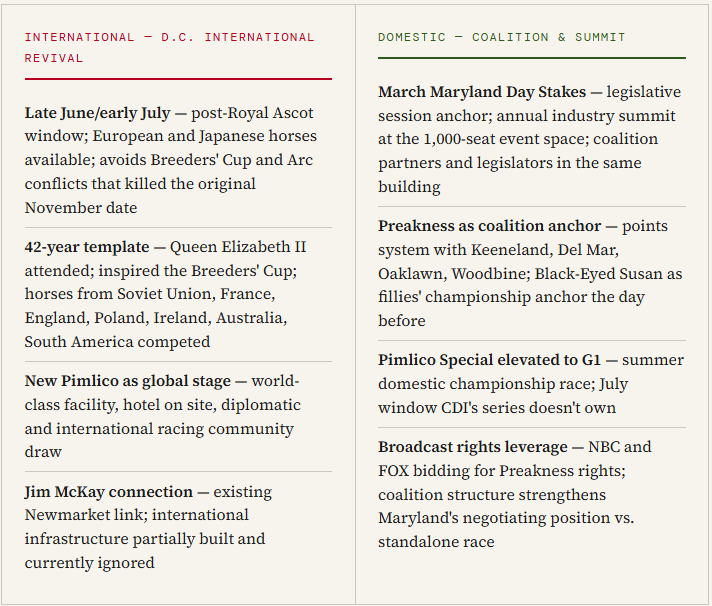
The international and domestic plays are complementary, not competing. The D.C. International targets horses CDI’s series doesn’t touch. The domestic coalition targets the three-year-old and older horse calendar CDI routes around Pimlico. The March summit builds the political and institutional infrastructure that keeps the whole thing funded and legislatively protected. Four events, one facility, three months of marquee racing, one annual industry convention — and a facility built specifically to host all of it.
The Black-Eyed Susan: The Most Underused Asset
Churchill Downs built the Kentucky Oaks into a cultural event that rivals the Derby itself — primetime NBC broadcast, a $1.5 million purse, a genuine identity separate from the race the next day. Maryland owns the Black-Eyed Susan, the fillies’ race the day before the Preakness, and has done almost nothing comparable.
The fillies’ championship is the strategic opening CDI leaves most exposed. The Thoroughbred Championship Series is built entirely around colts. The Kentucky Oaks is CDI’s fillies’ anchor — but after the Oaks, the summer and fall fillies’ calendar is relatively open. The Spinster Stakes at Keeneland, the Delaware Handicap, the Black-Eyed Susan — all independent, all undermarketed, all available for coalition.
A fillies’ championship series built around the Black-Eyed Susan, the Spinster at Keeneland, and Del Mar’s fillies’ races is a real product that CDI’s new series doesn’t touch. It’s achievable faster than the international play because it requires domestic negotiation, not international relationship-building. And Maryland owns the centerpiece.
What to Name the New Domestic Race
The Preakness carries the coalition anchor role. The Pimlico Special gets elevated. But the naming question for a new prestige domestic race has three viable options:
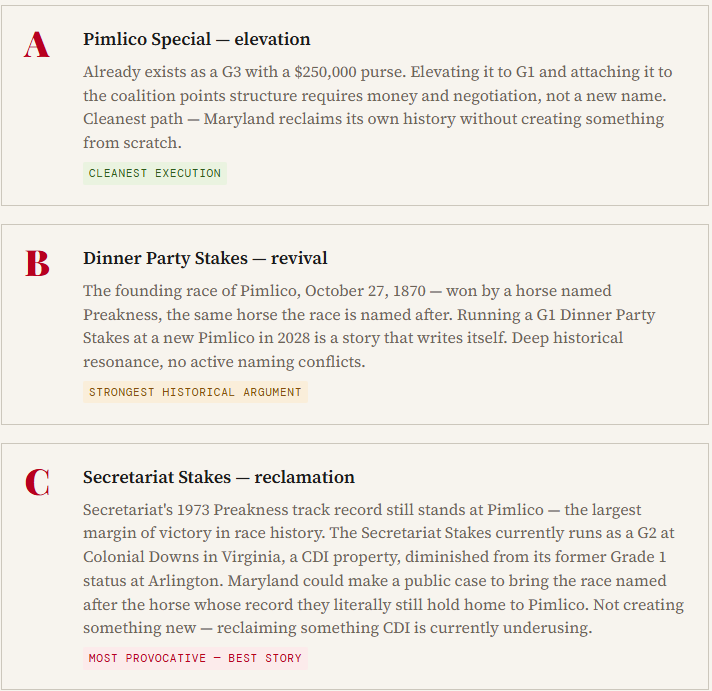
Maryland’s racing authority should be having this conversation publicly. It isn’t.
The Honest 2027 Problem
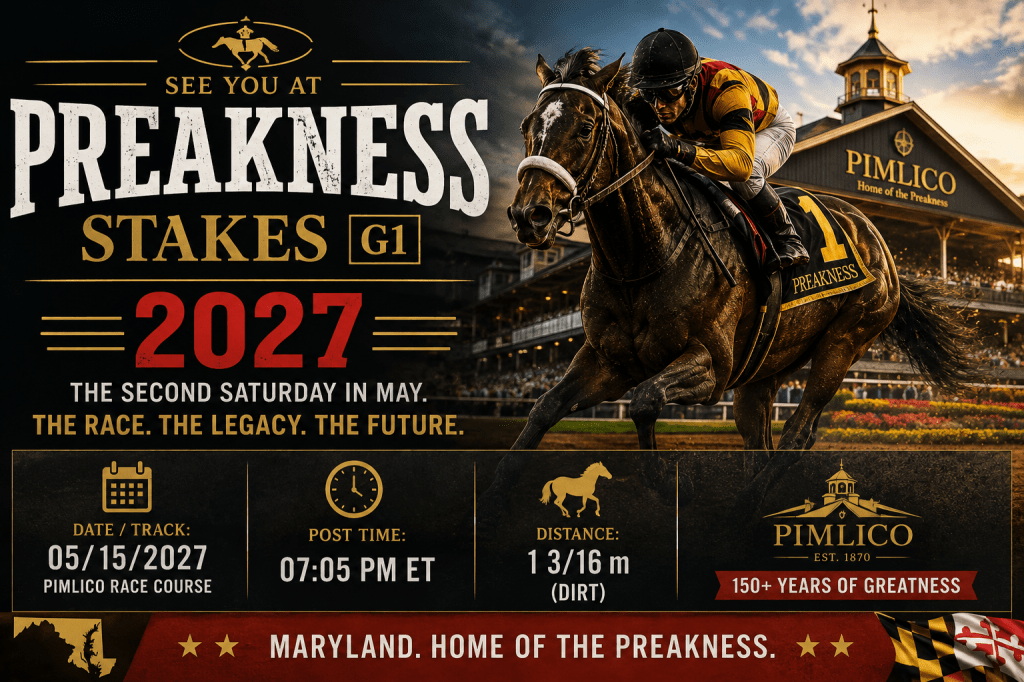
None of the strategic plays described above are 2027 stories. The new Pimlico will not be fully operational in 2027. Preakness 152 returns to a partially reconstructed facility — no permanent clubhouse, limited capacity, temporary infrastructure — while CDI and NYRA launch their championship series at three world-class venues with national television on NBC and FOX.
2027 is a survival year. Maryland needs to run the best Preakness it can at a half-built track while simultaneously building the coalition and international relationships it needs for 2028. The D.C. International revival, the Keeneland coalition, the fillies’ championship framework, the broadcast rights negotiation — all of it requires 2027 groundwork. None of it is visible. None of it has been announced.
The danger is that 2027’s diminished Preakness — construction site, reduced capacity, no championship pathway, competing against CDI’s shiny new series in its first year — becomes the defining image of the race’s trajectory before Maryland ever gets to play its real hand. By the time the new Pimlico opens in 2028, the narrative may already be set.
The window is 2028. The groundwork has to start now.
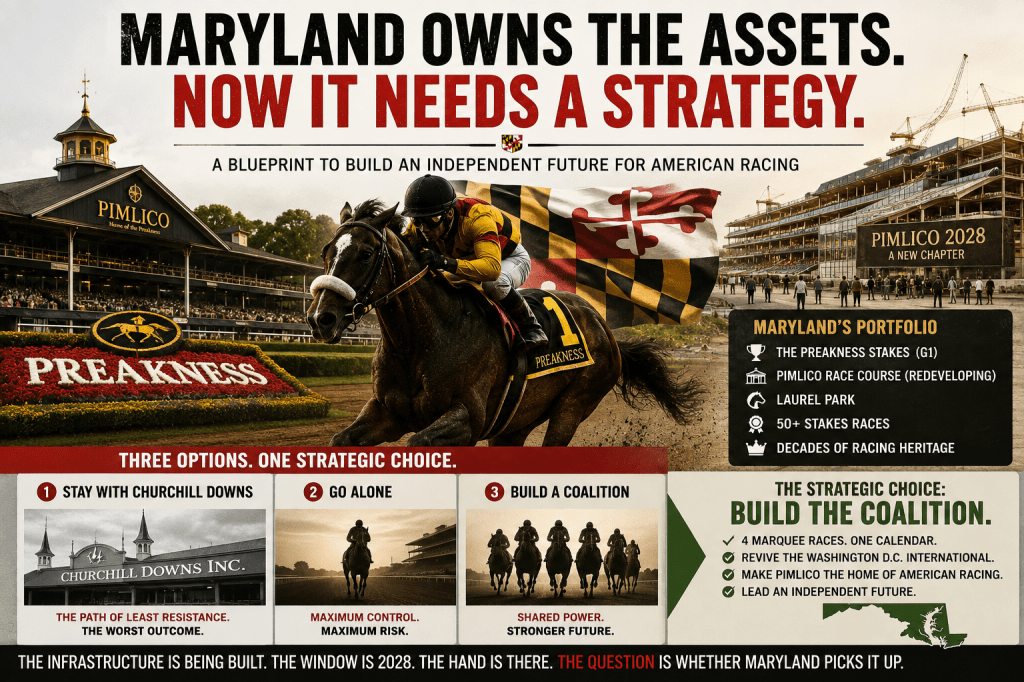
Maryland on the Map — and Wes Moore’s Choice
MDBayNews proposed a four-race qualifying structure in May. CDI built a version of it in June without Maryland. The diagnosis was correct. The prescription was right. Maryland was just too slow to fill it.
But the window isn’t closed. It’s just moved to 2028 — and the new Pimlico, with its 1,000-seat event space, on-site hotel, public plaza, and 100-plus racing days, is being built specifically as the kind of facility that can host what Maryland needs to build. The independent coalition has no natural home. The annual industry summit has no neutral ground. The international invitational has no American host since the D.C. International died in 1994. Maryland can be all three — if someone is willing to make the calls.
Annapolis built a sailing identity. Baltimore built a lacrosse identity. Pimlico has a deeper, older, more globally recognized claim on thoroughbred racing than either of those cities has on their sport. The second-oldest track in America. One hundred fifty years of the Preakness. A new facility opening in 2028. An independent coalition with no other home. A March summit timed to the General Assembly. A June international race in a calendar window no one else owns.
The hand is there. It has always been there.
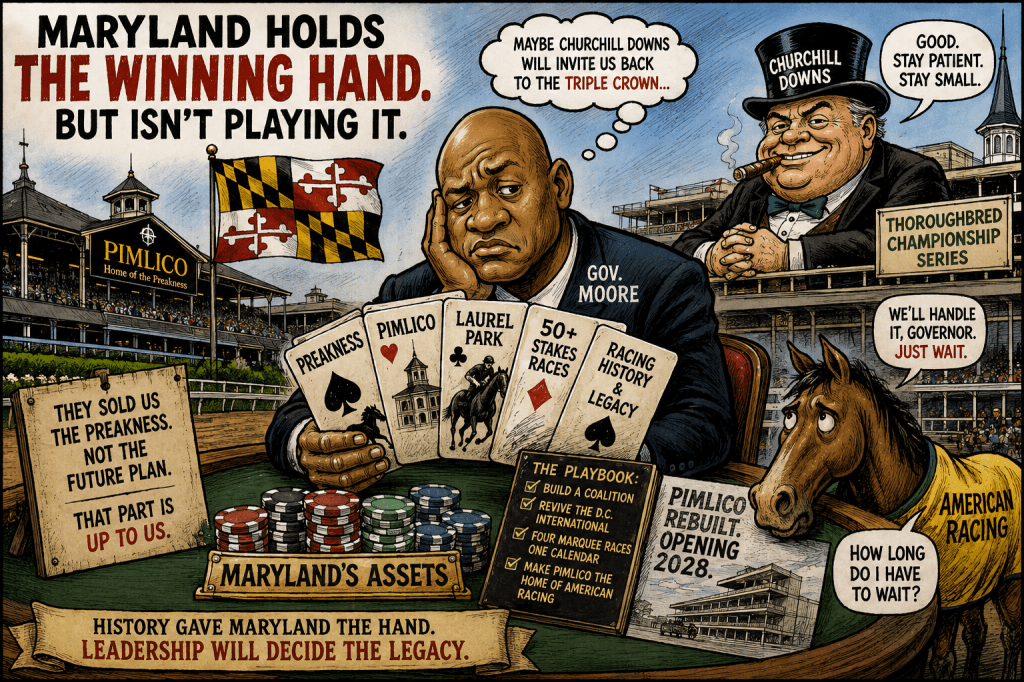
Whether Governor Moore picks it up is the only question that matters now. CDI acted in bad faith — the documented record makes that case. The AG should be examining it. The independent coalition should be getting calls from Annapolis today. The D.C. International should be in early-stage revival discussions with European and Japanese racing authorities. The broadcast rights negotiation should be using the coalition as leverage, not treating the Preakness as a standalone asset begging for a deal.
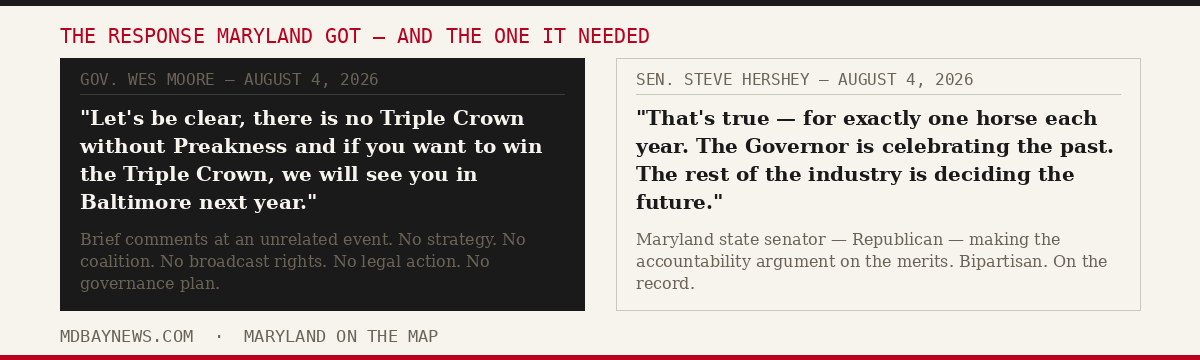
On Monday evening, Moore offered his first public response to CDI’s championship series announcement: “Let’s be clear, there is no Triple Crown without Preakness, and if you want to win the Triple Crown, we will see you in Baltimore next year.” State Senator Steve Hershey answered it directly: “That’s true — for exactly one horse each year. The Governor is celebrating the past. The rest of the industry is deciding the future.”
“Defending the Triple Crown’s historical integrity is not a strategy. It is a posture.”
Hershey is right that a posture is not a strategy. Moore has a scheduled press conference Wednesday — billed as a “major horse racing announcement” — that at minimum will reveal the 2027 Preakness date. What else it contains remains to be seen. The framework for what it needs to contain is documented above.
The assets are real. The history is unmatched. The facility is being built. The coalition, the D.C. International, the four-race calendar, the Maryland Day Summit, the broadcast rights negotiation, the legal question around CDI’s conduct — the tools are all there. The window is 2028. Maryland’s $633 million investment is waiting to find out if someone intends to use them.
Related Coverage — Maryland on the Map Series
“The Bet That Already Lost” — MDBayNews, August 3, 2026 · “Blindsided, Again” — MDBayNews, August 3, 2026 · “Nine Minutes” — MDBayNews, August 4, 2026 · “The Governor Bought a Horse Race” — MDBayNews, June 2026 · “The Preakness Doesn’t Need the Derby Winner. It Needs a Reason to Matter.” — MDBayNews, May 7, 2026
Sources
Maryland Stadium Authority project records and press releases; Maryland General Assembly, HB 1524 (2024); Thoroughbred Daily News, “State of Maryland Completes Acquisition of IP Rights to Preakness, Black Eyed Susan,” July 31, 2026; BloodHorse, “CDI, NYRA to Launch Championship Series for 3-Year-Olds,” August 3, 2026; The Baltimore Banner, “Kentucky Derby and Belmont Stakes to be part of new series without Preakness,” August 3, 2026; Daily Racing Form, historical stakes race records and championship series reporting, August 3, 2026; Equibase, historical race records for the Washington D.C. International Stakes, 1952–1994; Keeneland Association, ownership and race records; Del Mar Thoroughbred Club, ownership records; Oaklawn Jockey Club, ownership records; Woodbine Entertainment Group, ownership and race records; Jim McKay Turf Sprint race conditions and Newmarket entry provisions, Maryland Jockey Club; Jockey Club, graded stakes race classifications 2026; MDBayNews, Maryland on the Map series: “The Preakness Doesn’t Need the Derby Winner. It Needs a Reason to Matter.” (May 7, 2026); “The Governor Bought a Horse Race” (June 2026); “The Bet That Already Lost” (August 3, 2026); “Blindsided, Again” (August 3, 2026).


Leave a Reply