By MDBayNews Staff
ANNAPOLIS — A familiar but increasingly charged debate returned to the Maryland General Assembly this week as House Bill 63 (HB63), known as the Fairness in Girls’ Sports Act, heads toward a scheduled committee hearing amid accusations that legislative leaders are trying to quietly bury it.
HB63, formally titled Education – Interscholastic and Intramural Junior Varsity and Varsity Teams and Locker Rooms – Designation Based on Sex, was introduced by Kathy Szeliga (R–Baltimore & Harford Counties) with several Republican co-sponsors. The bill would require school athletic teams and locker rooms to be designated based on biological sex, rather than gender identity.
Supporters argue the measure is about fairness, safety, and privacy. Opponents say it is discriminatory and unnecessary. But what has intensified the fight this year is not just the substance of the bill — it’s the process.
“Dueling Doors” and Claims of Suppression
On Tuesday, members of the Maryland Freedom Caucus staged a visual protest inside the House Office Building, placing competing posters side-by-side — one promoting the bill as a safeguard for girls’ sports, the other labeling it “fiction.”
The group accused House leadership of attempting to limit debate by denying HB63 a full and meaningful hearing, despite years of public interest and repeated reintroduction.
“If proponents are so clearly wrong,” one caucus member said, “why not let the bill receive full scrutiny in the open?”
The hearing is scheduled for Thursday, February 5, 2026, before the House Ways and Means Committee, where written testimony is currently being accepted through the Maryland General Assembly portal.
What HB63 Would Do
Under HB63:
- Girls’, female, or women’s athletic teams could not include students of the male sex.
- Locker rooms designated for girls or women would be restricted accordingly.
- Schools would be protected from penalties or retaliation for maintaining sex-based designations.
- Students who believe they were deprived of athletic opportunities could pursue civil remedies.
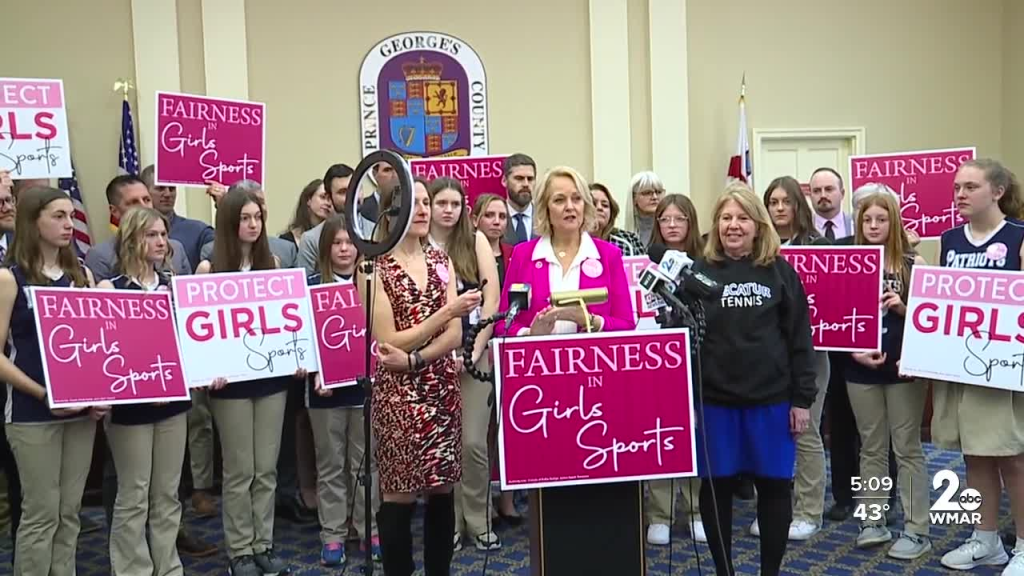
Supporters say the bill aligns with the original intent of Title IX by preserving competitive equity for female athletes. They argue that biological differences — particularly post-puberty — matter in sports and shared facilities.
A Familiar Pattern in Maryland
HB63 is not new. Versions of the Fairness in Girls’ Sports Act have been introduced repeatedly since 2022, each time stalling in committee. Maryland currently allows transgender students to compete according to gender identity under statewide athletic association guidelines.
Critics of the bill argue that transgender athletes represent a very small number of students and that inclusion policies have not caused widespread problems. Advocacy groups on the left frame HB63 as part of a broader national effort to roll back LGBTQ protections.
But supporters counter that the consistent refusal to advance the bill — even to a vote — suggests a political decision to avoid an uncomfortable debate rather than address parental concerns head-on.
Why This Matters for Maryland
Maryland prides itself on transparency and public participation in government. When legislation touching on education, civil rights, and youth athletics is repeatedly sidelined without a vote, it raises legitimate questions about whether certain viewpoints are being shut out entirely.
Regardless of where one stands on the policy, HB63’s handling has become a proxy battle over whether controversial issues will be debated openly — or quietly dismissed behind committee doors.
With similar bills advancing or already enacted in other states, and major federal court cases pending on related questions, Maryland lawmakers may soon find that avoiding the issue is no longer an option.


Leave a Reply