By Michael Phillips | Sports & Whatever
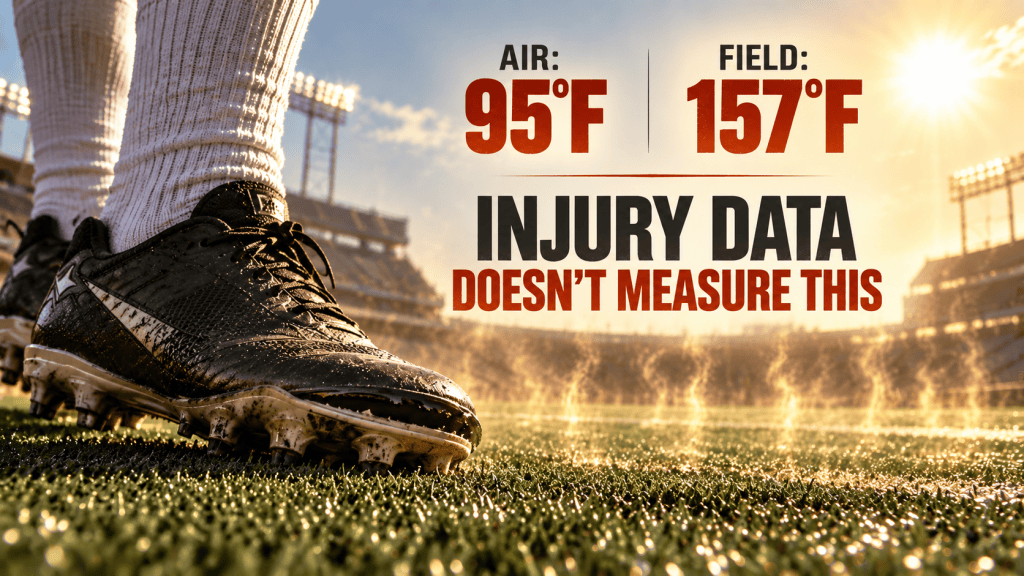
Sunday in Nashville, the temperature on the Nissan Stadium turf hit 157 degrees Fahrenheit, per the Fox broadcast. Titans safety Amani Hooker’s cleats had already lost their midsoles the week before, against the Jets. This time it was Philadelphia’s turn: Cam Jurgens said his feet were “burning, still hurting,” Titans staff sprayed water on players’ shoes from the sideline to keep the soles intact, and Eagles coach Nick Sirianni needed an IV at halftime after 90 minutes standing on a surface roughly 60 degrees hotter than the 95-degree air above it. Jordan Mailata, the Eagles’ NFLPA player rep, rolled his ankle twice and wondered aloud whether the plastic in his own cleats had gone soft in the heat.
“I’ve never thought about how hot a stadium can be if it’s turf,” Mailata said afterward. “We’ve got to bring it up. This is why we want all grass fields, to create a standard of play in the league where we’re not putting players in dangerous positions if we don’t have to.”
“A 157-degree playing surface and cleats coming apart in real time are a field-quality and heat-safety problem, not an injury-incidence statistic.”
Here is the part that should make this more than a heat-wave anecdote: this summer, that same argument had already been settled — not in a lab, not in a union white paper, but on the field. Nissan Stadium wasn’t one of the venues involved, but seven other NFL stadiums that normally play on synthetic turf — AT&T Stadium, Gillette Stadium, Lumen Field, Mercedes-Benz Stadium, MetLife Stadium, NRG Stadium and SoFi Stadium — tore out their turf and installed natural grass in the summer of 2026, on FIFA’s orders, to host World Cup matches. The installations weren’t flawless — MetLife’s grass in particular drew complaints from players including France’s Adrien Rabiot and Brazil’s Vinícius Júnior, who called it too hard and too dry, and France coach Didier Deschamps called it “a special surface” the teams would have to get used to — but FIFA maintained throughout that every pitch was healthy and performing to elite standard, and the tournament played out on grass in stadiums that don’t normally have it. And the moment the tournament ended in July, all seven stadiums ripped the grass back out and put the turf down again before Week 1.
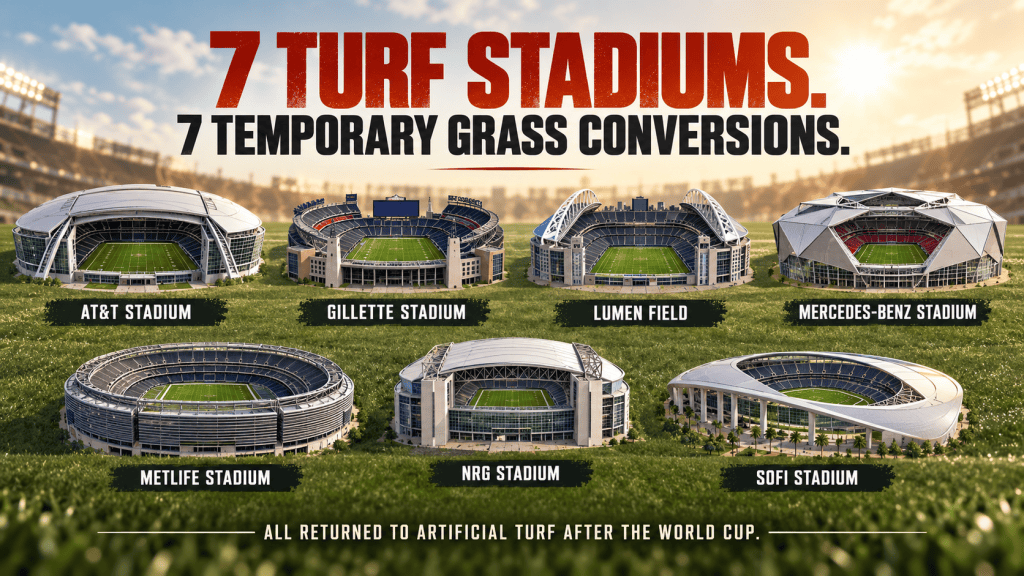
The stadiums, and the teams that own them, didn’t dispute that the grass conversions worked well enough to host a World Cup. They just declined to keep the grass.
“The stadiums, and the teams that own them, didn’t dispute that the grass conversions worked well enough to host a World Cup. They just declined to keep the grass.”
A question the league has already answered for itself
The turf-versus-grass fight has run for years on a genuinely contested premise: does the surface actually cause more injuries, or is it a perception problem? Both sides have data, and — sourcing note — they are not always measuring the same thing, which is worth being precise about rather than picking a side by omission.
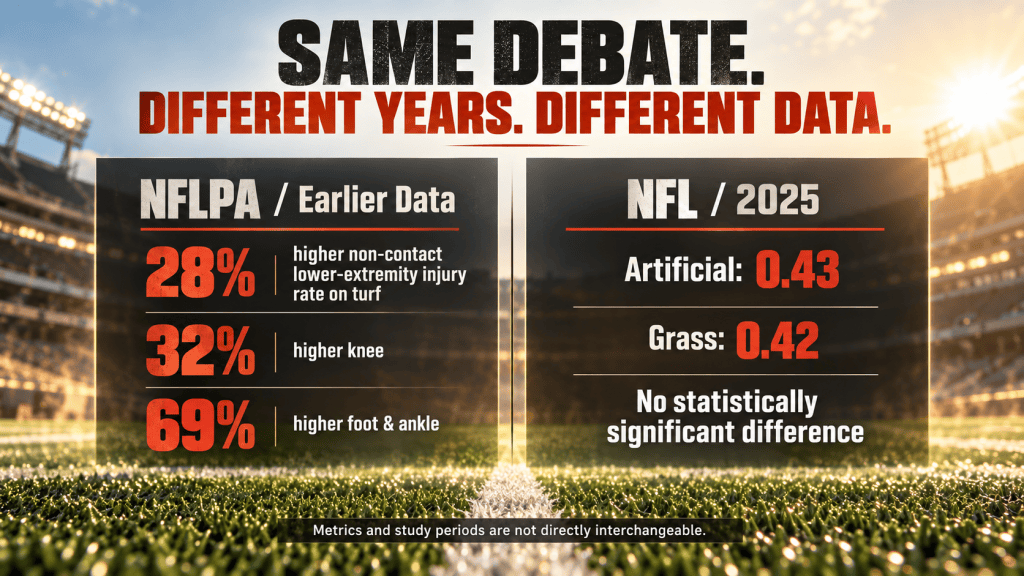
The NFLPA’s numbers, drawn from league injury data and published in a 2020 open letter by then-union president JC Tretter — who now runs the union outright, having been elected NFLPA executive director this past March — found a 28% higher rate of non-contact lower-extremity injuries on turf compared to grass, with the gap widest on the injuries that plausibly track back to surface mechanics: a 32% higher rate of non-contact knee injuries, and a 69% higher rate of non-contact foot and ankle injuries. Tretter’s explanation is a physics argument, not a vibes argument — grass gives at high force and rotation, releasing a planted cleat before the load reaches injury threshold, where synthetic surfaces don’t give the same way and push that force into the ankle, knee and foot instead.
Independent research backs the direction of that finding, if not always the magnitude. A 2024 peer-reviewed study in The Orthopaedic Journal of Sports Medicine, from researchers at UCSF, examined 718 lower-extremity injuries across the 2021 and 2022 seasons and found an injury rate of 1.42 per game on turf versus 1.22 on grass — and, more significantly, that the odds of a season-ending, surgery-requiring injury were 60% higher on turf (odds ratio 1.60, 95% CI 1.28–1.99), a relationship that held up after adjusting for weather, age, position and injury history.
The league’s own numbers tell a different story, and this is the discrepancy worth sitting with rather than smoothing over: the NFL’s 2025 season data found no statistically significant gap between turf (0.43) and grass (0.42) on what the league specifically defines as time-loss, non-direct-contact injuries — the same category of injury the union’s numbers target — a finding it has now published for three consecutive seasons, with 2022 the exception, when the league’s own committee (a joint NFL-NFLPA effort using a third-party firm, IQVIA) found a real gap, 0.048 non-contact injuries per 100 plays on turf against 0.035 on grass. NFL field director Nick Pappas put the league’s current position plainly this summer: “When we look at the injury rate and the severity of injury… it becomes just the injury rate of playing football at this point.” The two conclusions aren’t measuring the same thing so much as drawing on different datasets and different seasons — the union’s figures trace to internal NFL injury data from 2012–2018, the UCSF study below covers 2021–2022, and the league’s newest numbers cover 2025 — so the discrepancy is less a smoking gun than a sign that this data is genuinely unsettled year to year, in a way that lets each side lead with the years that favor it.
“The discrepancy is less a smoking gun than a sign that this data is genuinely unsettled year to year, in a way that lets each side lead with the years that favor it.”
What’s harder to wave away is the World Cup itself, because it wasn’t a study. It was 11 NFL stadiums running the actual experiment the league says is too complicated to run — pitch complaints and all. FIFA required grass; the stadiums got grass, on a compressed installation timeline, and hosted a global tournament on it. “If stadiums can make grass work for the World Cup, they can make it work for NFL players,” Miami’s Laremy Tunsil posted, tagging the union’s new campaign hashtag, #WorthTheCost. Green Bay linebacker Zaire Franklin: “The cost of doing nothing is paid for by players’ bodies. Make grass mandatory.” George Kittle, watching the World Cup final played on grass at what’s normally his own SoFi Stadium turf: “Clearly, we know it’s possible… wonder if we could get that all season.”
It’s also worth separating two different arguments that get bundled together in this debate, because the injury-rate dispute above doesn’t actually resolve the second one. Even if a reader takes the NFL’s numbers at face value and believes turf and grass produce statistically similar injury rates in a given season, that says nothing about what happened in Nashville: a 157-degree playing surface and cleats coming apart in real time are a field-quality and heat-safety problem, not an injury-incidence statistic, and the season-long numbers don’t touch it either way.
The NFLPA’s own framing of the summer was blunter than any individual player’s. “The temporary installation of natural grass fields for the World Cup is a choice by certain NFL team owners to do for soccer players what they refuse to do for NFL players,” the union said in a statement. “It’s no longer a question of capability: the technology exists, the expertise exists, and the resources exist.”
Why owners actually keep the turf
Set the injury data aside for a moment, because it’s not really what’s driving the decision on the ownership side — the economics are. Former Patriots safety Devin McCourty, now retired and covering the league, said the quiet part out loud this summer: “The owners don’t want to pay for the upkeep of a grass field. They want to be able in the offseason to have all of these different events at their stadium… You can place so many different things over it. You could do a rodeo over it; you can do a monster truck show over it.”

That’s the actual tradeoff. A synthetic surface tolerates concerts, monster trucks, college and high-school games, and back-to-back non-NFL bookings without the multi-week recovery period natural grass needs after heavy use. It doesn’t die in a heat dome, doesn’t need re-sodding after a rough November stretch, and doesn’t produce a bare patch at midfield that a kicker’s plant foot can find. For a stadium operator running a building 200-plus days a year rather than 10 NFL Sundays, turf is a scheduling tool as much as a playing surface — and that logic doesn’t disappear just because the World Cup proved the alternative is buildable. It just gets weighed against a cost the owners don’t bear directly: the players’ bodies.
“For a stadium operator running a building 200-plus days a year rather than 10 NFL Sundays, turf is a scheduling tool as much as a playing surface.”
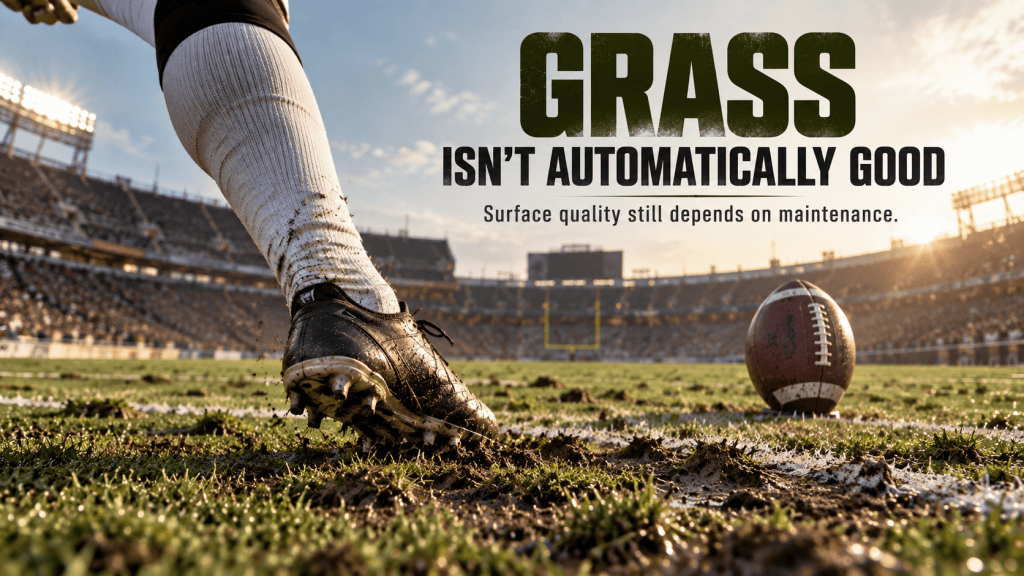
Grass isn’t automatically the safer choice by default, either, which is the nuance the league leans on and the union doesn’t love to dwell on. Pittsburgh’s Acrisure Stadium plays on natural grass and still finished dead last overall in the NFLPA’s most recent team report cards, with its field graded last among all 32 teams “by a wide margin.” The Steelers share the field with Pitt’s college team, and by an October 12, 2025 game against the Browns, the surface between the 30-yard lines had deteriorated badly enough that kicker Chris Boswell appeared to lose his footing — his plant foot seemed to briefly sink into the turf — on a missed 54-yard field goal, special-teams captain Miles Killebrew suffered a season-ending knee injury that teammates attributed to the field, and Aaron Rodgers called it “borderline unplayable.” That was the field’s last game before the grounds crew tore it up for a mid-season resod. Rooney has since committed to a full resurfacing with Tahoma 31 Bermuda, the same cold-hardy blend now used in Philadelphia and Chicago. The lesson there isn’t “grass fails too” — it’s that grass has to be maintained like the asset it is, and an owner who won’t fund upkeep will produce a bad field regardless of what’s growing on it.
“Grass has to be maintained like the asset it is, and an owner who won’t fund upkeep will produce a bad field regardless of what’s growing on it.”
The report card the union wasn’t supposed to publish
This is where the fight stopped being a preference argument and became something closer to leverage. For the first time, the NFLPA’s annual team report cards — based on a survey of 1,759 players conducted in late 2025 — graded home playing field as its own category, turning years of “92% of players prefer grass” sentiment into a specific, public, team-by-team grade. In February, an arbitrator ruled that publishing the report cards violated the CBA and ordered the union to keep them internal; ESPN obtained and published the full results anyway. The Steelers finished dead last overall for the first time in the survey’s four-year history, with failing grades across several categories — field, locker room, team travel, treatment of families — rather than surface quality alone. Miami finished fourth in home-field quality specifically, with players crediting the natural grass at Hard Rock Stadium.
That grade doesn’t stay inside the locker room. It’s the kind of document an agent puts in front of a team’s negotiators when a free agent is choosing between two comparable offers — a searchable, citable record of which organizations the players’ own union says are failing them on a basic condition of employment. Pittsburgh, one of the most institutionally respected franchises in the league, responded to a last-place grade by committing to a full resurfacing. That’s the mechanism working as designed: not sentiment, a scoreboard.
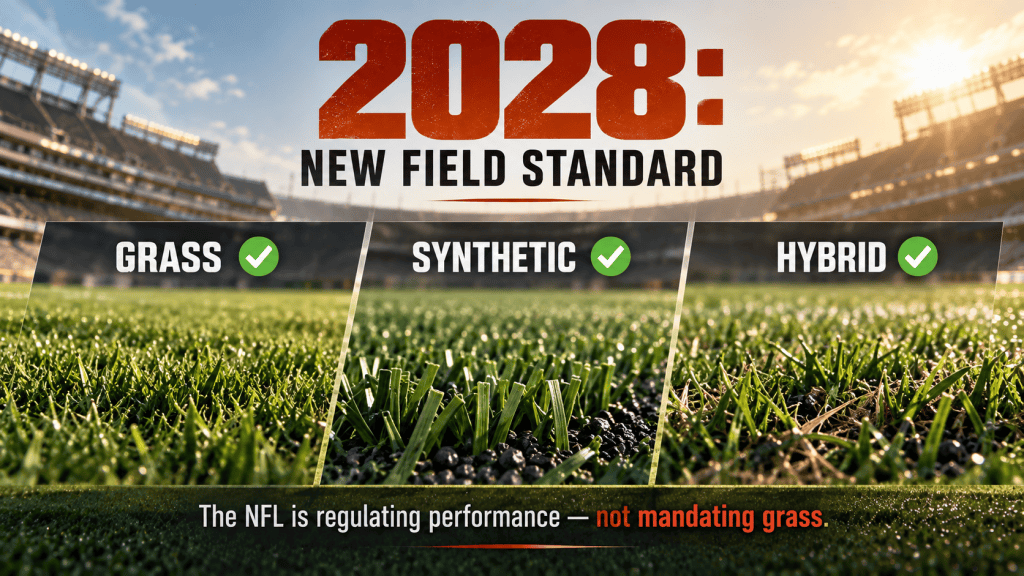
The league has also, separately, moved: in December 2025, the NFL announced every stadium’s existing surface — turf, hybrid or grass — must be replaced by the end of the 2027 season with a field that meets new lab- and field-tested standards, an acknowledgment that “it’s just football” isn’t holding as an answer anymore. But it is explicitly not a grass mandate. NFL field director Nick Pappas said clubs will simply choose from “a library of approved and accredited NFL fields,” whatever the material, and chief medical officer Dr. Allen Sills was blunt about why: injury data, he said, shows no statistically significant difference in lower-extremity injuries between surface types once you’re looking at fields that actually meet the standard. That’s the league’s real position in a sentence — not that turf is fine, but that a good field beats the material argument, and it would rather regulate field quality than concede the surface fight the union keeps having in public.
What Nashville actually proves
“That trade — consistency for the operator, danger for the players in the conditions that actually show up — is the whole argument in miniature.”
None of this makes Nissan Stadium’s Sunday an outlier so much as a preview of what every remaining turf building is going to look like more often, on a warming climate’s schedule, until something changes. The Titans left grass for turf in 2023 specifically to solve a maintenance headache — Nashville’s climate makes grass hard to keep in game condition through a full season, and the switch bought them a surface that doesn’t need re-sodding. It also bought them a surface that hit 157 degrees under a heat dome and started dissolving the players’ equipment. That trade — consistency for the operator, danger for the players in the conditions that actually show up — is the whole argument in miniature.
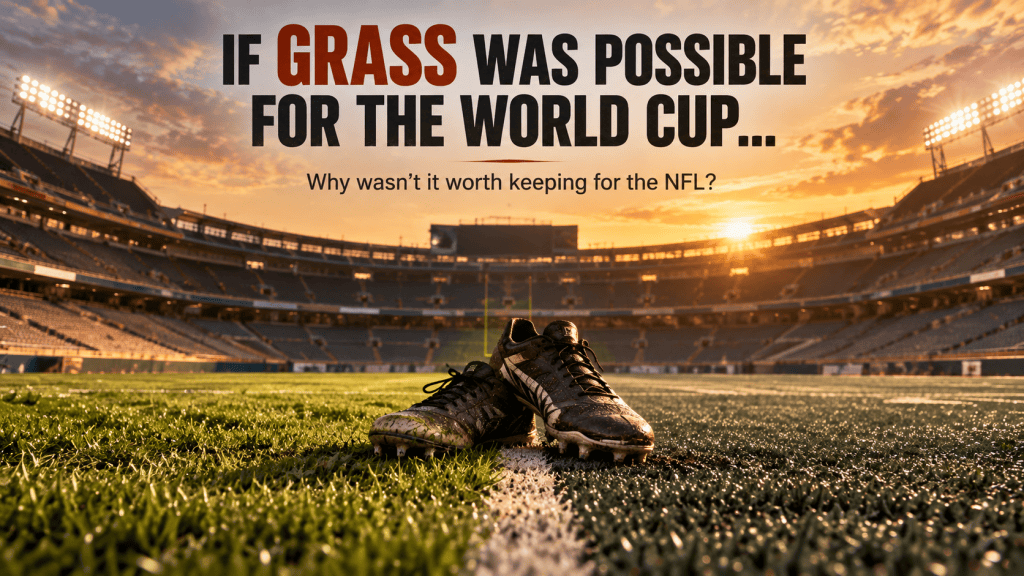
The league spent a summer proving, at FIFA’s insistence and on FIFA’s schedule, that the “it’s too hard” objection doesn’t hold up. Then it put the turf back the moment the mandate expired. The players noticed, said so publicly and repeatedly, and built a union report card designed to make sure the point doesn’t go away quietly. Nashville just gave that argument its most literal image yet: a league office confident enough in its own aggregate injury numbers to keep the artificial surface, and players spraying water on their cleats to keep them from melting on it.
Sources: Reporting on Sunday’s Titans-Eagles game and the 157-degree turf reading is drawn from ESPN, Yahoo Sports and Eagles Wire. Injury-rate data comes from the NFL’s own “2025 Season Key Takeaways” (NFL.com), the NFL-NFLPA joint 2022 surface report as covered by Fox News, the NFLPA’s 2020 open letter from then-president JC Tretter (nflpa.com), and the peer-reviewed 2024 study by Venishetty, Xiao, Ghanta, Reddy, Pandya and Feeley in the Orthopaedic Journal of Sports Medicine. World Cup conversion details and player reaction are sourced to Yahoo Sports, the Los Angeles Times, Reuters, Forbes and the Sporting News. NFLPA report-card results and the arbitrator ruling are drawn from ESPN’s Kalyn Kahler, Sportico, CBS Sports and NBC Sports’ Pro Football Talk. The Acrisure Stadium field incident is sourced to the Pittsburgh Post-Gazette, ESPN and Yahoo Sports/Steelers Now. The NFL’s new field-standard mandate is drawn from NFL.com, Reuters and Fox Sports. Tretter’s current role and the Bengals’ and Titans’ surface histories are confirmed via the NFLPA, ESPN and Wikipedia stadium records.
 Sports & Whatever
Leave a comment