By Michael Phillips | Sports & Whatever
Two days before the Premier Lacrosse League crowns its 2026 champion, Fox’s John Roberts spent the morning teasing a segment that had nothing to do with a box score. Alison Crowther, the mother of a Boston College lacrosse player who has been dead for 25 years, was coming on “America’s Newsroom” alongside PLL co-founder Paul Rabil to talk about an award that bears her son’s name. It is the kind of booking that makes no sense in a sports media landscape built on hot takes and injury reports — until you remember that Welles Crowther has never really left the sport that shaped him. He has just kept finding new ways to reenter it.
Ten days earlier, President Trump had posthumously awarded Crowther the Presidential Medal of Freedom, the nation’s highest civilian honor, at a White House ceremony on the Ellipse marking the 25th anniversary of September 11. Now the Premier Lacrosse League — in its eighth season, built in part by former college and pro standouts who grew up idolizing exactly the kind of player Crowther was — was using its championship weekend to put his name back in front of a national sports audience, via its Welles Crowther Humanitarian Award. The two moments, a week and a half apart, are really one story: a 24-year-old equities trader who once wore No. 19 for Boston College has become one of the most durable crossover figures in American sports and civic memory, and lacrosse — a sport that still fights for oxygen in the national conversation — has spent nearly a quarter-century refusing to let him be forgotten by anyone else.
“Welles Crowther has never really left the sport that shaped him. He has just kept finding new ways to reenter it.”
The Facts, Stated Plainly
“Lacrosse — a sport that still fights for oxygen in the national conversation — has spent nearly a quarter-century refusing to let him be forgotten by
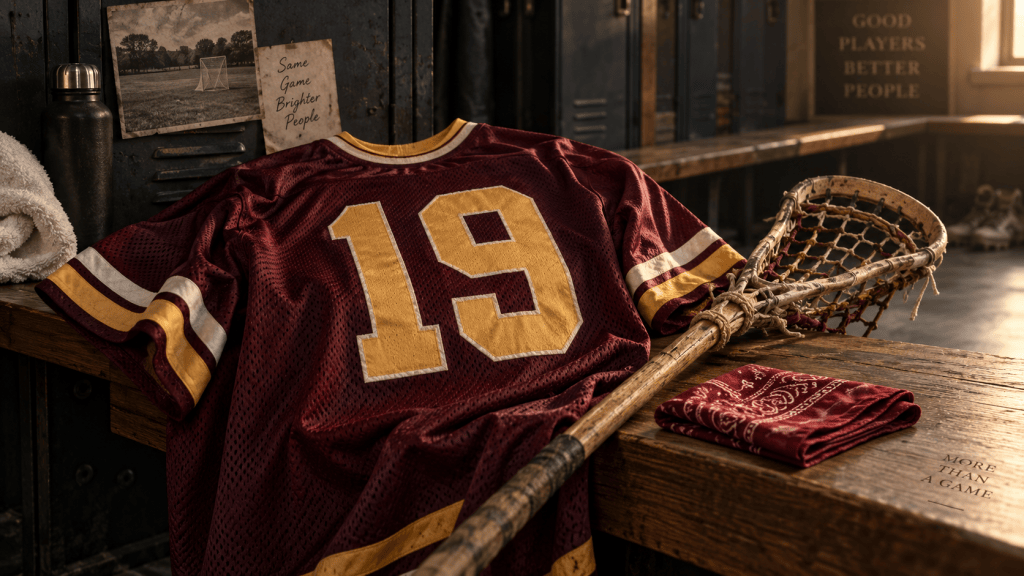
Welles Remy Crowther was born in New York City in 1977 and raised in Upper Nyack, New York, the son of Jefferson Crowther, a volunteer firefighter with the Empire Hook and Ladder Company Number One. Welles followed him into the department as a volunteer while still in high school, and the red bandana that would later define his death started as a gift — his father gave him a red one at age six, a dress one for church at seven, and Welles carried them both for the rest of his life, tucked into a back pocket or a helmet, according to accounts from the National September 11 Memorial & Museum.
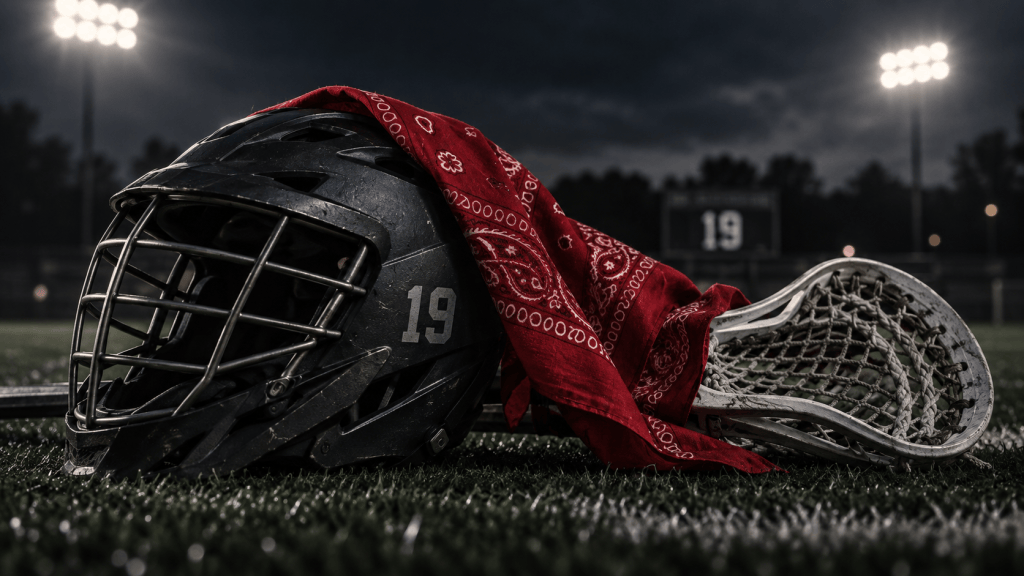
He played lacrosse at Boston College, wearing No. 19, and graduated in 1999 with an economics degree. He had interned at the investment bank Sandler O’Neill & Partners in the summer of 1997, then spent the following summer in Spain studying foreign markets through a Syracuse University program, before joining Sandler O’Neill full-time after graduation, working first in equities research before earning his Series 7 license and moving to the equities trading desk on the 104th floor of 2 World Trade Center, the South Tower. He was 24 years old on the morning of September 11, 2001, when United Airlines Flight 175 struck the tower between the 77th and 85th floors. Sixty-four of his Sandler O’Neill colleagues died that morning.
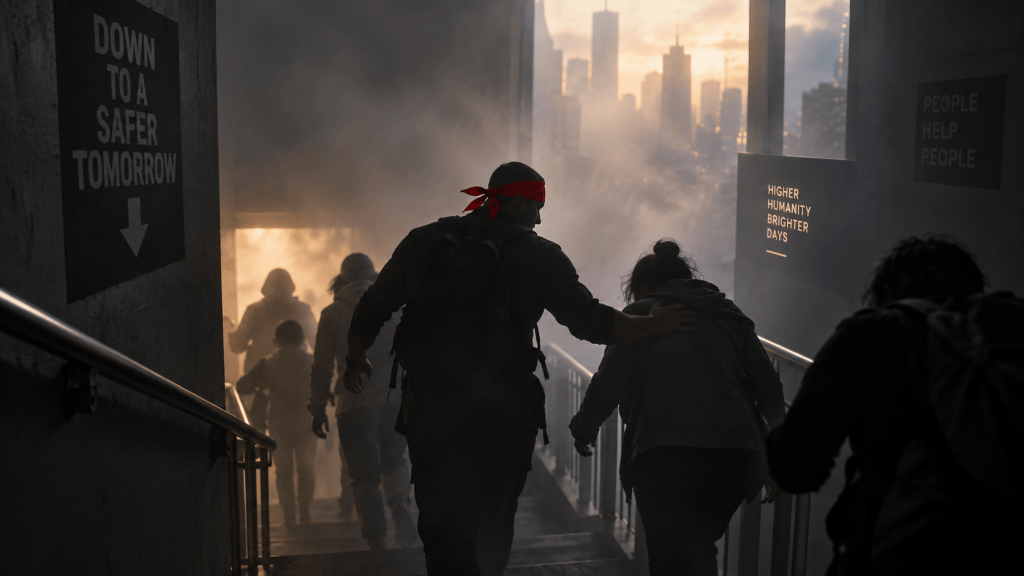
What happened next has been documented by the National September 11 Memorial & Museum, in Tom Rinaldi’s book and ESPN documentary “The Man in the Red Bandana,” and in survivor testimony collected in the years since: rather than evacuate, Crowther made his way down to the 78th-floor sky lobby, where dozens of injured and disoriented survivors had gathered with no clear way out. Covering his nose and mouth with the red bandana to filter smoke, he located one of the only passable stairwells and began leading people down it, making three trips to the sky lobby by the Memorial’s account, and reportedly carrying at least one injured woman on his back for several flights. Survivors Ling Young and Judy Wein were among those who later credited an unnamed man in a red bandana with saving their lives. He is credited with helping save as many as 18 people. He was last seen heading back into the building shortly before the tower collapsed. His remains were recovered on March 19, 2002, alongside FDNY firefighters and emergency personnel who had been operating a command center in the South Tower lobby — a discovery that helped explain, for his family, why he never made it out.
For nearly a year, Crowther’s own family did not know the specifics of what he had done. It was a 2002 New York Times account, piecing together survivor testimony about a man in a red bandana, that led his mother Alison to recognize her son in the story — a detail she has since said was, in its own way, a gift: proof of how her son chose to spend his final hour. That gap between the act and the recognition of it has itself become part of how the story gets told and retold; the 2017 documentary “Man in Red Bandana,” narrated by Gwyneth Paltrow and directed by Matthew Weiss, builds its entire structure around that mystery, following the survivors — including Ling Young, Judy Wein, and Kelly Reyher — as they eventually connect the man who saved them to a name and a family.
A Sport That Never Let Go

What separates Crowther’s legacy from countless other stories of 9/11 heroism is how completely one institution — competitive lacrosse — has institutionalized his memory rather than simply marking his death once a year.
Boston College has staged an annual “Red Bandana Game” in football, with the team wearing special uniforms referencing Crowther’s number and bandana, and the school separately gives out its own Welles Crowther Service Award each year as part of its Ever to Excel Awards, honoring a student who “consistently demonstrates a commitment to service” — an entirely different honor from the PLL’s, run by BC’s Volunteer and Service Learning Center rather than a professional sports league, but drawing on the same well of institutional memory. The Tewaaraton Foundation, which administers college lacrosse’s version of the Heisman Trophy, inducted Crowther as a Spirit of Tewaaraton honoree in 2018. Bill Belichick — a coach not known for public sentimentality — has spoken about Crowther’s story in remarks that reportedly left Alison Crowther in tears, presenting her with a bandana of his own during an appearance tied to the award. The Dropkick Murphys wrote a song, “A Hero Among Many,” inspired by his story. A cybersecurity detection dog in Rockland County was named Remy in his honor. New York City named him an honorary firefighter in 2006.
“What separates Crowther’s legacy from countless other stories of 9/11 heroism is how completely one institution — competitive lacrosse — has institutionalized his memory.”
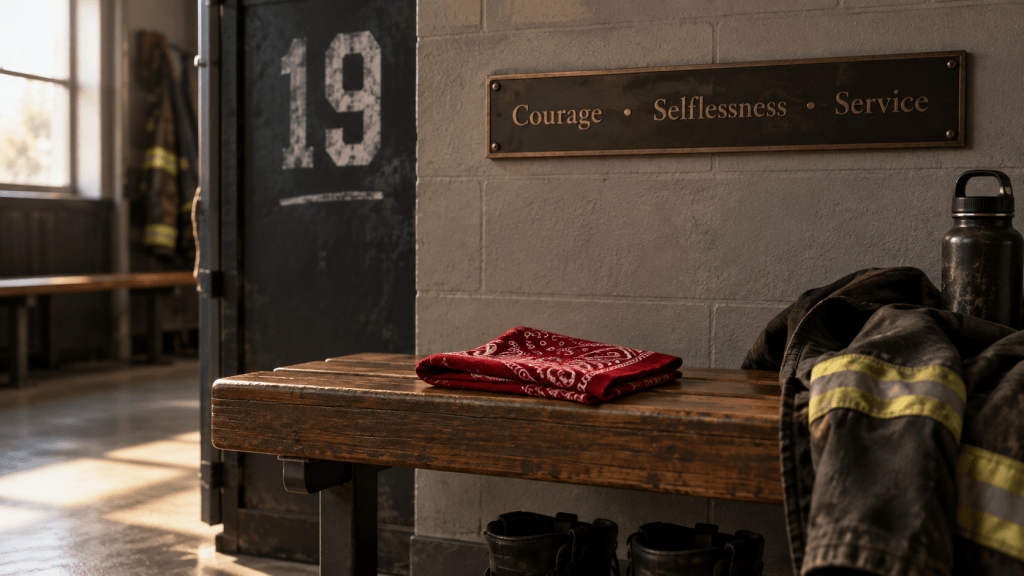
The Premier Lacrosse League folded Crowther into its institutional memory from its first season. The Welles Crowther Humanitarian Award has been part of the league’s awards tradition since the PLL’s 2019 launch, given to a player whose off-field conduct reflects “courage, selflessness and service to others” — the same three words that recur, with minor variation, in nearly every official description of Crowther himself. Past winners include Scott Ratliff (2019, the inaugural honoree), Lyle Thompson (2021 and 2022, for his advocacy around the treatment of Indigenous children in Canada’s residential school system), Eric Law (2023), and Romar Dennis (2024 and 2025, back-to-back, as a California Redwoods midfielder who said he simply never learned to say no to a community-service ask). The league also sells an official Nike Dri-FIT Red Bandana tee through its team shop, with 10 percent of proceeds benefiting the Welles Remy Crowther Charitable Trust — a small but telling sign that this isn’t an old award the league merely lists on a webpage, but something actively worked into its current commercial identity.

That a sport with a fraction of the media footprint of the NFL or NBA has sustained a humanitarian award named for a specific, non-player individual since its inaugural season says something about lacrosse’s self-conception — a sport whose modern professional era is still young enough that its origin myths are being actively written, and that has chosen, repeatedly, to write Crowther into them.
The Medal, and What It Changes

The Presidential Medal of Freedom ceremony on September 8 was not really new information — Crowther’s story has been public, and honored, for two decades. What it did was formalize, at the highest level the federal government offers, something the lacrosse world and the 9/11 memorial community had already concluded. Trump had first announced the award in May 2026 at a rally in Rockland County, New York — Crowther’s home turf — appearing alongside Rep. Mike Lawler (R-N.Y.), who had pushed for federal recognition of Crowther’s actions. The formal presentation came four months later, folded into a Tunnel to Towers Foundation “Steel Across America” event that brought a 16,900-pound steel beam recovered from Ground Zero to the White House Ellipse, timed to the 25th anniversary of the attacks.
“The medal does not change the historical record of what Crowther did. What it changes is reach.”
Alison Crowther and Crowther’s sister, Paige Crowther Charbonneau, accepted the medal on his behalf. “This means the world to me, my daughters, Paige and Honor, and our entire family,” Alison Crowther said at the ceremony. “This will be treasured for generations to come.”
The medal does not change the historical record of what Crowther did. What it changes is reach — a Medal of Freedom ceremony draws a different, wider audience than a college football uniform choice or a lacrosse awards banquet, and it is that wider audience the PLL appears to be courting by putting Alison Crowther in front of a national cable news audience ten days later, ahead of a championship weekend that will otherwise be fighting for attention against NFL Sundays and the tail end of college football’s opening month.
Why This Belongs in a Sports Story
It would be easy to treat Crowther’s story as belonging to 9/11 coverage rather than sports coverage — a heroism narrative that happens to have a lacrosse detail attached. That undersells what the lacrosse world itself has decided about him. Every institutional choice made by Boston College, the Tewaaraton Foundation, and the PLL over the past two decades has been a deliberate act of claiming him as one of their own, not merely a person who once played the sport before his death made him famous for something else.
That distinction matters for what happens this weekend. The PLL closes its 2026 season Sunday, September 20, when the PLL U.S. Bank Championship airs from Sports Illustrated Stadium in Harrison, New Jersey, capping a season that began May 8. The league named finalists for its full 2026 Lexus End of Year Awards slate on September 2, sending a second round of balloting to PLL coaches and general managers, members of the Professional Lacrosse Hall of Fame, the league’s front office and advisors, and select media, ahead of winners being revealed today, September 18, in New York City. The three finalists for this year’s Welles Crowther Humanitarian Award are Trevor Baptiste, the New York Atlas faceoff specialist and a past league MVP, and two Utah Archers teammates, Piper Bond and Mason Woodward. Roberts’ segment with Alison Crowther and Paul Rabil, taped ahead of that announcement, functioned as a preview of an announcement the league had not yet made public — the specific 2026 recipient was not named as of this writing.
“Crowther has become shorthand for the kind of athlete the PLL wants to be associated with.”
A championship-week story about equities trading or emergency stairwell evacuation would be journalism. A championship-week story about the humanitarian award a professional lacrosse league has spent its entire history defending, in a young sport still establishing which values it wants attached to its name, is something closer to what the league itself is trying to say about itself. Crowther has become shorthand for the kind of athlete the PLL wants to be associated with, in the same way the Boiardi and Regan and Looney awards on the same ballot each memorialize a different, specific kind of sacrifice pulled from lacrosse’s own ranks.

 Sports & Whatever
Leave a comment