By Greg Visscher | Sports & Whatever
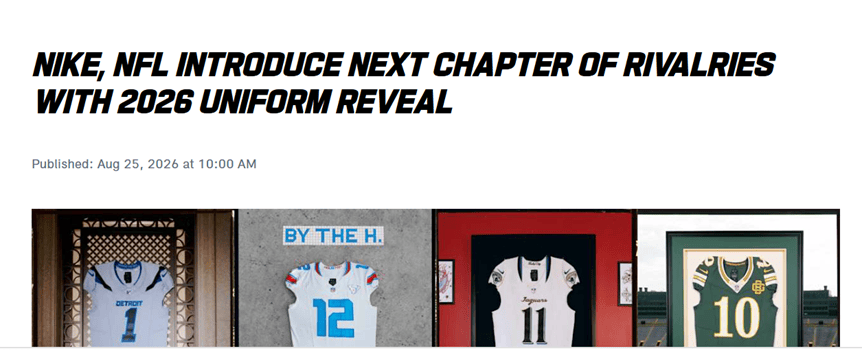
The NFL and corporate partner Nike, Inc. rolled out the second year of their “Rivalry” 2026 uniform program last month – a promotion so successful last year that it became Fanatics’ best-selling merchandise release to date:
And in a recent advertisement for the Washington Commanders vs. Philadelphia Eagles on NFL Kickoff Sunday (September 13th), I noticed Fox Sports gave the broadcast of the game the tagline “Rivalry Renewed”, or some such title.
But my argument is that “rivalries” in the National Football League in 2026 are a husk, a shell of themselves compared to the mid-1990s or even the Tom Brady-Peyton Manning rivalry era of the 2000s and early-to-mid 2010s. Perhaps the current AFC North division is the exception, though I welcome dissenting opinions.
“The NFL is trying to sell the history of rivalries while increasingly removing the continuity that made those rivalries matter.”
Who gets the blame? There are a number of factors for this sad, current state of essentially rivalry-free football. All of which could be addressed… but likely will not because of short-term focused media attention, high time preference among ownership groups, greed, and competing professional and business interests – not the base football fan’s interests.
Chief among the causes of pro football “rivalry erosion” in the sport is the salary cap on team player payrolls.
Yes, the salary “cap” has assisted in making the NFL unpredictable at times and brought more talent parity across the league. And yes, the salary cap, as instituted, is being aggressively manipulated within the rules anyway (go look at how the Philadelphia Eagles and other franchises do it via pro-rated signing bonuses, restructures, and other cap can-kicking measures) – but the salary cap, at root, is an excuse for player cuts used by many (yes, not all) pro franchise owners (billionaires). It is an excuse to justify jettisoning established, proven veterans in favor of cheaper labor replacement. Or alternatively, the “cap” is used to justify the one-year veteran deal, not a long-term commitment.
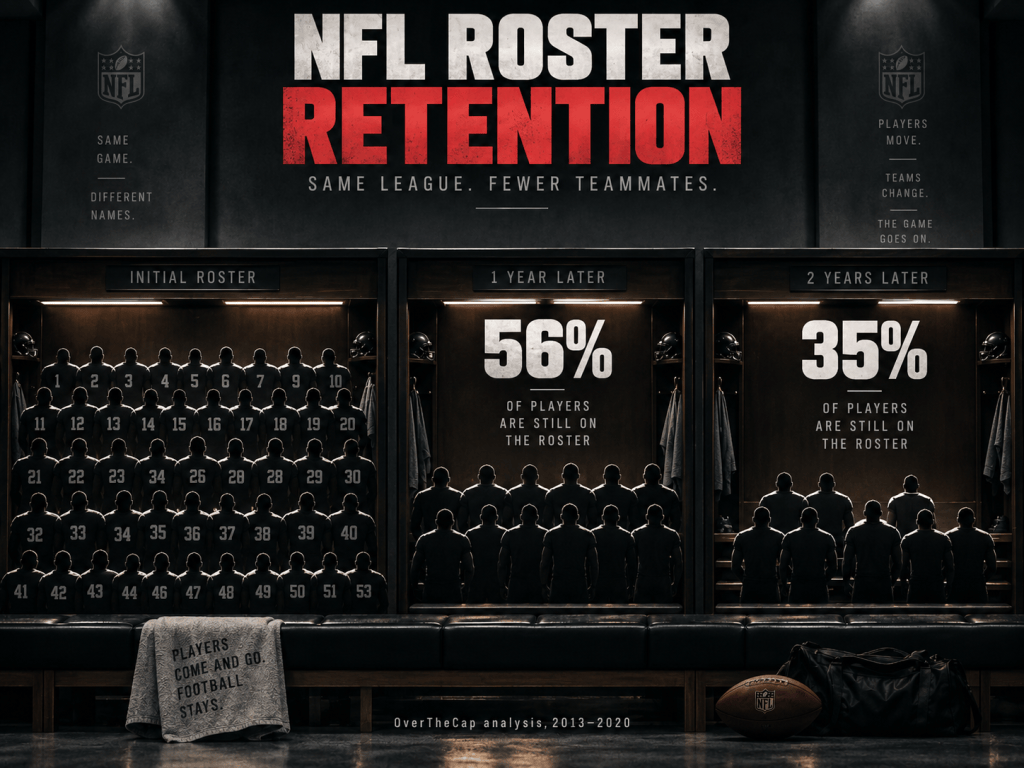
According to an article and analysis of rosters from 2013 through 2020, published a few years ago (April, 2022) by OverTheCap.com’s Jason Fitzgerald, “a quarter of the [NFL] teams will hold over 62% and usually one team a year is around 70% [roster retention of the prior year’s players].” Fitzgerald then goes on to the ‘money’ quote of the piece/analysis:
“To say NFL rosters are unstable is certainly an understatement. On average only 56% of players return from one year to the next and two years out it is just around 35%.”
To be fair to the league, OverTheCap’s more recent team-by-team turnover tracking shows retention has actually climbed back up since that 2013-2020 window – NFL-average retention was closer to 60% in 2024 and over 71% in 2025. That does not undo the larger point about churn and rivalry continuity, but it is worth acknowledging the trend line has not simply worsened in a straight line since 2022.
“On average only 56% of players return from one year to the next and two years out it is just around 35%.”
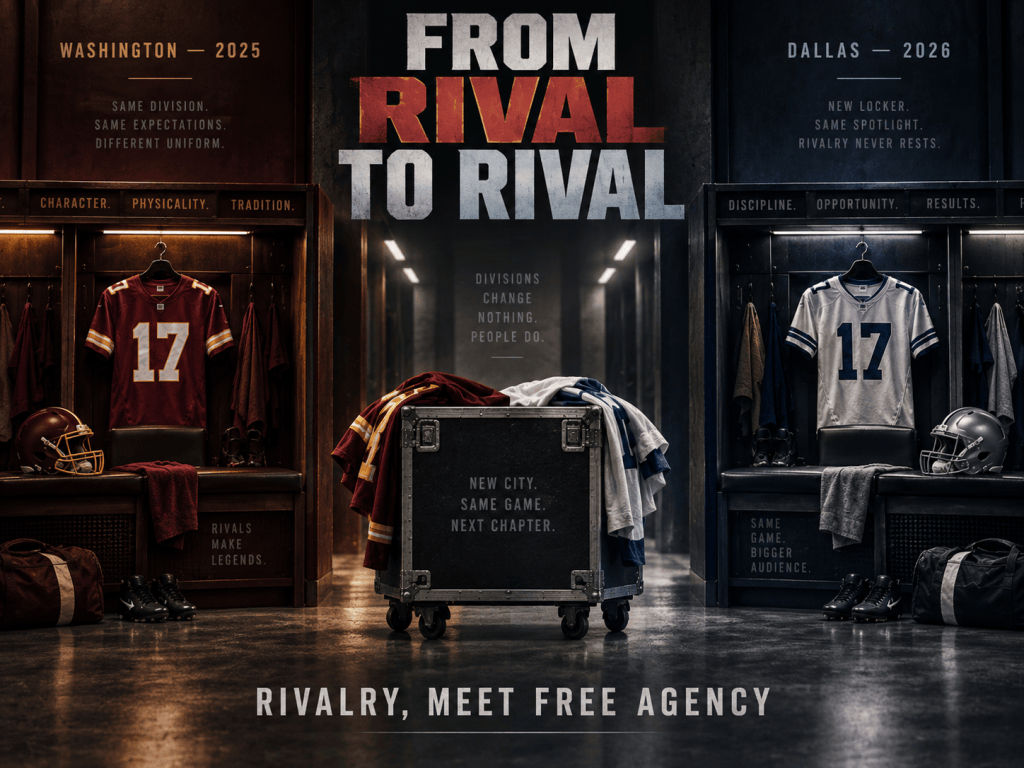
This ridiculous level of churn is justified as “owners and GMs just wanting to win,” but it really should be called what it is – a constant attempt to replace proven veteran players, often community-linked guys, with cheaper youth labor or more “flexible” contract labor. This is why the one-year vet deal is all “in vogue” right now and also why a guy like Von Miller can sign with Washington’s franchise and then hop the next year to the “rival” Dallas Cowboys. Clearly the “rivalry” between the two teams was only contract paper-thin in his eyes.
“Clearly the ‘rivalry’ between the two teams was only contract-paper thin in his eyes.”
The one small caveat to this crazy roster churn is the quarterback position, but we see even this position isn’t immune to constant change and turnover, particularly with impatient ownership groups. This season, roughly a quarter of the league is trotting out a different Week 1 starting quarterback than it had a year ago – Miami, the Jets, Las Vegas, Arizona and Minnesota among them, with Atlanta the latest addition after an injury forced a last-minute change just days before kickoff.
And, yes, sometimes the payroll cap-induced roster overhaul is also simply punishing a team for their “sins of the free agent past” – but that is also a dumb reason to break up community-oriented, franchise cornerstone guys from teams – the very men who help craft the rivalries the NFL is selling! These men (again, generally not QBs) have simply earned a bit more “market value” for their labor through outstanding on-field play coupled with tremendous community and fan support. If they are willing and want to stay and play for a team, why does the franchise get punished, financially via the cap, for it? This is backwards. And yet the NFL does pretty much nothing to try and address it.
The obvious defense of the modern NFL’s cap system is that it manufactures the parity fans actually want – no team can just buy a decade of dominance, and free agency gives players real leverage over their careers. There’s something to that. But it’s not the whole story: leagues without a hard cap, like MLB, have managed relative competitive balance too, at least until a club like the Los Angeles Dodgers comes along and starts assembling a roster few franchises can touch. So parity isn’t purely a function of the cap – and the loss of real rivalries in the NFL still looks less like a side effect of competitive balance than a byproduct of the short-term “win now, worry later” planning the cap has encouraged almost everywhere outside the quarterback position.
A perfect example of this is former longtime Washington Redskin Lorenzo Alexander, aka “One Man Gang,” who wanted to stay in Washington, D.C. (where he had established strong community bonds and an exemplary non-profit foundation).
“If they are willing and want to stay and play for a team, why does the franchise get punished, financially via the cap, for it?”
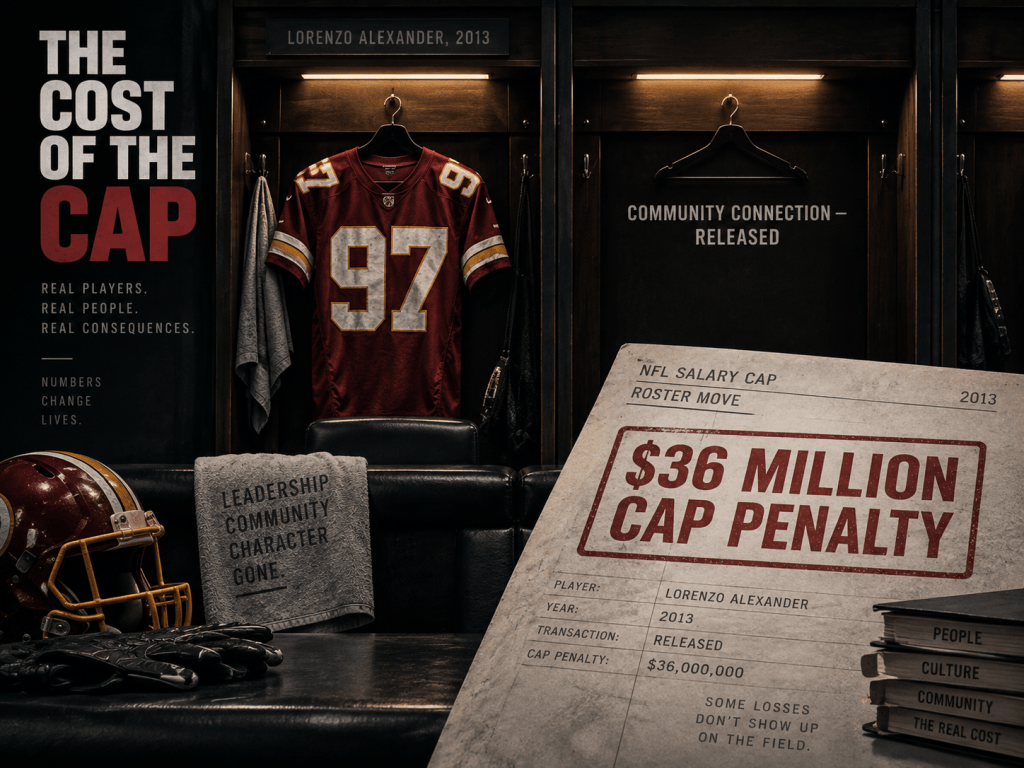
Alexander became an unrestricted free agent after the 2012 season. Per contemporaneous Washington Post reporting, he said the Redskins first discussed a three-year, $7.5 million offer with $2.6 million guaranteed, then cut the guarantee to $1.4 million with no explanation; a team spokesman disputed his account. The Post separately reported that Washington’s $36 million salary-cap penalty for the 2012 and 2013 seasons directly cost the team the ability to retain him.
When franchise billionaire owners do this, year after year, the rivalry of this great sport becomes increasingly hollowed-out. There is a steady compounding effect until NFL rivalries are a shell of what they once were – no matter how much the league tries to market it. What makes a sports rivalry incredible is the energy, passion, tradition, and yes – the historical story arc and consistency of the men in the script that appears each year leading up to the sporting contests. There is a “historical story” that matters in any rivalry. It is why, historically, college football had the best sporting rivalries of any North American team sport.
People are engaging in something that transcends the “here-and-now” immediacy of too much of society. If it is a true “rivalry” – it goes back decades, but it is built over “groups of seasons” because the cast of characters in the “play” is familiar to the generation witnessing it, and these football players have strong roots in the community or city that adorns their tailored jersey. A perfect example? The San Francisco 49ers versus Dallas Cowboys: three straight NFC Championship Games from 1992-1994 (with Dallas going on to cap the era with a Super Bowl title after the 1995 season). Teams built through consistent coaching, drafts, and culture. That’s what is missing here, now, in the NFL. The salary “cap” excuse and these (largely) greedy and/or impatient ownership groups are unquestionably a reason why. Coaching staffs turn over at a high rate as well – but this can sometimes spark a rivalry, not quash one.
“A true rivalry goes back decades, but it is built over groups of seasons because the cast of characters is familiar.”
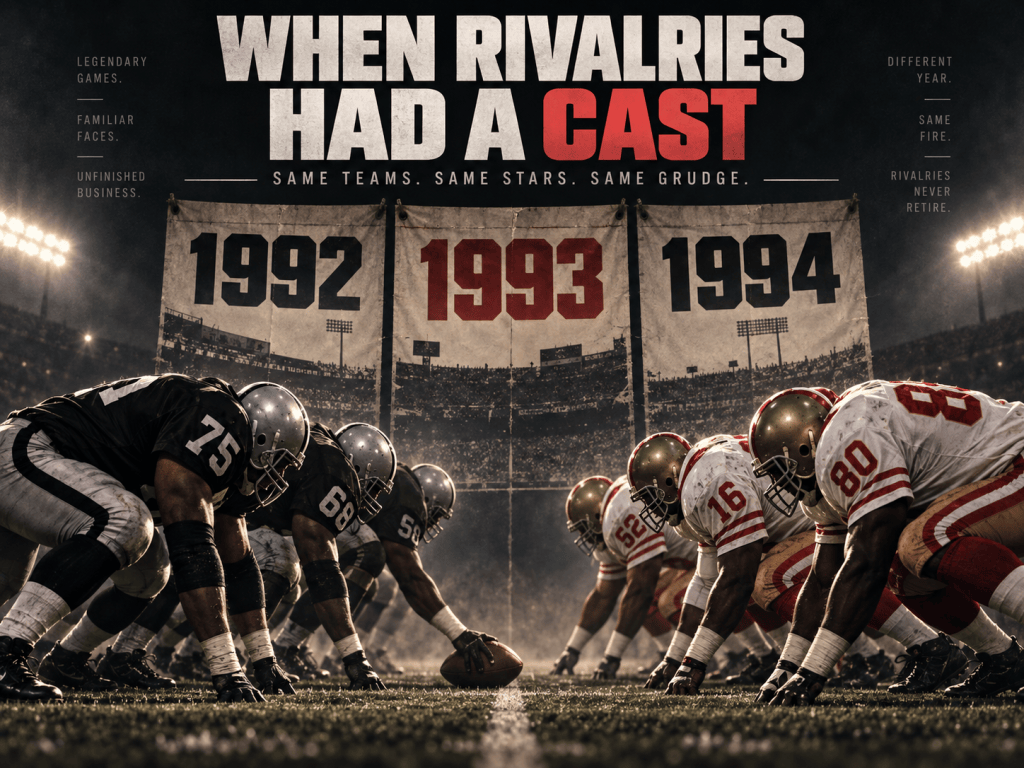
NFL teams used to be about roster development, longer-term team building and the formation of what could be called “indigenous locker room cultures” and monikers. This is largely gone – it could never survive under such constant roster turnover. Worse – this short-termism has now bled into the college game, where a sort of bizarre “hyper free agency” exists and far easier player movement through the transfer portal can create largely remade teams year after year. Can a real rivalry exist in such a culture?
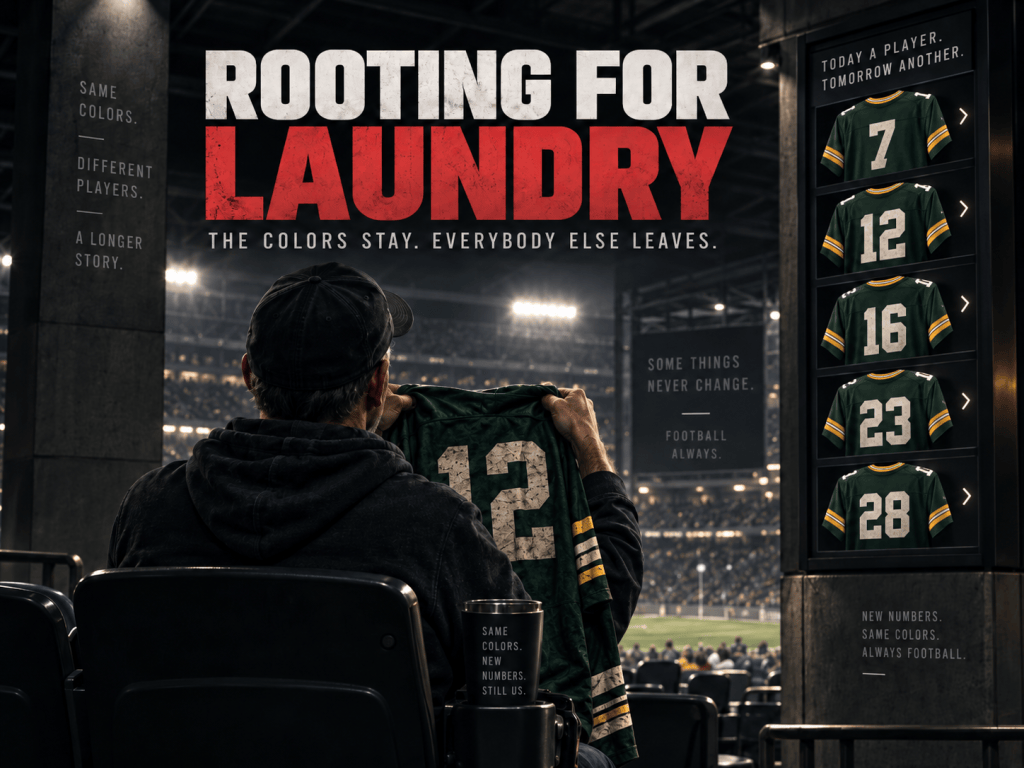
“Jerry Seinfeld joked decades ago that modern sports fans are really just ‘rooting for laundry.’ The NFL increasingly seems determined to prove him right.”
Jerry Seinfeld joked decades ago that modern sports fans are really just “rooting for laundry.” The NFL, while selling us “Rivalries” uniforms, increasingly seems determined to prove him right. Call it sour grapes by this author; this means you, the football fan, are ultimately just cheering and supporting the polyester-blended laundry of millionaires. You may not like Dallas fans or the star logo, but the owners of these long-standing American institutions don’t really care too much about your rivalry with their city or franchise.
They just want you to keep buying the latest laundry of a player who will be gone to a different roster in perhaps two or three seasons – perhaps to that “rival” you claim to revile.
“They just want you to keep buying the latest laundry of a player who will be gone to a different roster in perhaps two or three seasons — perhaps to that ‘rival’ you claim to revile.”
Sources: Nike and the NFL’s August 25, 2026 announcement of the second-year Rivalries uniform program (about.nike.com); Jason Fitzgerald’s OverTheCap.com roster-turnover analyses, including the original April 2022 study and his more recent 2024 and 2025 team-by-team retention data; contemporaneous Washington Post reporting on Lorenzo Alexander’s 2013 departure from Washington and the team’s $36 million salary-cap penalty; wire reporting on Von Miller’s August 2026 signing with the Dallas Cowboys; NFL and team-issued 2026 schedule releases confirming the Commanders-Eagles Week 1 matchup; and current beat reporting on 2026 Week 1 quarterback changes in Miami, New York, Las Vegas, Arizona, Minnesota and Atlanta.
 Sports & Whatever
Leave a comment