Twenty-five years on, the games have kept the tributes. The question is whether the players and fans who never lived that day still feel them.
By Michael Phillips | Sports & Whatever
On May 30, 2026, the NYPD’s Finest shut out the FDNY’s Bravest 14-0 in the 53rd annual Fun City Bowl at Mitchel Field in Uniondale, New York — a rivalry born in a bar argument in 1973, long before either department needed it to mean anything more than bragging rights. Now it means considerably more. The football game began as a lark. It became, after September 11, 2001, something closer to a ritual of institutional grief: a way for two departments that buried hundreds of their own to keep playing, and keep remembering, on a field instead of at a funeral.
Twenty-two members of the FDNY’s own football team — seven then-active players and fifteen alumni — died in the attacks. The team didn’t fold. It couldn’t. The next year, eight months after the towers fell, the Bravest and Finest played again at Giants Stadium in front of 15,000 fans, the players touching a banner that had belonged to their fallen team captain, Durrell “Bronko” Pearsall, before they took the field.
That was 2002. More than five decades into the rivalry, the Fun City Bowl is still raising money for widows’ and children’s funds, still drawing a crowd every spring. But the roster has turned over completely. As ESPN’s Tom Junod wrote after visiting the team for its 20th-anniversary game, the players the Bravest’s head coaches were fielding by then had been children — or not yet born — when their predecessors died. The coaches, nearing retirement themselves, described feeling the weight of a question with no clean answer: how do you keep a memory alive in people who never had it to begin with?
“How do you keep a memory alive in people who never had it to begin with?”
Where It Started: A Home Run and a Canceled Season
The ritual didn’t begin as ritual. It began as improvisation, and two moments from the fall of 2001 set a template the major leagues have followed since.
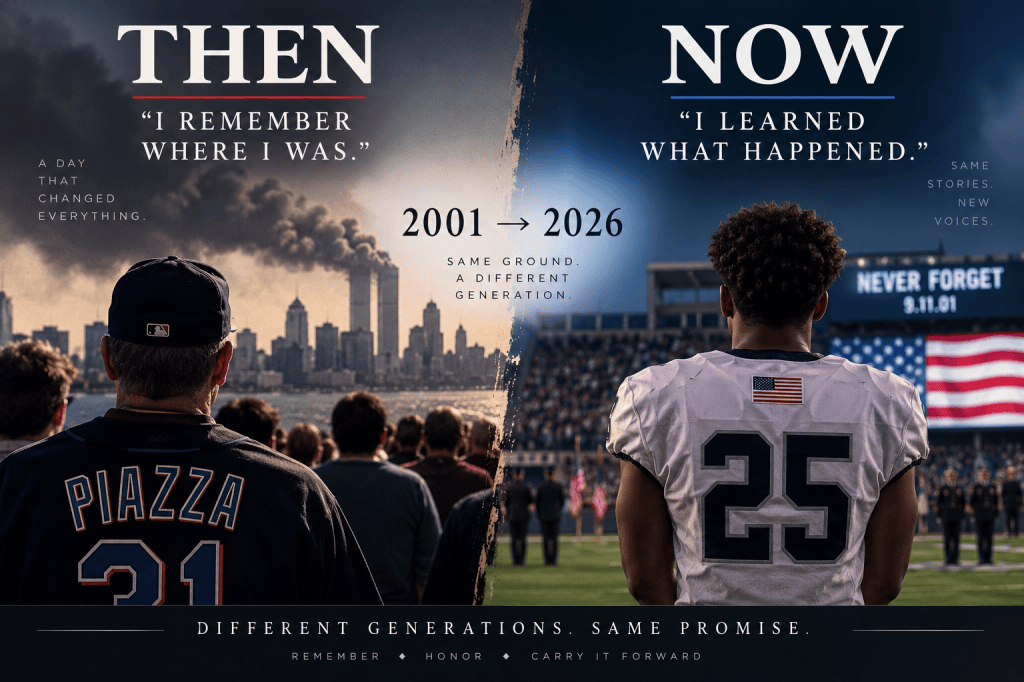
Ten days after the attacks, with lower Manhattan still burning, the Mets hosted the Braves at Shea Stadium in New York’s first professional sports event since 9/11. The Mets were still technically alive in a fading playoff race — five games back of Atlanta in the NL East — but nobody remembers the standings. In the eighth inning, Mike Piazza hit a go-ahead two-run home run that turned into one of the most replayed moments in the sport’s history, not for what it did to the standings but for what it represented: a city being given permission, briefly, to make noise about something other than the towers. The jersey Piazza wore that night has since been displayed at the National September 11 Memorial & Museum and sold at a memorabilia auction, changing hands as a piece of history rather than staying fixed in one place.
Major League Soccer’s response was starker. Commissioner Don Garber, a native New Yorker whose brother worked at 7 World Trade Center, canceled the rest of MLS’s 2001 regular season outright rather than resume play, a decision he’s described as one of the biggest tests of his early tenure. When the league did return for its championship six weeks later, FDNY and NYPD members performed the ceremonial coin toss at MLS Cup 2001 in Columbus — establishing, a year before the Fun City Bowl became explicitly memorial in character, the same first-responder-centered template the NFL is still using in 2026.
The Institutionalization of “Never Forget”
“What’s changed is the audience.”
That improvisation has now become institution, and this year — the 25th anniversary — the production is bigger than it’s ever been.
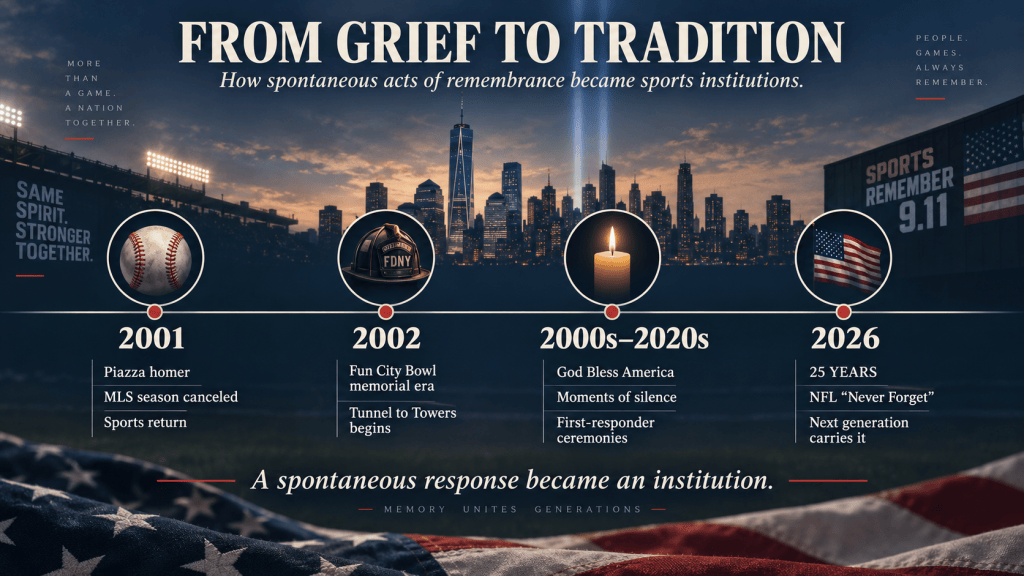
Major League Baseball began playing “God Bless America” during the seventh-inning stretch when games resumed six days after the attacks, and the practice never fully went away: many clubs still play it on Sundays, holidays, and during the postseason, and the league’s “We Shall Not Forget” ribbon patches, moments of silence, and charitable proceeds to the 9/11 Memorial, the Pentagon Memorial, and the Flight 93 Memorial have run every September since at least the mid-2000s. Yankee Stadium is the outlier — it’s played there at every single home game since the tradition started, the only park in the league that never scaled back. Aaron Judge has said singing along is his way of thanking the veterans honored on the field alongside it, tying the ritual as much to service generally as to 9/11 specifically. Most other clubs settled into the Sundays-and-holidays pattern years ago, after a mid-2000s debate — reported at the time in outlets covering the Texas Rangers’ broadcast decisions — over whether a wartime-era patriotic song still belonged in a ballpark once the “unifying” moment that introduced it had passed. That debate is now old enough to be part of the history the ritual is supposed to be teaching.
MLS has continued marking the anniversary through club and league commemorations — moments of silence, first-responder ceremonies, and, on major anniversaries, commemorative uniform patches modeled on the one clubs wore returning from that canceled 2001 season, alongside league-organized volunteer service days.
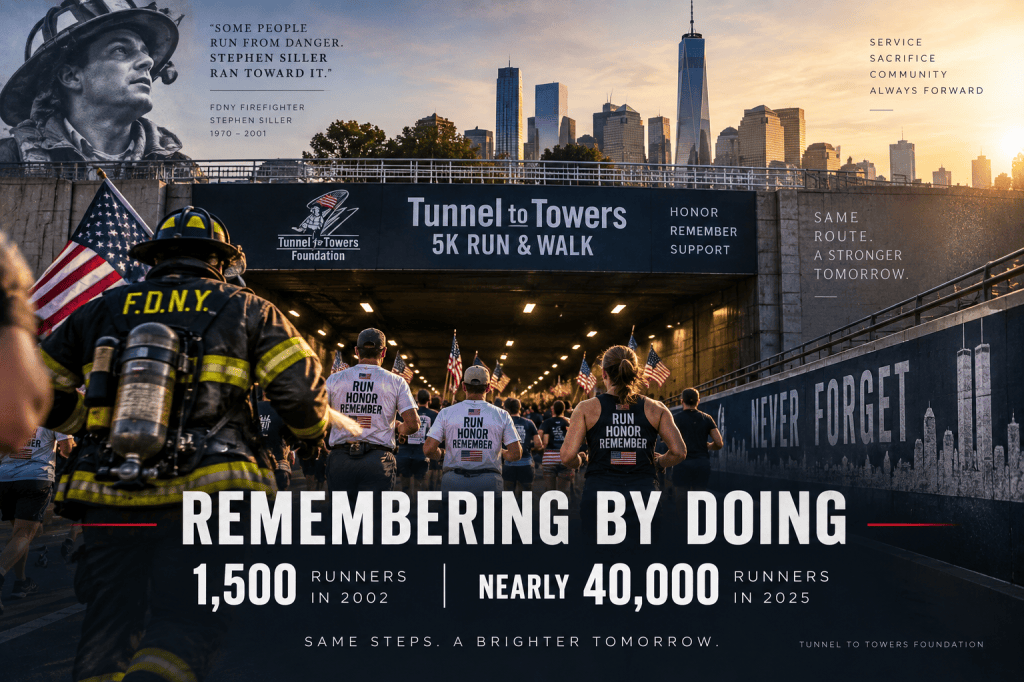
Then there’s the ritual most explicitly built for legacy rather than spectacle: the Tunnel to Towers Foundation’s 5K Run & Walk, which retraces FDNY firefighter Stephen Siller’s final steps — off-duty, in full gear, on foot through the closed Brooklyn Battery Tunnel — to the towers, where he died trying to help. What started with 1,500 runners in 2002 drew nearly 40,000 to the flagship New York race in 2025 alone, with dozens of satellite 5Ks around the country and a growing partnership with pro sports: Anheuser-Busch is sponsoring the NYC race for a fifth consecutive year ahead of the 25th anniversary, and the Foundation has run in-stadium tributes with MLB clubs including the Cardinals. Unlike a moment of silence, the run is designed as something a stadium’s actual next generation can physically do, not just watch.
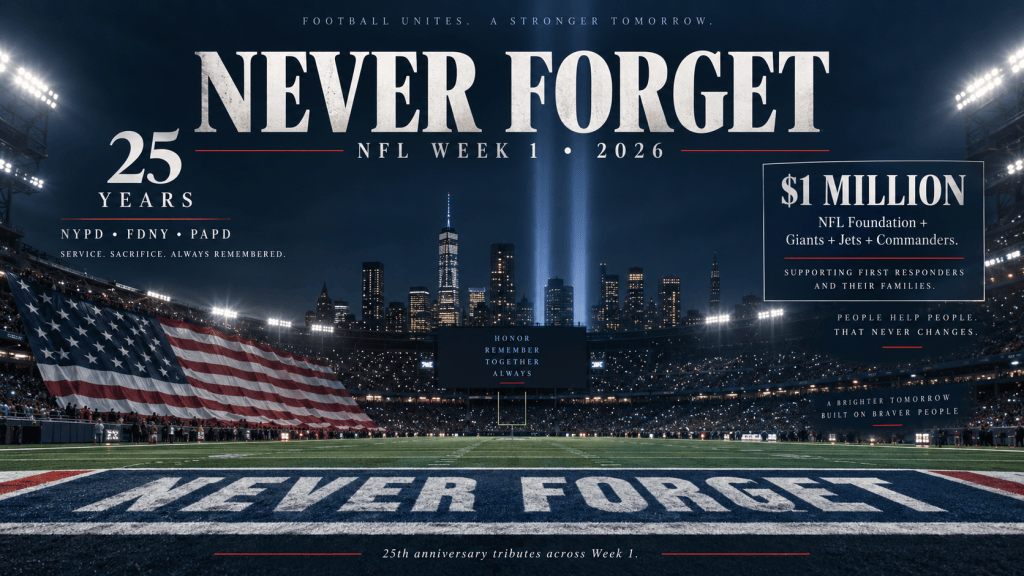
The NFL has built the 25th anniversary into one of its biggest 9/11 commemorations yet: “Never Forget” stenciled into every end zone across Week 1, commemorative coin tosses auctioned for charity, players from the Giants and Cowboys wearing NYPD, FDNY, and PAPD caps for their Sunday Night Football game blocks from where the towers fell, and a joint $1 million contribution from the NFL Foundation together with the Giants, Jets, and Commanders to the National September 11 Memorial & Museum — notably not the Cowboys, despite Dallas playing in the featured Week 1 game. Commissioner Roger Goodell framed it as continuing to honor “those we lost” and the “unity and service” that followed — language that has appeared, with minor variations, in the league’s 9/11 statements for years.
None of this is new, exactly. It’s an escalation of something the leagues have done every September for two decades: institutionalize a spontaneous 2001 gesture of grief into a recurring, scheduled, sponsor-adjacent tribute. What’s changed is the audience. The players wearing those caps, singing that song, and running that 5K are now, overwhelmingly, people who were toddlers or not yet born on the day being commemorated.
What the Numbers Say About Memory
“A moment of silence or a stenciled end zone is doing real work — not just decoration, but active memory transmission.”
That generational gap isn’t just a sports-page observation — it shows up in the data. A 2022 survey by the group More in Common found that while 9/11 still holds deep significance for most Americans, with a majority saying it changed their lives, that significance is visibly receding for younger respondents; the study’s own authors described the event as “receding into history books” for Millennials and Gen Z. A separate, more pointed poll — conducted by pollster J.L. Partners for the Daily Mail in December 2023, amid a spike of “Letter to America” content circulating on TikTok following the outbreak of the Israel-Hamas war — found a notable share of 18-to-29-year-old respondents expressing sympathy toward Osama bin Laden. The pollster called the results personally disgusting; 9/11 family members called them horrifying; and at least one Gen Z respondent, interviewed afterward by a local outlet, attributed the gap partly to a K-12 education that covered the attacks without meaningfully covering who carried them out or why. The poll captured a specific, online-driven moment rather than a stable baseline, but the underlying education gap it points to lines up with the broader trend in the More in Common data.
Against that backdrop, a moment of silence or a stenciled end zone is doing real work — not just decoration, but active memory transmission to an audience that, statistically, needs it more than the audience of five or ten years ago did.
Whether It’s Landing
“These rituals aren’t failing, but they’ve changed jobs.”
The evidence that it’s working, imperfectly, at the personal level is scattered but consistent. A Task & Purpose feature on a University of North Carolina ROTC stair-climb memorial — the kind of event that leans heavily on college athletes and cadets — captured a parent watching a stadium full of students who couldn’t remember 9/11 nonetheless commit to an early-morning, muscle-burning ritual to mark it, built explicitly on the hope that repetition turns into “curiosity and respect.” Former NBA player Nerlens Noel, who visited the 9/11 Memorial as a college prospect during 2013 NBA Draft week, described the visit as something that made him “cherish life” and feel grateful, despite having only fragmented memories of watching the attacks unfold on television as a small child. FDNY assistant coach Steve Orr told Yahoo Sports his team keeps the memory functional, not ceremonial, by screening old NFL Network 9/11 retrospectives for rookies during road-trip film sessions — an institutional workaround for players who have no memory to draw on.
“They land differently.”
That’s the honest shape of the answer: these rituals aren’t failing, but they’ve changed jobs. They started as outlets for a nation’s real, shared, present-tense grief. Twenty-five years later, for most of the people performing and watching them, they function instead as a delivery mechanism for history — closer to a battlefield reenactment than a memorial service. Whether that’s a loss or just what commemoration necessarily becomes once nobody performing it was there is arguably the more interesting question than whether the tributes “still land.” They land differently. The Fun City Bowl’s rookies don’t feel what Steve Orr’s generation felt in 2002. But they show up, they learn the story on the bus, and they play the game anyway — which, historically, is roughly how every other American day of remembrance has made it past the generation that lived it.
Sources consulted: MLB.com (2016, 2021, 2024, 2025, 2026 releases), NFL.com, ESPN.com, Yahoo Sports, Task & Purpose, More in Common (2022 survey), J.L. Partners/Daily Mail poll (via SAN/TND wire coverage), Fox 5 NY, Fox Business, Uniformed Firefighters Association, OutKick, Tampa Free Press, 911families.org, MLSsoccer.com, KRON4, ABC7 NY, Tunnel to Towers Foundation (t2t.org), National Public Safety Football League (npsfl.org), SABR, NBC New York, Barry Popik/Fun City Bowl history, NY1, CBS New York.


Leave a Reply