By Michael Phillips | Sports & Whatever
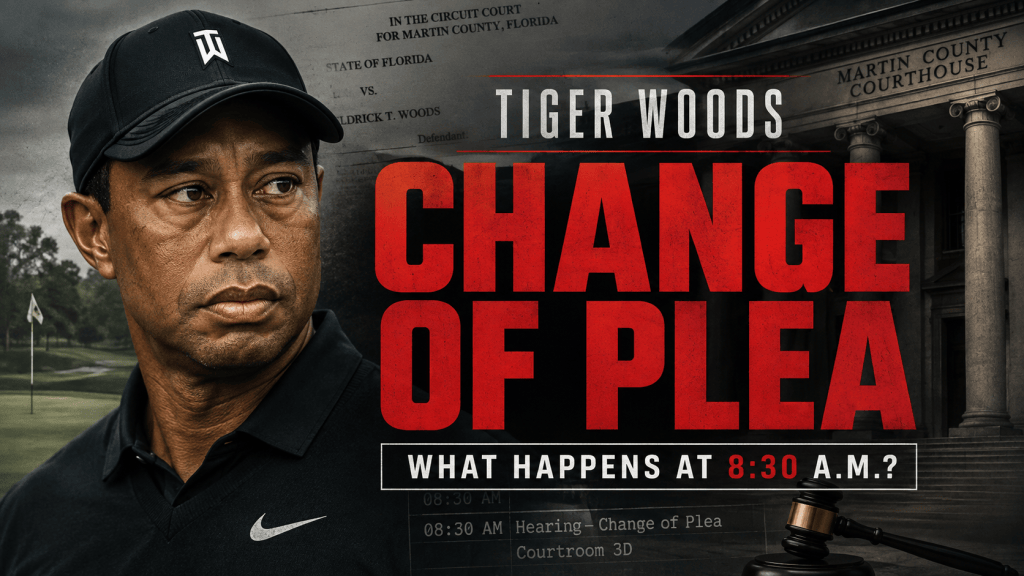
Tiger Woods is due in a Martin County courtroom at 8:30 this morning to change his plea in the DUI case that’s followed him since a Range Rover, a beachside road with a 30-mph limit, and two hydrocodone pills in his pocket turned into a rollover crash back in March. Court records call it a “change of plea.” His attorney’s own filing calls it a “plea conference.” Nobody outside that courtroom knows yet which one it actually is, and that gap between the two labels is worth sitting with for a second, because it’s basically the story of Tiger Woods’ entire relationship with driving under the influence: the public gets a headline, and the specifics show up months, sometimes years, later.
What actually happened in March
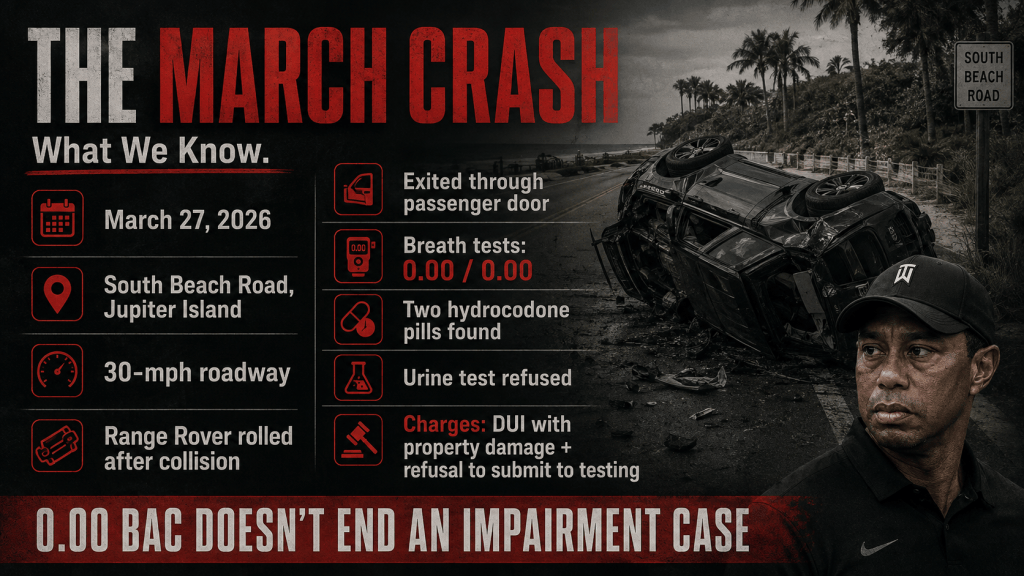
On March 27, Woods was driving on South Beach Road on Jupiter Island — not far from his own house — when, according to Martin County Sheriff John Budensiek, he came up on a pickup truck towing a pressure-washing trailer at high speed. The truck was starting to turn into a driveway. Woods swerved, clipped the trailer, and rolled his Range Rover. He climbed out through the passenger door alone and, by his own account to deputies, told them he’d been looking at his phone and messing with the radio. Deputies also found two hydrocodone pills on him and noted signs of impairment. He blew a 0.00 on the breathalyzer — twice — but refused a urine test, which is its own separate charge under Florida law regardless of what the breathalyzer says.
He was booked, posted $1,150 bail, and was out that night. Within days, he’d entered a written not-guilty plea to two misdemeanors — DUI with property damage and refusal to submit to testing — plus a careless-driving citation that comes with a $163 fine. Then he left the country for inpatient treatment, which the court signed off on while the case sat pending.
That’s the framework everyone’s operating from going into today. What nobody’s confirmed publicly is whether “change of plea” means a negotiated deal, a straight guilty plea, no contest, or something structured like the diversion arrangement he took back in 2017. His attorney, Doug Duncan, hasn’t said. The State Attorney’s Office hasn’t said. As of this morning, it’s a scheduled hearing, not a resolved case.
The 2017 shadow hanging over this
It’s impossible to write about this case without the 2017 arrest showing up in the first paragraph of basically every wire story, and for good reason — the shape of it rhymes. Back then, Palm Beach County deputies found Woods asleep behind the wheel of a parked car on the side of the road, engine running, with Ambien, Vicodin, Dilaudid, Xanax, and THC in his system. He blew 0.0 on alcohol both times, too. He pleaded not guilty, didn’t show up to his own arraignment, and eventually took a plea deal: guilty to reckless driving, a year of probation, community service, DUI classes, a $5,000 fine, and his record wiped clean if he stayed out of trouble.
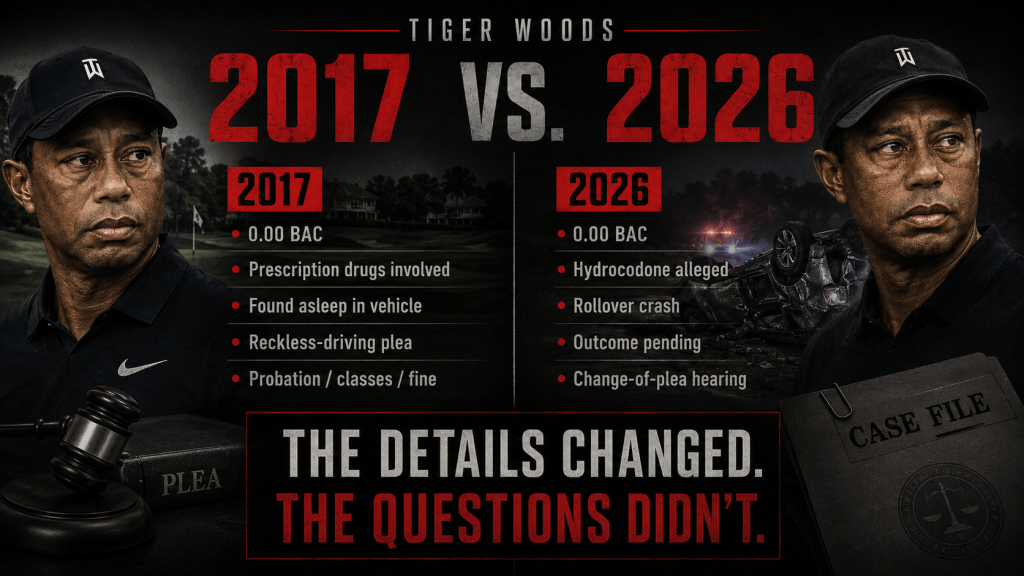
The overlap isn’t just thematic. In both cases, alcohol wasn’t the issue — prescription medication was. In both cases, Woods avoided personally appearing at the moment his plea was formally entered or discussed, at least until forced to. In both cases, the legal outcome ended up being some version of “not technically a DUI conviction, but also not nothing.”
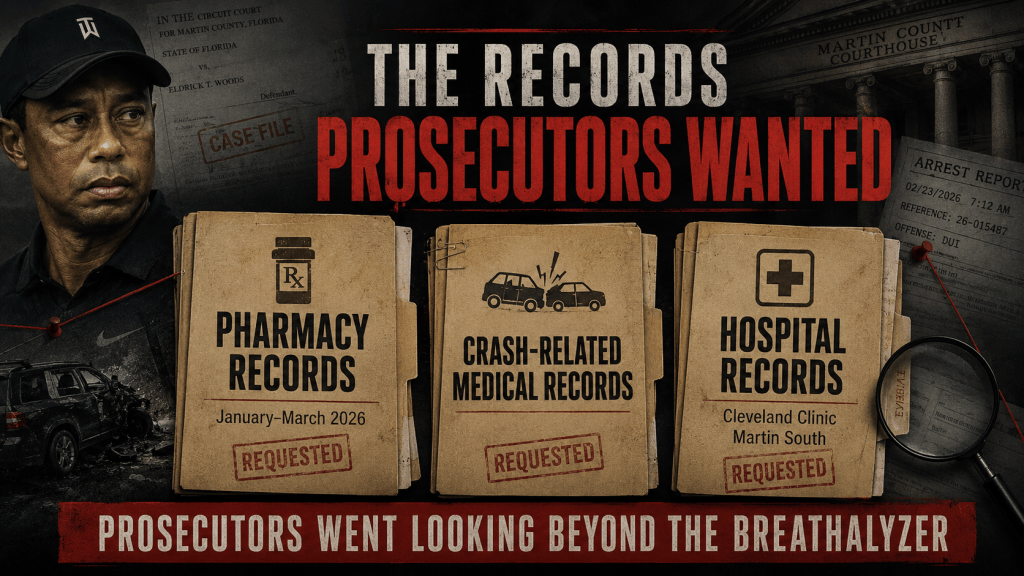
What’s different this time is the amount of institutional access prosecutors have gotten. A judge approved a request in May for all of Woods’ prescription records from a Palm Beach pharmacy covering January through the end of March, and in July signed off on a second order letting prosecutors review medical records tied directly to the crash and arrest, plus his hospital records from Cleveland Clinic Martin South. That’s a level of medical discovery that didn’t happen in 2017, and it suggests either prosecutors are building a more substantial case around impairment by medication, or the defense is trying to get ahead of exactly that by building a documented treatment narrative. Possibly both.
Why the “change of plea” label matters more than it looks like it should
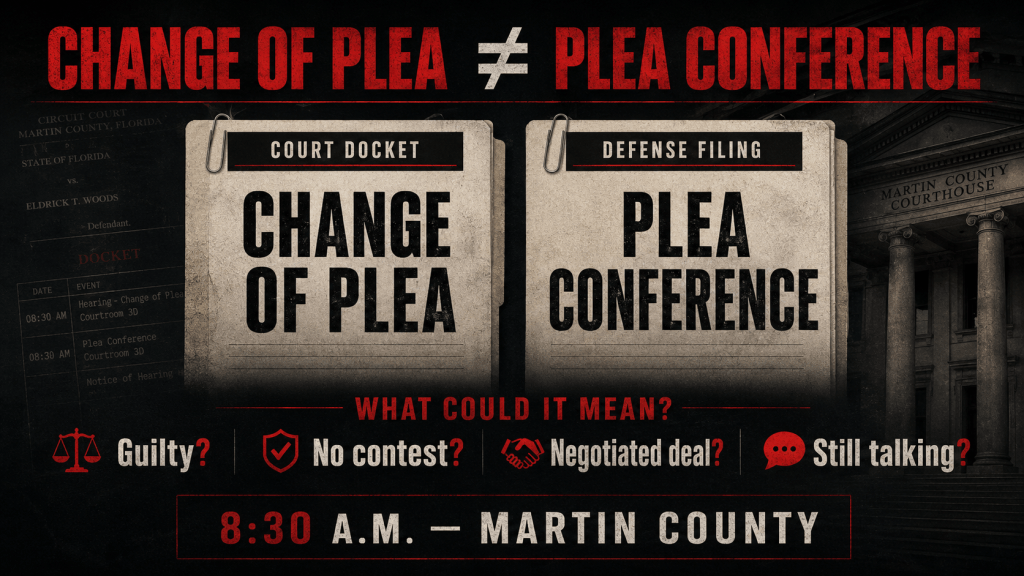
Legal reporters covering this locally have flagged the same wrinkle: a “change of plea” hearing, as a docket item, typically signals a defendant has already agreed to plead guilty or no contest, and a sentence might get handed down right there. A “plea conference,” which is how Duncan’s own filing describes it, is a softer, more exploratory designation — it doesn’t necessarily mean anything’s been finalized. The fact that the court paperwork and the defense paperwork use two different terms for the same 8:30 a.m. appointment is either bureaucratic sloppiness or a genuine signal that something’s still being negotiated up to the wire. Given that in-person appearance is mandatory for a change-of-plea hearing — unlike 2017, when Woods skipped his own arraignment — the smart read is that whatever happens today, Woods himself has to be standing there for it.
The bigger, uncomfortable frame

Set aside the legal mechanics for a second. This is at least the fourth vehicle incident tied to Woods since 2009, which includes the 2021 crash in Rancho Palos Verdes that nearly cost him his leg and effectively ended his career as a full-time competitor. The pattern with Woods has never really been about any single event — it’s the recurring loop of crisis, disappearance, rehabilitation, and comeback that’s defined the second half of his public life since 2009. This latest chapter arrives at a moment when Woods, at 50, is watching that comeback math get harder in real time: Scottie Scheffler just closed out a season with three wins, five runner-up finishes, a FedEx Cup, and passed Woods on the PGA Tour’s all-time career earnings list. Woods posted a gracious congratulations on X anyway. Whatever else is true about how this hearing goes, that juxtaposition — the guy who used to be the sport’s inevitability now watching someone else own the record book while his own name is back in a courtroom docket — is going to be the actual story once the legal formalities are done.
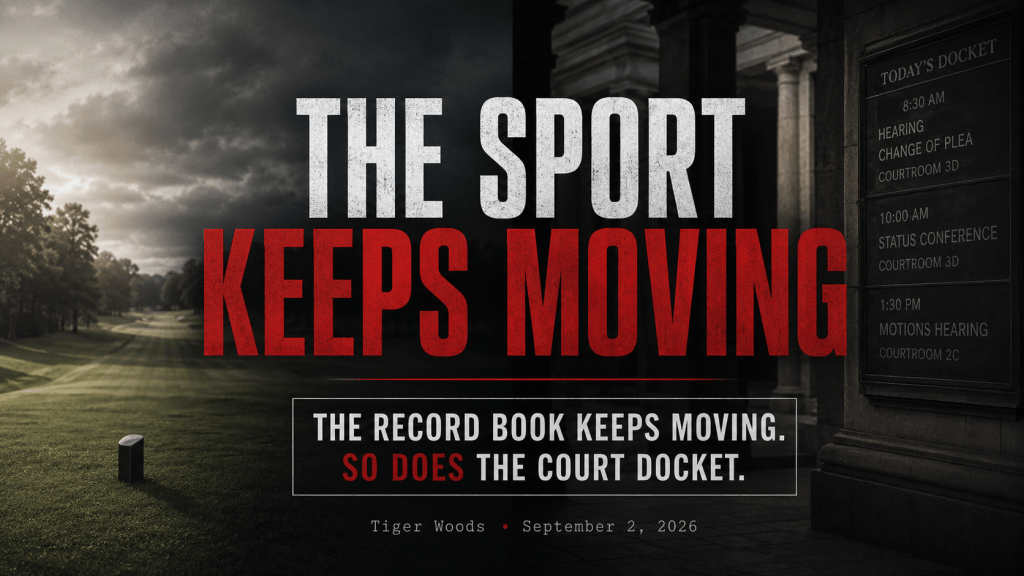
This piece will be updated once today’s hearing concludes, and the actual plea and any sentencing terms are confirmed.


Leave a Reply