By Michael Phillips | Sports & Whatever
MicahJo Barnett scored a touchdown. Then he ran to the sideline to celebrate with his teammates. Then he told the team doctor he was having trouble breathing. Then he was gone.
That’s the timeline, as William Jewell College’s interim president Drew Van Horn laid it out at a vigil Saturday night. A doctor started CPR immediately. Paramedics who were already stationed at the game — because someone, mercifully, had the foresight to have them there — arrived within moments. Barnett was taken to Liberty Hospital, where he died. He was a junior, a business administration major, the kind of teammate other players remember for how he made them feel rather than how he ran the ball. He called a defensive end twice his age “unc.” He was Liberty North High School’s guy — a state champion, “Mr. Liberty himself” to people who knew him. He was a 2025-26 Academic All-Great Lakes Valley Conference honoree. He was 20 years old, survived by his parents and six siblings.
The game against Fort Lewis College was suspended, then canceled outright. William Jewell led 7-0 on Barnett’s touchdown when it ended for good.
Here is the part that should make you uncomfortable: MicahJo Barnett is not an isolated tragedy. He’s the second player connected to this region to die around football in the span of ten days. And depending on how you draw the map, he’s at least the sixth young man to die playing organized football in Kansas and Missouri since 2018 — most of them tangled up, in ways that keep not getting fully explained, with heat.
“MicahJo Barnett is not an isolated tragedy.”
A pattern with a name nobody’s officially put on it
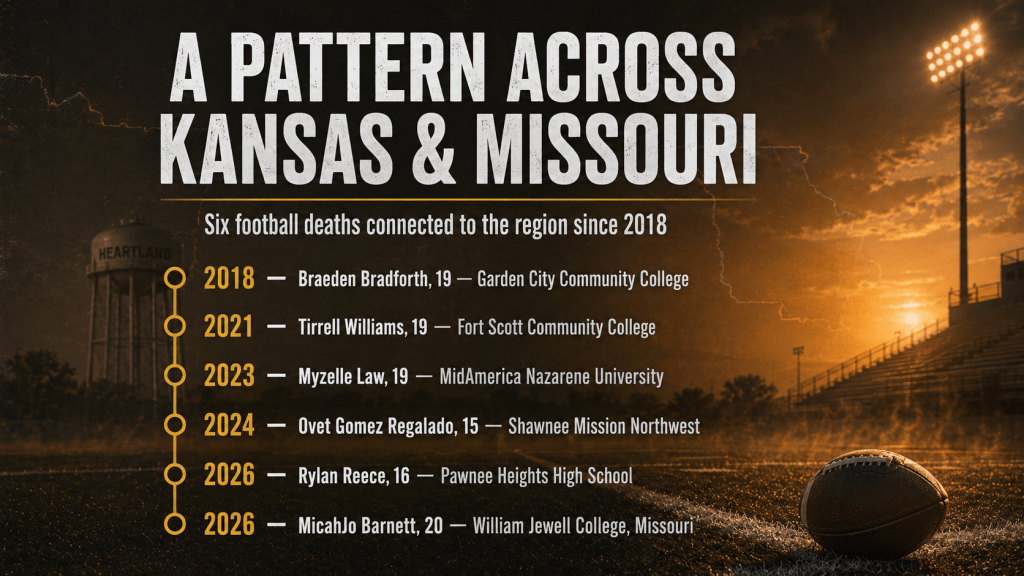
Ten days before Barnett collapsed, a 16-year-old named Rylan Reece went down on the first day of practice at Pawnee Heights High School, a six-man football program in Rozel, Kansas — population somewhere in the low three digits. It was 90 degrees with 57 to 58 percent humidity that evening, depending on which outlet you check the National Weather Service against. CPR was administered on the field before first responders arrived. Reece died that night. His autopsy results, according to the county attorney who ordered it, may take three months.
Reece was a 140-pound fullback and wide receiver — notably not the profile of the previous four deaths, which had all been “big linemen,” the build that struggles hardest to shed heat. That detail matters, and it’s the kind of thing that should terrify anyone running a summer practice schedule: this isn’t just a big-body problem anymore, or it was never only that to begin with, and we just noticed the big guys first because they went down more often.
The four before Reece, going back to 2018: Braeden Bradforth, 19, died after his first-ever practice as a freshman at Garden City Community College. Tirrell Williams, 19, died at Fort Scott Community College in 2021 after a preseason workout that, per reporting at the time, involved players being punished by the head coach over trash left on the field. Myzelle Law, 19, died after a workout at MidAmerica Nazarene University in Olathe in 2023; his cause of death was never made public. And in 2024, 15-year-old Ovet Gomez Regalado died of heat stroke complications after an August workout at Shawnee Mission Northwest.
That’s a Kansas death toll. Missouri now has Barnett. Texas, this same August, lost 17-year-old Odin Hensley of Lake Travis High School, who suffered cardiac arrest at practice on Aug. 10 and died three days later.
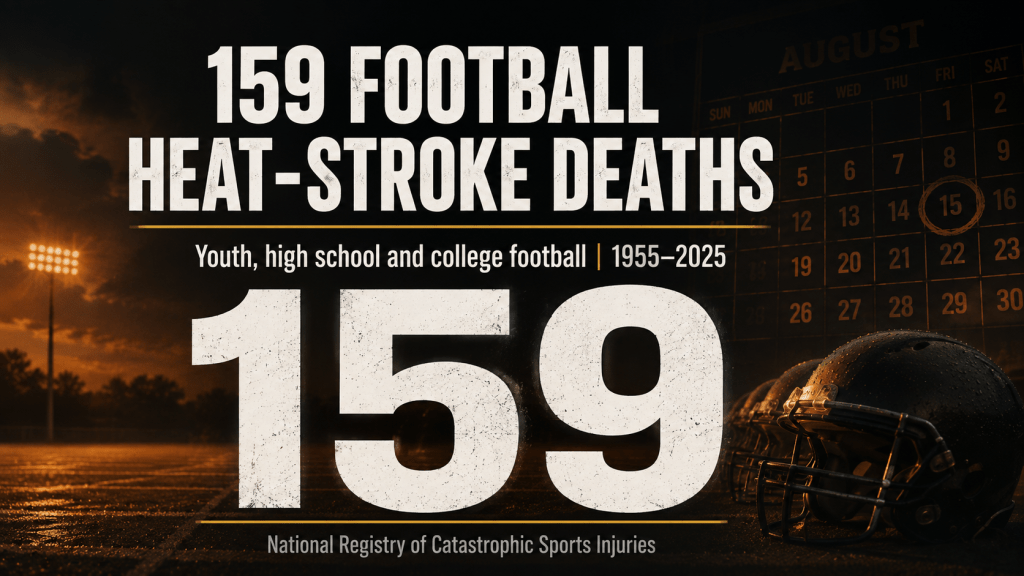
The National Registry of Catastrophic Sports Injuries has documented 159 deaths from exertional heat stroke among youth, high school, and college football players between 1955 and last year. That’s not a spike-and-fade story. That’s seventy years of the same institutional failure repeating on a loop, with a new burst of urgency every August and total silence every January.
“That’s seventy years of the same institutional failure repeating on a loop.”
What we don’t know, and why that gap matters
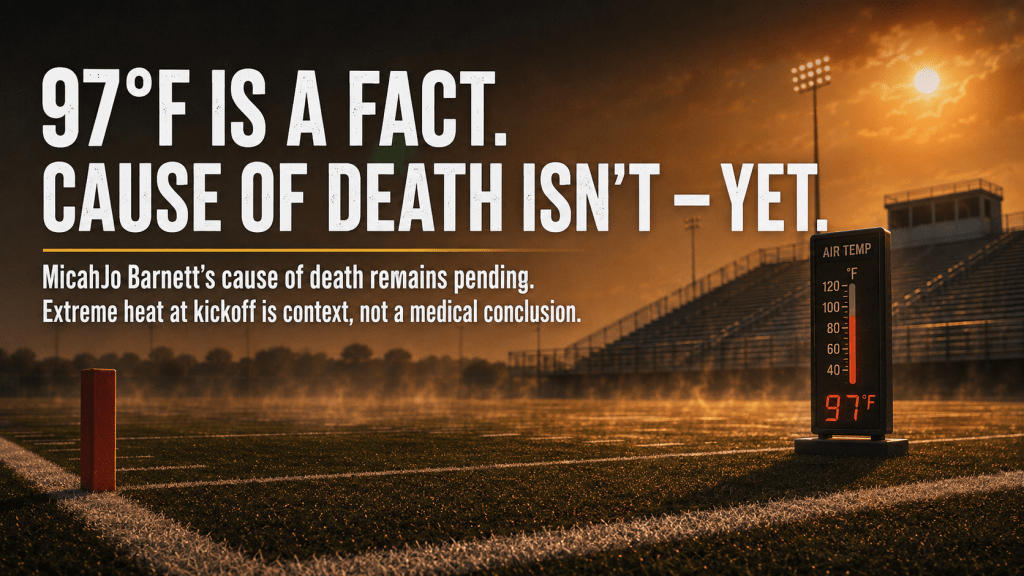
Let’s be precise about Barnett, because precision is the whole point of a story like this. Nobody has said heat killed him. The Clay County medical examiner hasn’t ruled on a cause of death. Kickoff temperature at Greene Stadium was 97 degrees as a late-summer heat wave rolled through the Kansas City metro — that’s a fact, not a diagnosis. William Jewell’s own president said Saturday night that the question of an internal investigation would wait on the medical examiner’s findings, which is the responsible thing to say and also, frankly, the thing every school says right up until it doesn’t have to say anything else.
“Stacked together, five or six of them in the same two-state radius over eight years is not a series of unrelated singular tragedies.”
That caution is appropriate. It’s also exactly the mechanism by which this story disappears. A kid dies in August. The school issues a statement about a “medical emergency.” The cause takes weeks or months to become public, if it ever does — Myzelle Law’s family and MidAmerica Nazarene never got one on the record. By the time an actual finding lands, the season’s underway, the news cycle’s moved to conference play, and nobody connects it back to the pattern. Each death gets covered as its own singular tragedy, because in the moment, that’s what it is to the people who loved that kid. But stacked together, five or six of them in the same two-state radius over eight years is not a series of unrelated singular tragedies. It’s a systems problem, and systems problems only get fixed when someone insists on looking at the aggregate instead of letting each case get filed away as an unknowable act of God.
The GoFundMe economy of grief
One more thing worth sitting with: a GoFundMe titled “In Memory of Micah Jo,” organized by a family friend, seeking $35,000 to cover Barnett’s funeral and memorial costs, with donations routed directly to the family. A memorial fund for Reece’s family, meanwhile, was set up through a small-town church in Burdett, because Pawnee County doesn’t exactly have deep institutional pockets either. This is what’s left to families after their son dies playing a sport that, at the college and professional levels, generates billions of dollars a year and, at the level where these kids actually play, generates six-man football in a town of a few hundred people and a doctor on standby if you’re lucky.
“The sport that took a 16- or 20-year-old doesn’t have a mechanism — doesn’t want one — for what comes after.”
At Barnett’s vigil, his mother, Michelle Barnett, stood in front of the team her son had just died playing for and told them to keep going. “It’s gonna be a hard pill for me to swallow, because my son loved football since kindergarten,” she said. “But I need y’all to be strong. Y’all can hear me up there yelling. I’m still gonna be yelling. I’m gonna be yelling for MicahJo’s spirit.” Family members led a chant for his number, No. 1, as they left the quad.
That’s the trade the sport has quietly negotiated with these families, and they keep accepting it out of love for the kid and love for the game — grief absorbed by a mother telling a locker room to play on, funeral costs absorbed by a GoFundMe and a church collection plate. The NCAA puts out a statement. The conference cancels a game. And then a community passes a hat, because the sport that took a 16- or 20-year-old doesn’t have a mechanism — doesn’t want one — for what comes after.
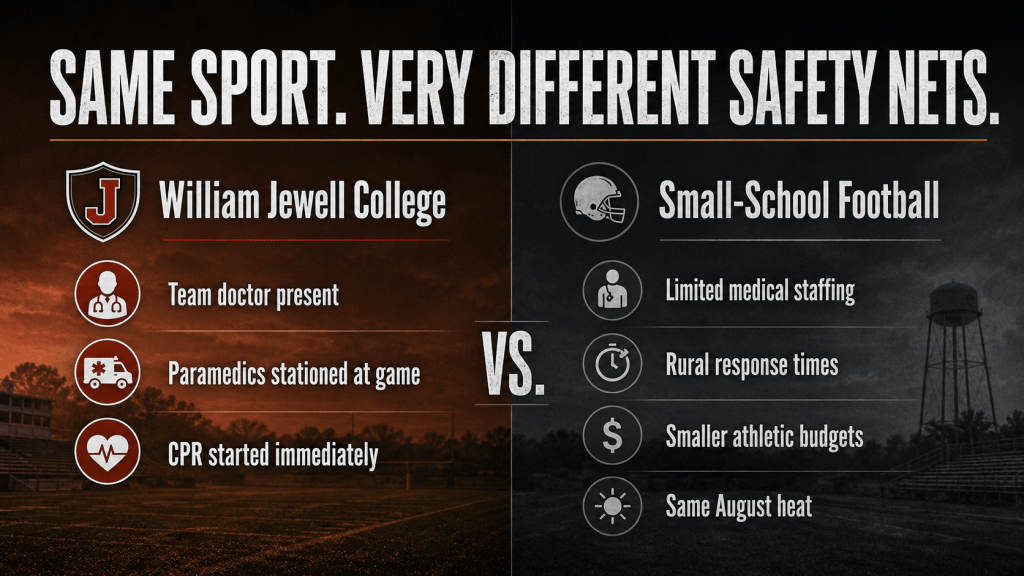
Heat acclimatization protocols exist. Athletic trainer staffing minimums exist, on paper, in most state athletic association handbooks. What doesn’t reliably exist, per reporting out of Kansas specifically, is the money and staffing to make those protocols real at every level — a Class 6A suburban powerhouse and a six-man program with 140 students in the whole district are not operating with remotely the same medical infrastructure, and the second category is disproportionately where these deaths keep happening.
“A sport that makes this much money at the top has no excuse for the bottom looking like this.”
Nobody’s proposing we stop playing football. That’s not the argument, and it’s a strawman when people reach for it. The argument is smaller and more damning: a sport that makes this much money at the top has no excuse for the bottom looking like this. MicahJo Barnett had a doctor on the sideline and paramedics already stationed at his game, and it still wasn’t enough. Rylan Reece had neither. Something in between those two realities is where the actual policy conversation needs to happen — and it needs to happen before next August, not during it.
This piece will be updated as the Clay County medical examiner’s findings on MicahJo Barnett’s death become public.


Leave a Reply