By Michael Phillips | Sports & Whatever | NHL
Every fall, the same lie gets told: that breakouts are unpredictable. They’re not, mostly. You can see them coming if you look at what actually happened last season instead of what the hype said would happen — and 2025-26 handed the league a legitimately loaded rookie class, most of whom finished the year in wildly different spots than where they started it. Some blew past expectations. Some got buried on the bench. Some got traded mid-season and had their whole year scrambled. All of it matters if you’re trying to figure out who’s actually set up to jump in 2026-27.
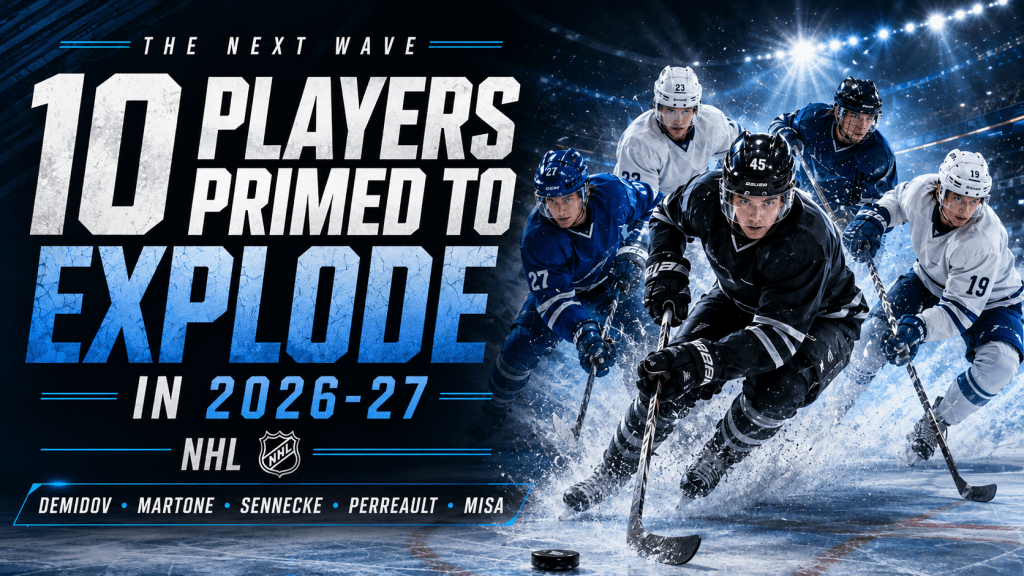
Here are 10 players 24 and under worth watching, based on how their seasons actually ended — not how they were supposed to go.
Ivan Demidov, RW, Montreal Canadiens
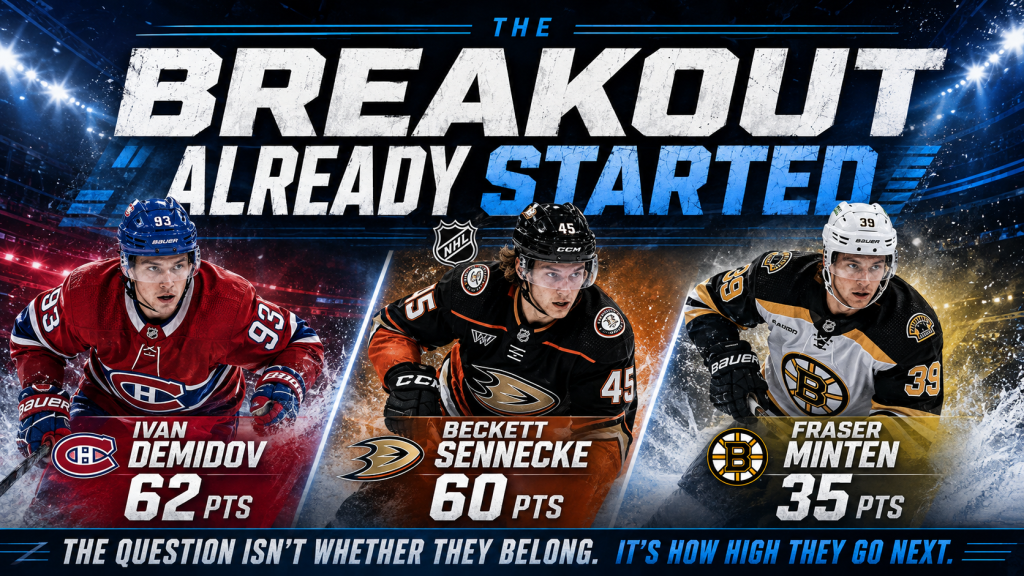
Demidov doesn’t need to “break out” so much as confirm what everyone already suspects: he’s a superstar. He finished his rookie season with 19 goals and 43 assists for 62 points across all 82 games, leading every rookie in the league in points and assists, and finished as Calder Trophy runner-up to Islanders defenseman Matthew Schaefer. Twenty power-play points, 14 multi-point games, first Canadiens rookie since Gilbert Dionne to hit double-digit multi-point outings inside his first 50 games. He also added nine points in 19 playoff games as Montreal reached the Eastern Conference Final. This isn’t projection anymore — it’s just a matter of how much higher the ceiling goes with a full training camp and an expanded power-play role.
Porter Martone, RW, Philadelphia Flyers
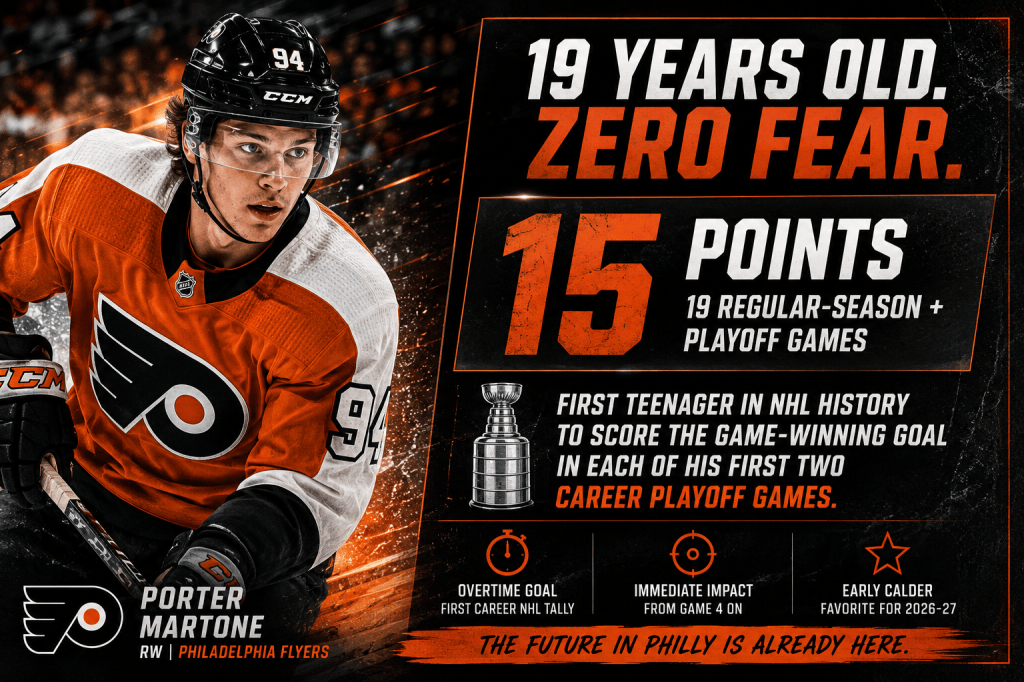
Martone barely played last season and still looked like the best story in the league. He spent 2025-26 lighting up Michigan State as a freshman, signed with Philadelphia after his college season ended in late March, and then went off: 15 points across 19 combined regular-season and playoff games, an overtime goal for his first career NHL tally, and — this is the part that should scare people — he became the first teenager in NHL history to score a game-winning goal in each of his first two career playoff games. That’s not hot streak stuff. That’s a 19-year-old who looked like he belonged from his fourth game on. He’s already one of the early Calder favorites for 2026-27, and deservedly so.
Beckett Sennecke, RW, Anaheim Ducks
Sennecke quietly had one of the best rookie seasons in the league and didn’t get a fraction of the attention Demidov or Martone did. Final line: 23 goals, 37 assists, 60 points — tied for the rookie goal-scoring lead and just one point off the Ducks’ rookie scoring record set by Trevor Zegras. He was a Calder finalist alongside Demidov and Schaefer. Anaheim isn’t a marquee market and Sennecke didn’t enter his rookie year with the same immediate playoff spotlight attached to his name as some of the league’s other young stars, which is exactly why he’s a value play here — the production was already elite-rookie level, and a full healthy season with a Ducks core on the rise should push the counting stats higher than most people outside Orange County are pricing in.
Matvei Gridin, LW, Calgary Flames
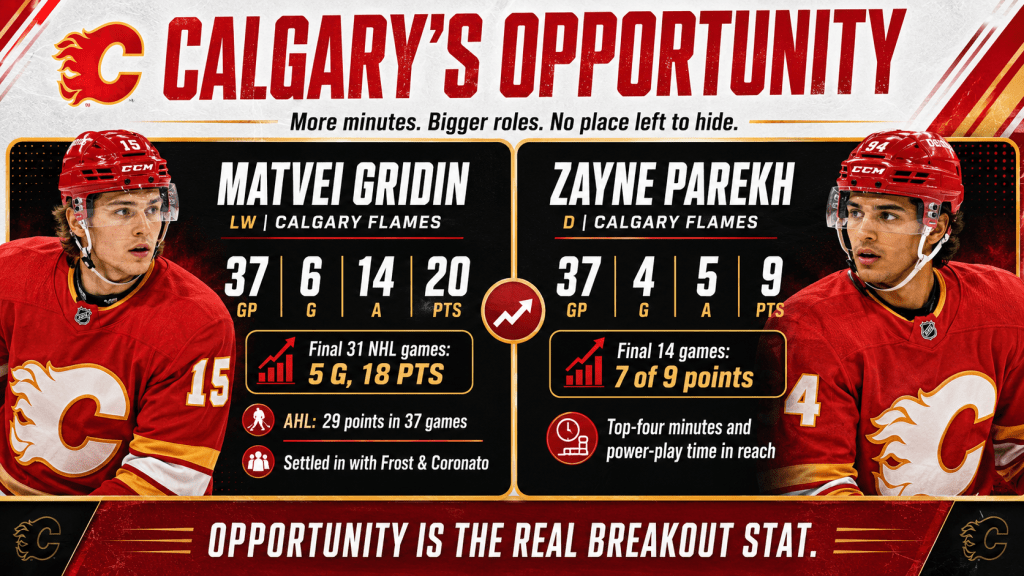
Gridin made Calgary’s roster out of camp partly because Jonathan Huberdeau and Martin Pospisil were injured, scored a goal in his NHL debut on opening night against Edmonton, then bounced between the AHL and NHL for most of the year before locking in for good in January. Once he settled alongside Morgan Frost and Matt Coronato, the numbers took off: over his final 31 games with Calgary, he put up 5 goals and 18 points. Final tally: 6 goals, 14 assists, 20 points in 37 NHL games, plus a strong AHL run with Calgary’s Wranglers (29 points in 37 games) before the recall. A rebuilding team’s best asset is minutes, and Gridin is now getting a permanent look at them.
Fraser Minten, C, Boston Bruins
Minten is the return piece from the Brandon Carlo trade that nobody outside New England seems to be talking about. He played all 82 games last season — one of only three Bruins to do so — and finished with 17 goals, 18 assists, and 35 points, good for 10th in Calder voting. He’s not walking into 2026-27 as a projection; he’s walking in as a proven full-season NHL center who’s already earned real trust from the coaching staff, with the offensive tools to keep climbing Boston’s lineup.
James Hagens, C, Boston Bruins
Hagens is the highest-variance name on this list, mostly because there’s almost no NHL sample to go on. The seventh-overall pick in 2025 got into exactly two NHL games last spring after a strong sophomore year at Boston College (23-24-47 in 34 games) and a short AHL stint, recording one assist. That’s it. But a full training camp, an obvious talent level, and a Bruins team that’s aggressively building around its young center depth all point toward a real top-nine role arriving fast. This is the bet on pedigree over track record.
Konsta Helenius, C, Buffalo Sabres
Helenius spent almost the entire season in the AHL and still had one of the more impressive years of anyone on this list. He led Rochester with 63 points in 63 games — the most by a teenager in Amerks history — then got recalled for Buffalo’s second-round playoff series against Montreal and scored twice in four games. After the season, he capped it off by scoring the golden goal in overtime to win the World Championship for Finland. His NHL regular-season sample is tiny (nine games, four points), but everything else about how his year ended says he’s ready for a real top-nine job in Buffalo.
Gabe Perreault, RW, New York Rangers
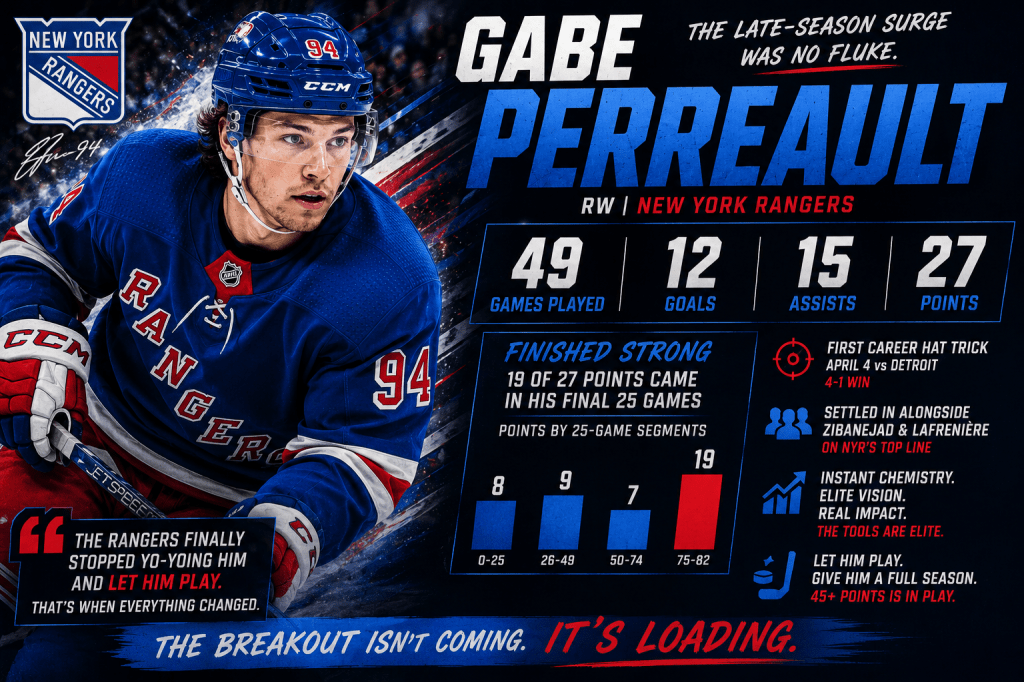
Perreault’s season looked shaky through the middle stretch — bounced to Hartford twice, limited minutes, stretches without a point — before it turned into the best story on a bad Rangers team. He finished with 12 goals, 15 assists and 27 points in 49 games, but the shape of that season is what matters: 19 of those points came in his final 25 games, including his first career hat trick, a 4-1 win over Detroit on April 4. He settled in alongside Mika Zibanejad and Alexis Lafrenière on New York’s top line and looked like he belonged there. The tools were never in question — the instincts, the vision, the offensive IQ. What changed was that the Rangers finally stopped yo-yoing him and let him play. Do that for a full season and 27 points in 49 games starts looking like 45-plus over 82.
Zayne Parekh, D, Calgary Flames
Parekh’s rookie year was rougher than the hype suggested. Injuries limited him to 37 games, and he finished with just 4 goals, 5 assists, and a minus-9 rating, a long way from the 30-goal-scoring OHL phenom Calgary drafted ninth overall. But the shape of the season matters here too: 7 of his 9 points came over his final 14 games, as his role and confidence visibly grew down the stretch — Calgary’s own account of his year is that after returning from the World Juniors, “he just took off.” And the runway is already clear: Calgary traded away both Rasmus Andersson and MacKenzie Weegar during the season, which leaves no returning veteran blocking Parekh from real top-four minutes and power-play time in 2026-27. This is a bet on opportunity catching up to talent, not a guaranteed leap — but the tools are real, and the path is wide open.
Michael Misa, C, San Jose Sharks
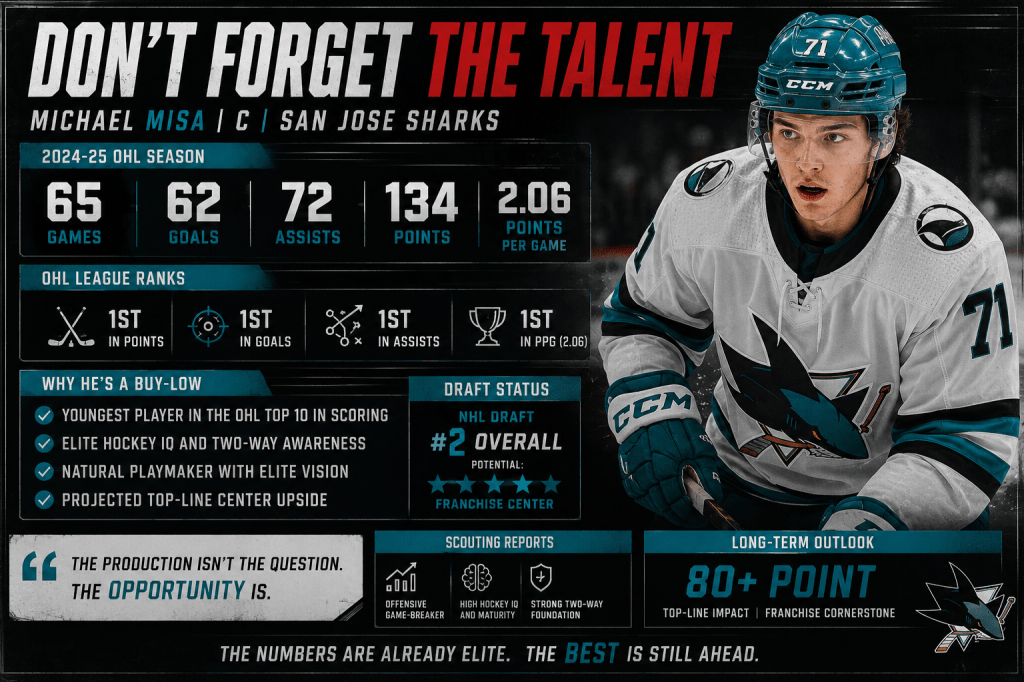
Misa is the buy-low name on this list. San Jose’s second overall pick in 2025 had one of the more disappointing rookie usage patterns among his draft class — 45 games played, healthy-scratched or hurt for long stretches, and the lowest average ice time (12:49) of any 2025 draft pick who played 10 or more games. Final line: 9 goals, 12 assists, 21 points. That’s a far cry from the player who put up 134 points in his draft year and led the OHL in scoring. None of that talent has gone anywhere — San Jose simply didn’t play him much, which is its own kind of red flag and its own kind of opportunity. If the Sharks commit to him in a real role in October, the ceiling is still exactly what it was on draft night.
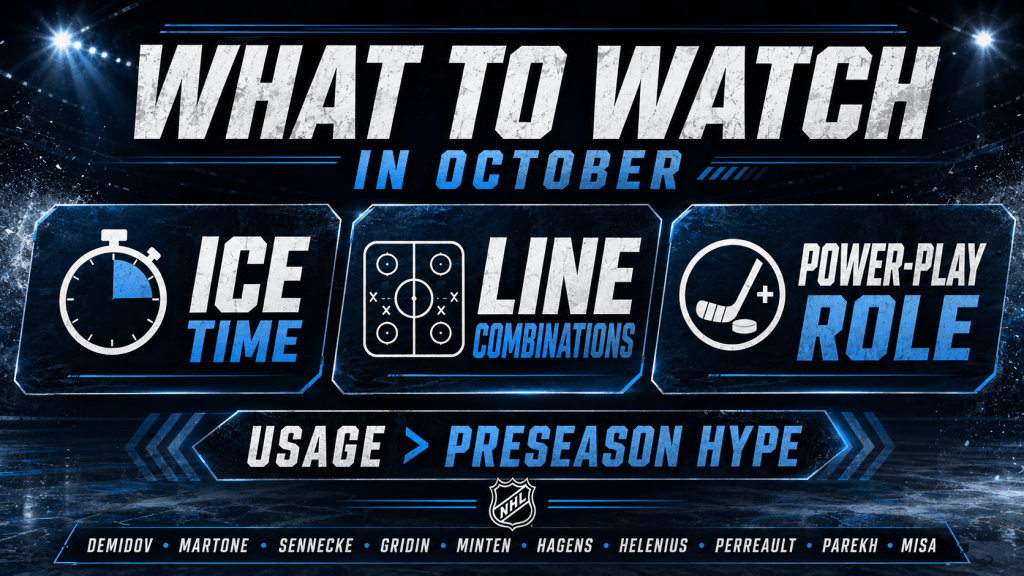
The pattern, if you want one: the players who look most dangerous heading into 2026-27 aren’t the ones who had clean, hyped rookie years — they’re the ones whose seasons ended on an upward trajectory, regardless of how messy the middle was. Martone, Perreault, Gridin, and Parekh all finished their years playing better than they started, often by a wide margin. Misa is the inverse bet: talent that never really got tested. Watch usage patterns in October more than preseason hype — that’s where these stories actually get written.


Leave a Reply