
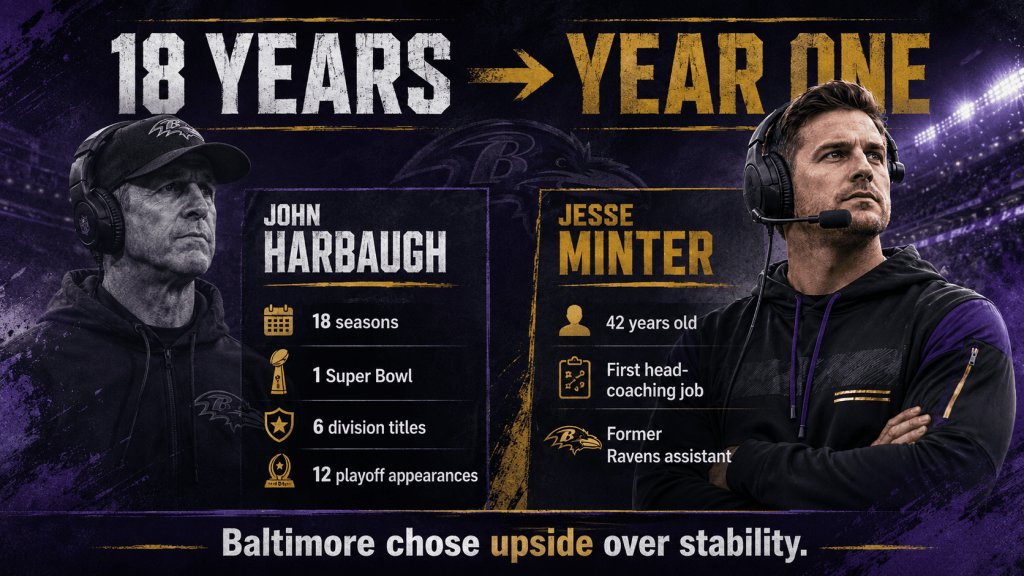
Baltimore just did something almost no franchise does: it looked at a Hall of Fame-caliber head coach with a Lombardi Trophy, six division titles, and 12 playoff appearances on his résumé, and said thanks, but no thanks.
John Harbaugh is gone after 18 years. Jesse Minter, a 42-year-old first-time head coach who was a Ravens defensive assistant less than a decade ago, is in. And somehow, despite blowing up the most stable coaching situation in football, the Ravens are still being handed a top-five Super Bowl number and a win total that ties for the highest in the league.
That’s the tension sitting at the center of this season. Baltimore has never had more talent and less certainty about how to use it.
The Firing Nobody Saw Coming
Let’s be clear about what actually happened, because “Ravens move on from Harbaugh” undersells it. This wasn’t a bottoming-out. Harbaugh’s teams went a combined 25-9 in 2023 and 2024 and still couldn’t get over the hump. Then 2025 fell apart — a season that opened with championship-or-bust expectations closed with an 8-9 record and a 26-24 loss to the Steelers in the Week 18 finale that handed Pittsburgh the AFC North and left Baltimore on the outside of the playoffs. A missed field goal, in the biggest game of the year, against your bitter rival, ending your season. That’s about as Ravens as it gets.
Two days later, owner Steve Bisciotti fired him anyway. Not for the record, by most accounts — for something closer to organizational fatigue. Bisciotti called it “the time.” Harbaugh landed with the Giants almost immediately, which tells you the league didn’t view this as a coach who’d lost anything on the field. It just tells you the Ravens wanted something different.
Enter Minter — and a Staff Full of Rookies
Minter isn’t a stranger in Baltimore. He was a defensive assistant here under Harbaugh from 2017 to 2020 before leaving to coordinate at Vanderbilt, then Michigan — where he ran the defense that allowed the fewest points in the country during the 2023 national title season — and finally the Chargers, where his units ranked top-five in points allowed, total yards, passing yards, and takeaways over two seasons. He beat out 15 other candidates for this job, including in-house buzz for guys like Anthony Weaver, who’s now his own defensive coordinator.
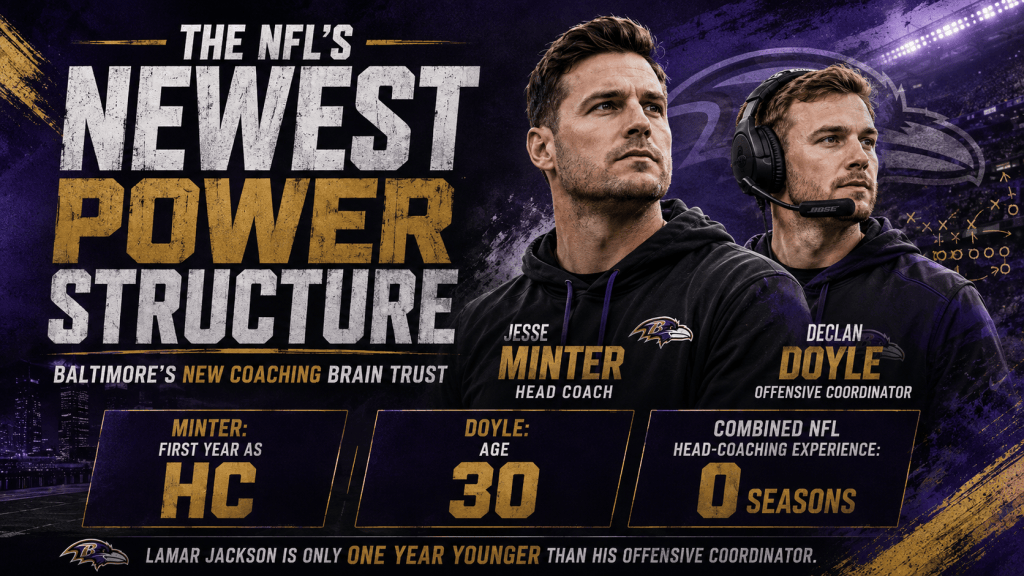
But here’s the thing that should make Baltimore fans a little nervous: this is Minter’s first head-coaching job at any level. And his handpicked offensive coordinator, Declan Doyle, is the youngest OC in the NFL — 30 years old, just a year older than his own starting quarterback, and coming off exactly one season calling plays anywhere, as Chicago’s OC in 2025 (and even then, Ben Johnson had final say as head coach). Baltimore just replaced an 18-year institution with two guys who have a combined zero years of experience being the top offensive and head-coaching voice in a building.
That’s either the move that finally modernizes this offense, or it’s a wildly risky bet on upside. Probably both.
The Doyle Bet
Doyle’s pitch is legitimate, though. Chicago finished sixth in total offense and third in rushing last season with him in the room, and Caleb Williams took a real step forward under his and Johnson’s system. Doyle has already signaled he wants Lamar Jackson operating under center far more than he ever did under Todd Monken or Greg Roman — a real schematic shift for a quarterback who’s spent his career living in shotgun.
The idea, per people around the building, is to lean into what one Athletic reporter described as Jackson’s “superpower” — his ability to process what a defense is doing and store it like a highlight reel, then use structure and misdirection to actually get in front of that instinct instead of playing purely off schedule. If that clicks, this offense gets scarier, not safer.
If it doesn’t click fast, you’ve got a new coach, a new coordinator, and a two-time MVP all trying to speak the same language in real time, in a division that doesn’t wait for you to figure it out.
The Lamar Question Nobody Wants to Ask Out Loud
Jackson is 76-31 as a starter and has two MVPs. He’s also 29 years old, still hasn’t been to a Super Bowl, and just came off arguably his most fragile season as a pro — 13 games played, a hamstring injury, a back contusion, career-low rushing numbers, and one of the highest sack rates in football. His cap number is set to balloon in 2027, which means this season and next effectively function as an audition for how the front office thinks about paying him going forward.

None of that is panic-button material. It is, however, the actual stakes of the year. A healthy, explosive Jackson in a system built to hide his warts and amplify his instincts is a top-five quarterback in the league, full stop. A banged-up Jackson learning his fourth offensive coordinator in as many years while a rookie play-caller finds his footing is how you get another 8-9.
The Schedule Is Doing the Coaching Staff a Favor
Here’s where Baltimore actually has a real, tangible reason for optimism: the schedule makers were kind. The Ravens have the ninth-easiest slate in the league, and their first six opponents — the Colts, Saints, Cowboys (in a Week 3 trip to Rio de Janeiro), Titans, Falcons, and Browns — combined for a .369 winning percentage last season. Baltimore doesn’t face a single 2025 playoff team until November 1st, in Buffalo.
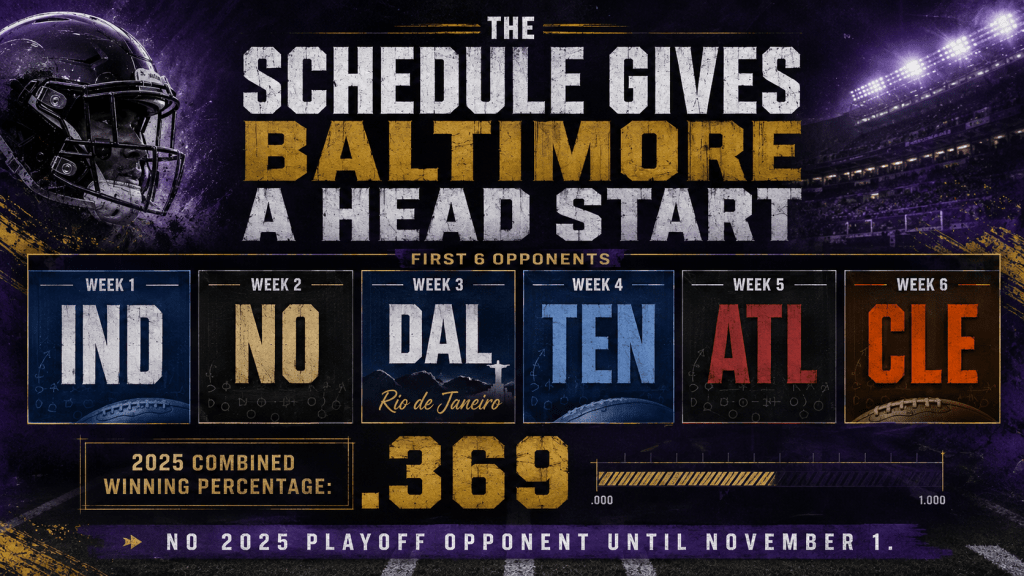
That’s led to some genuinely bold predictions floating around — ESPN’s Field Yates has publicly floated the Ravens as the last undefeated team in football heading into that Buffalo game. That’s the kind of take that gets made in August and forgotten by October, but the underlying point holds: this team has a real chance to build a cushion before the schedule turns hostile.
And turn hostile it will. Weeks 8 through 12 are as brutal a stretch as exists on any team’s 2026 schedule — at Buffalo, home against Jacksonville, home against the Chargers, at Carolina, at Houston. Every one of those teams made the playoffs last year. Baltimore went 2-6 against playoff teams in 2025. That five-game gauntlet is the actual season. Everything before it is a warmup; everything after a Week 13 bye — which, for what it’s worth, the Ravens have historically used well, making the playoffs in seven of the last eight years they’ve had a bye in Week 10 or later — is the stretch run toward a Bengals rematch on Thursday Night Football, New Year’s Eve, in Cincinnati, a building where Baltimore has never won a primetime game.

So, What Actually Happens?
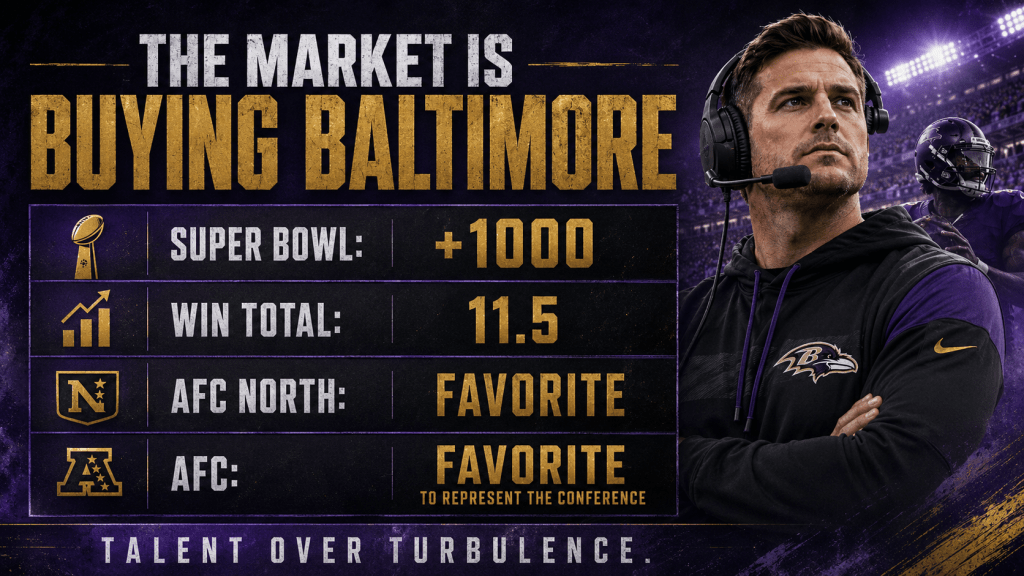
Vegas is buying the talent over the turbulence. DraftKings has Baltimore at +1000 to win the Super Bowl — behind only the Los Angeles Rams, who jumped the field after trading for Myles Garrett in June, and tied with Buffalo for the second-best odds in football. Baltimore is also the favorite to represent the AFC, and the market treats a playoff berth as close to a formality. The win total sits at 11.5, tied with the Rams for the highest number on the board, though the pricing suggests the market still leans slightly toward the under. The Ravens are favored to reclaim the AFC North over Cincinnati.
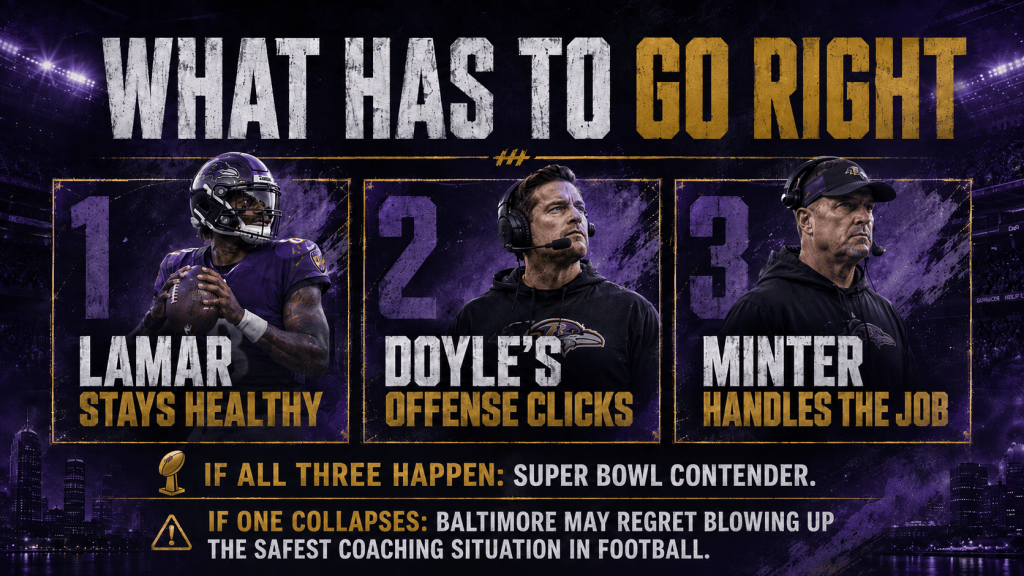
That feels roughly right, with an asterisk the size of Owings Mills. The roster has real reason for that confidence — beyond Jackson, Henry, Flowers, and Andrews, Baltimore added edge rusher Trey Hendrickson to a pass rush that finished near the bottom of the league in sacks last season, and used a top draft pick on guard Vega Ioane to help replace departed center Tyler Linderbaum up front. Rookie receivers Ja’Kobi Lane and Elijah Sarratt add size to a corps that already had plenty of speed. Add in a defense now run by a coordinator who’s been top-five in nearly every meaningful category the last two years, and this is a top-two or -three roster in the AFC on paper. The schedule sets up a fast start that could paper over growing pains. But a new head coach, a new offensive coordinator, and a quarterback trying to stay on the field are three separate variables the Ravens are betting will all break right, simultaneously, for a team that just fired the coach who got them to 25-9 over two seasons because it wasn’t quite enough.
Sunday’s roster cutdown didn’t change much of that math — Baltimore’s 53-man moves were mostly around the margins, headlined by a minor trade sending defensive lineman C.J. Okoye to the Giants (reuniting him with John Harbaugh) for a 2028 seventh-round pick, and offensive lineman Diego Pounds going to the Chiefs. The core of the roster that Vegas is pricing so aggressively arrived at Week 1 intact.
Baltimore doesn’t need a Super Bowl to justify pulling the trigger on this reset. It needs proof, by December, that the calculated risk was worth taking. If the offense looks alive and Jackson is upright in Week 13, the Buffalo gauntlet becomes a launching pad instead of a reckoning. If not, the “internal tension” that reportedly got Harbaugh fired will look like the good old days.


Leave a Reply