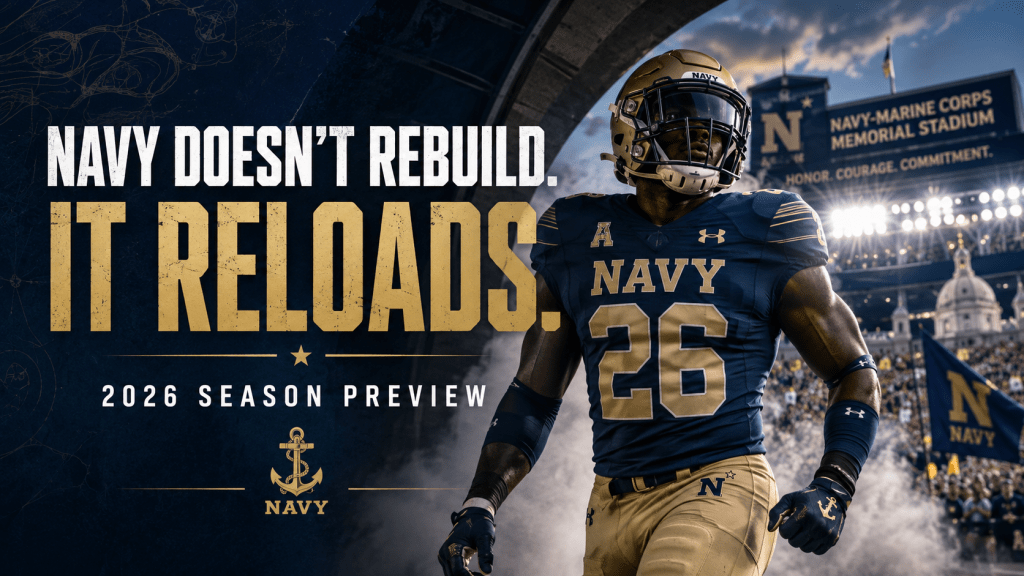
There’s a version of this article that writes itself every year in Annapolis: Navy loses its best players, nobody outside the program expects much, and the Midshipmen go win ten games anyway because the system doesn’t care who’s driving it. That’s basically been the story of the Brian Newberry era for two straight seasons now, and there’s no real evidence 2026 breaks the pattern — even though, on paper, this is the most talent Navy has had to replace at once in years.
Navy is coming off an 11-2 season, a Liberty Bowl win, a Top 25 finish, and a Commander-in-Chief’s Trophy secured on a 17-16 nail-biter over Army. The Midshipmen have won at least ten games in each of the last two years, and the oddsmakers think it keeps happening — Navy carries the best odds to win the American Conference at +360, and the win total sits at 7.5 with the over favored. That’s a lot of external confidence for a team replacing its quarterback, its top two skill-position playmakers, and its defensive coordinator all in the same offseason.
The Quarterback Change Nobody’s Panicking About
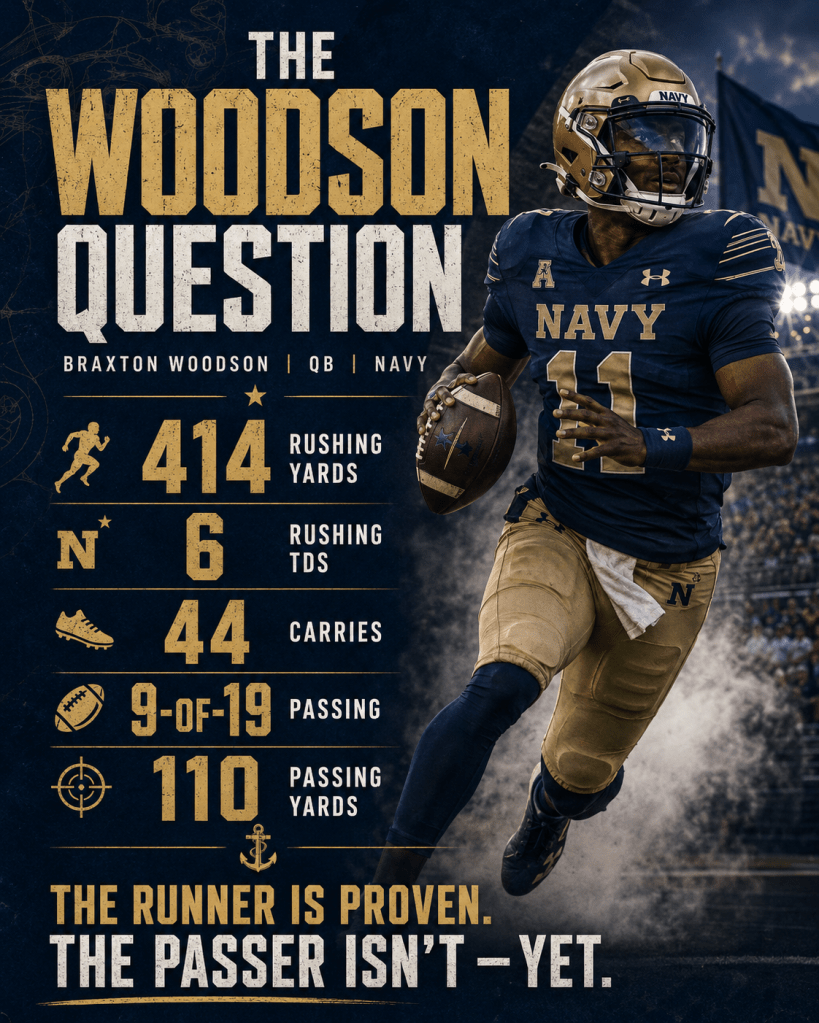
Blake Horvath is gone, and with him goes a guy who was the engine of Navy’s option offense for two years and the MVP of a Liberty Bowl win over Memphis. In most programs, losing that quarterback means a step back. At Navy, it means Braxton Woodson steps into a system that’s been designed for two decades to make the quarterback interchangeable by design — the triple option doesn’t need a star; it needs someone who reads the defense and doesn’t turn the ball over.
But it’s worth being precise about what Woodson actually showed in his backup role last season, because “he’s a proven commodity” isn’t quite right. As a runner, yes — 414 yards and six touchdowns on just 44 carries, including a signature relief performance against USF where he ran for 103 yards and two scores off the bench. As a passer, the sample is tiny and rough: 9-of-19 for 110 yards on the year. That’s not “struggled,” that’s barely tested. Woodson is a legitimately dangerous runner stepping into the job with almost no proven passing track record, in an offense that still needs enough of a passing threat to keep defenses honest. That’s the real variable here — not whether Navy’s system can produce, but whether Woodson can throw enough to keep it from becoming one-dimensional.
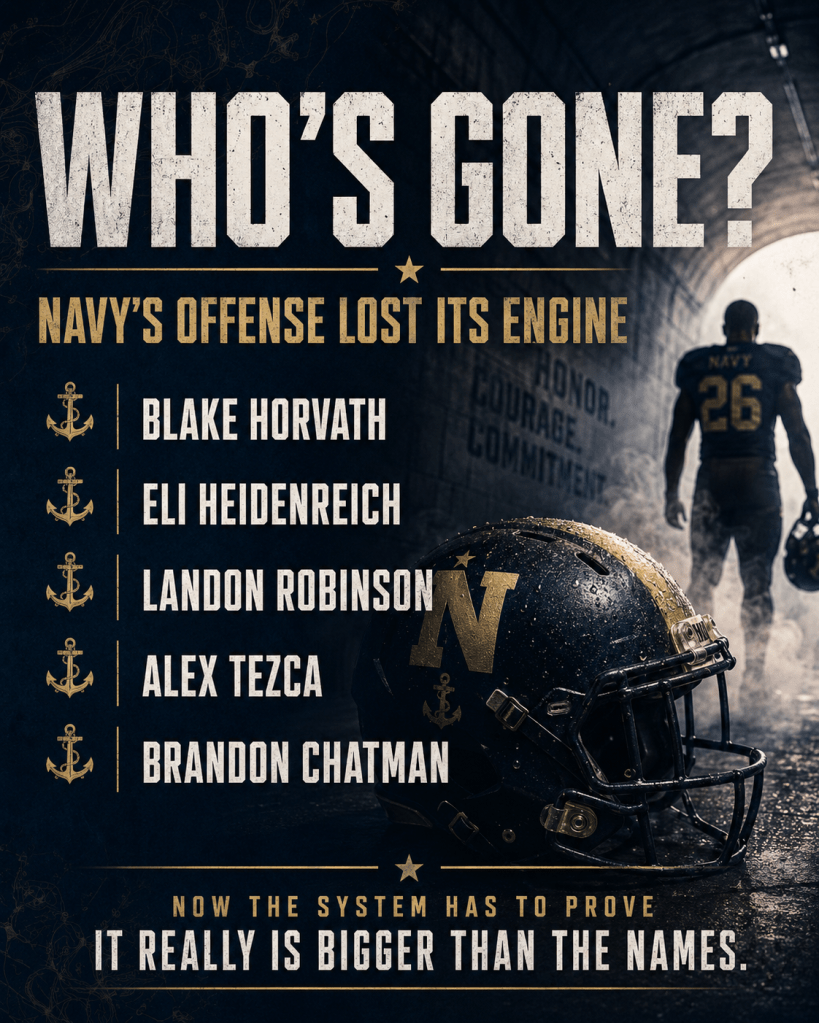
That’s not to undersell what’s gone on the personnel side, either. Navy also loses slotback Eli Heidenreich and running back/fullback Landon Robinson — the two players who, along with Horvath, were the actual engine of the offense’s big plays the last two seasons — plus running back Alex Tezca and slotback Brandon Chatman. That’s four skill-position starters gone from a team that scored in bunches. Navy needs breakout years from a mostly unproven receiving corps, and a quarterback who can complete enough throws to make them matter, for the Midshipmen to stay near the top of the conference rather than just competitive within it.
A Defense Breaking In a New Coordinator, But Keeping Its Anchors
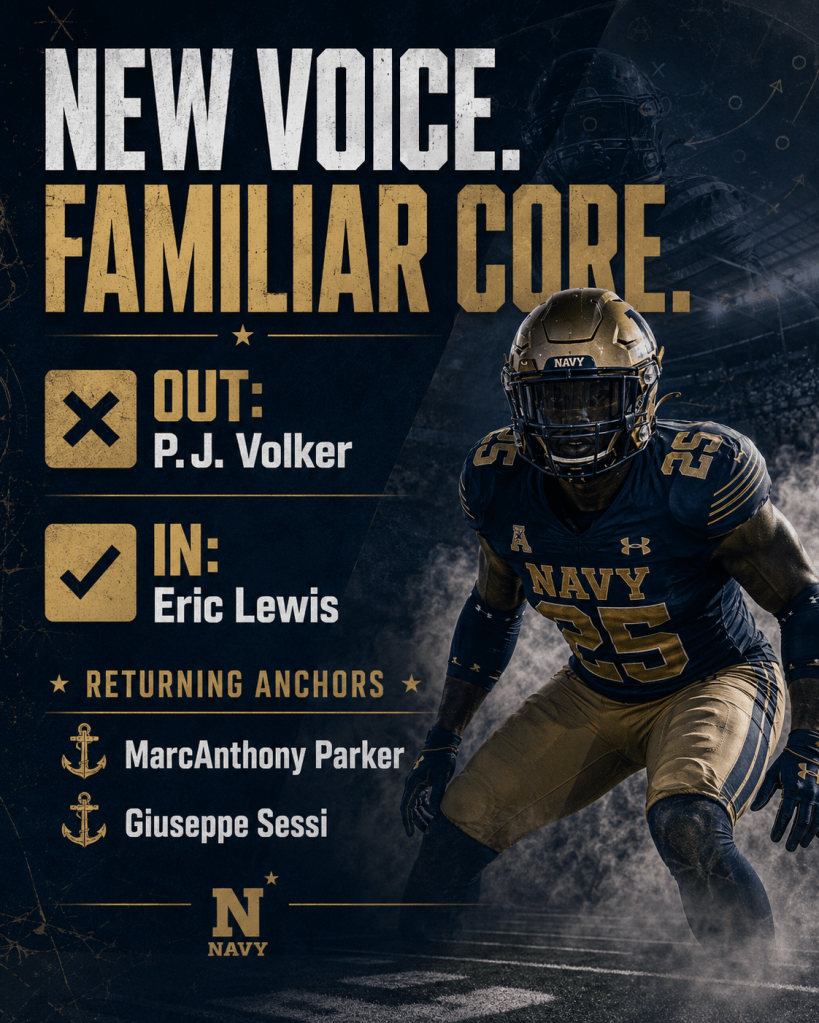
Navy also loses its defensive coordinator from last season, which is the kind of transition that can quietly sink a team’s floor even when the offense holds up. P.J. Volker ran the Midshipmen defense for seven seasons before leaving this offseason to become a safeties coach with the Baltimore Ravens; the job goes to Eric Lewis, promoted from safeties coach, who’s had two prior stints as an FBS coordinator at Eastern Michigan and Bowling Green. The good news: the personnel losses on that side of the ball are less catastrophic than on offense. Inside linebacker MarcAnthony Parker and strong safety Giuseppe Sessi both return as established starters and both earned preseason All-AAC recognition, giving Lewis a defense that isn’t starting from scratch even if the scheme changes.
The Schedule Is Almost Suspiciously Favorable Again
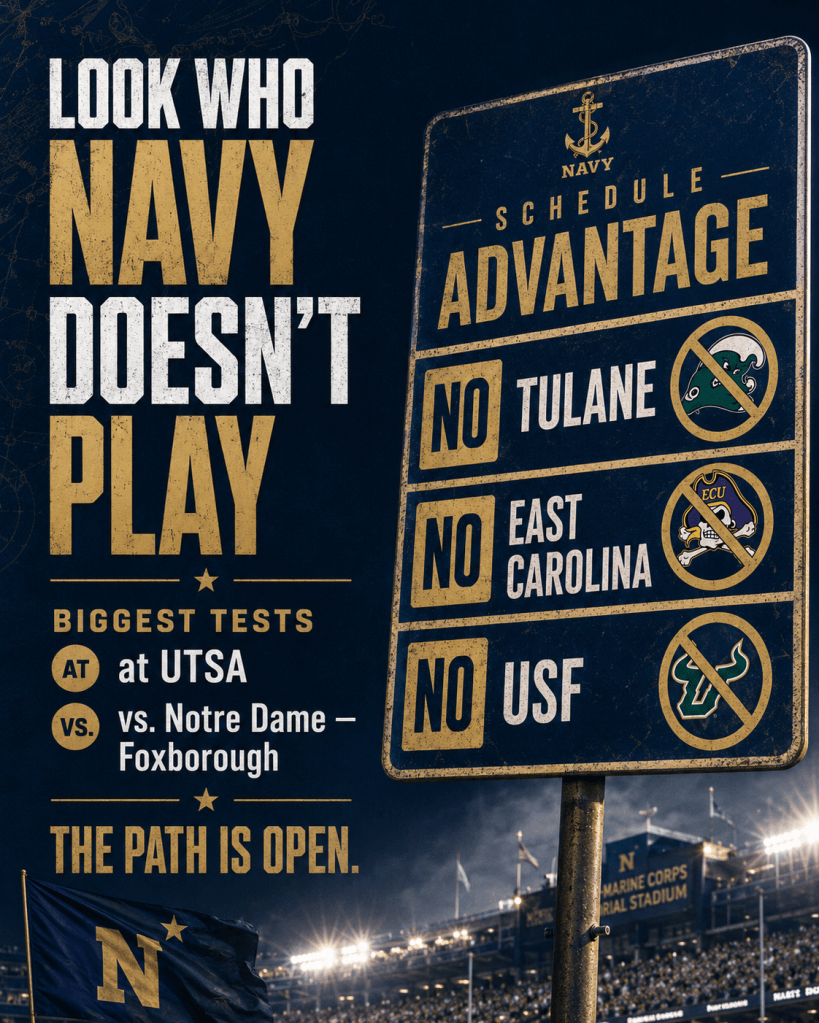
This is where Navy’s argument gets strong. For the second straight year, the Midshipmen miss both Tulane — the reigning conference champion that made the College Football Playoff — and a loaded East Carolina team. They also avoid USF and a Rice squad that gave Navy all it could handle in a tight 21-13 game last season. Add it up, and Navy’s toughest conference test might genuinely be a road trip to UTSA, which has built itself into a legitimate power at home.
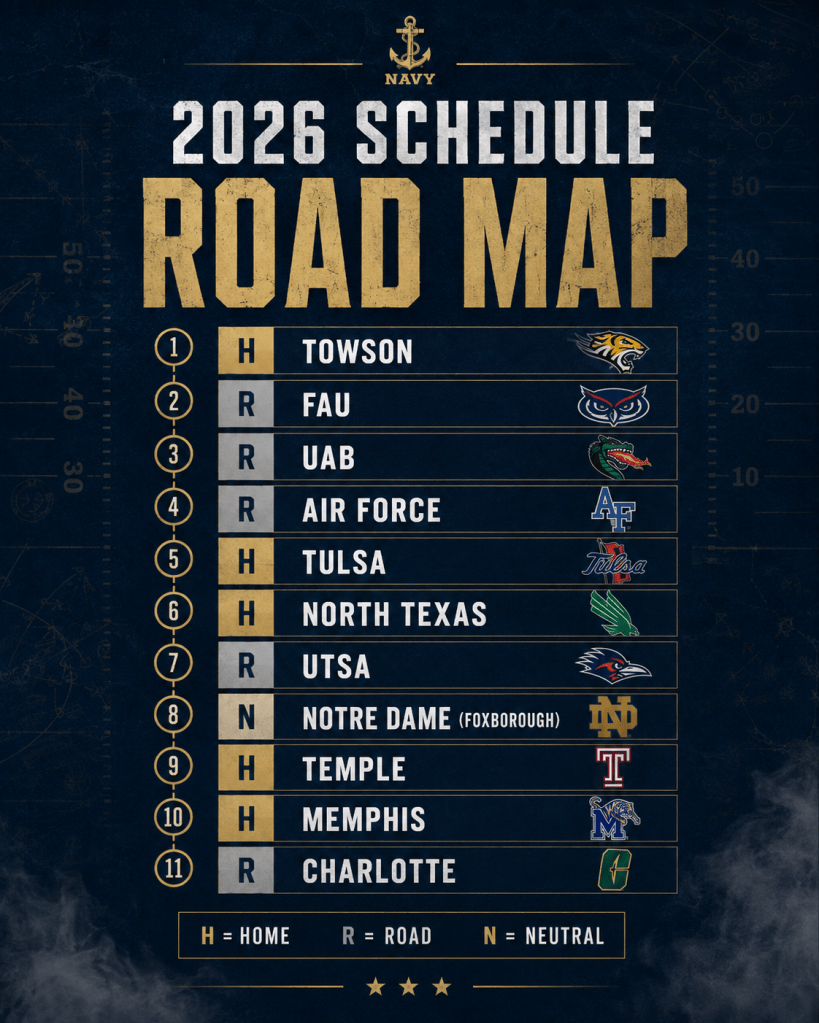
The full slate: Towson at home to open, then road trips to FAU and UAB, a trip to Air Force, Tulsa and North Texas at home, UTSA on the road, Notre Dame at a neutral site in Foxborough, then Temple and Memphis at home before closing conference play at Charlotte. Notre Dame remains the one game Navy simply isn’t going to win — the Irish have beaten the Midshipmen in the last two meetings by a combined score of 100-24, and there’s no reason to expect a different outcome in Foxborough. Beyond that, though, this is a schedule built for Navy to win nearly everything else, assuming the pieces around Woodson hold up.
Chasing What’s Actually Eluded This Program
Here’s the part of the story that should matter more than it usually does in the coverage: Navy has not been to the American Conference title game in ten years. Despite back-to-back 10-plus win seasons, the Midshipmen have watched Tulane and North Texas get there instead — last year, Navy’s own conference-title hopes died on a 31-17 loss to North Texas, a game that, had it gone the other way, would have put the Midshipmen in the championship instead of a very good but title-less season. This year’s slate sets up a legitimate path: after the Notre Dame game, Navy closes with Temple, Memphis and Charlotte, none of which represent the level of North Texas or Tulane at their best.
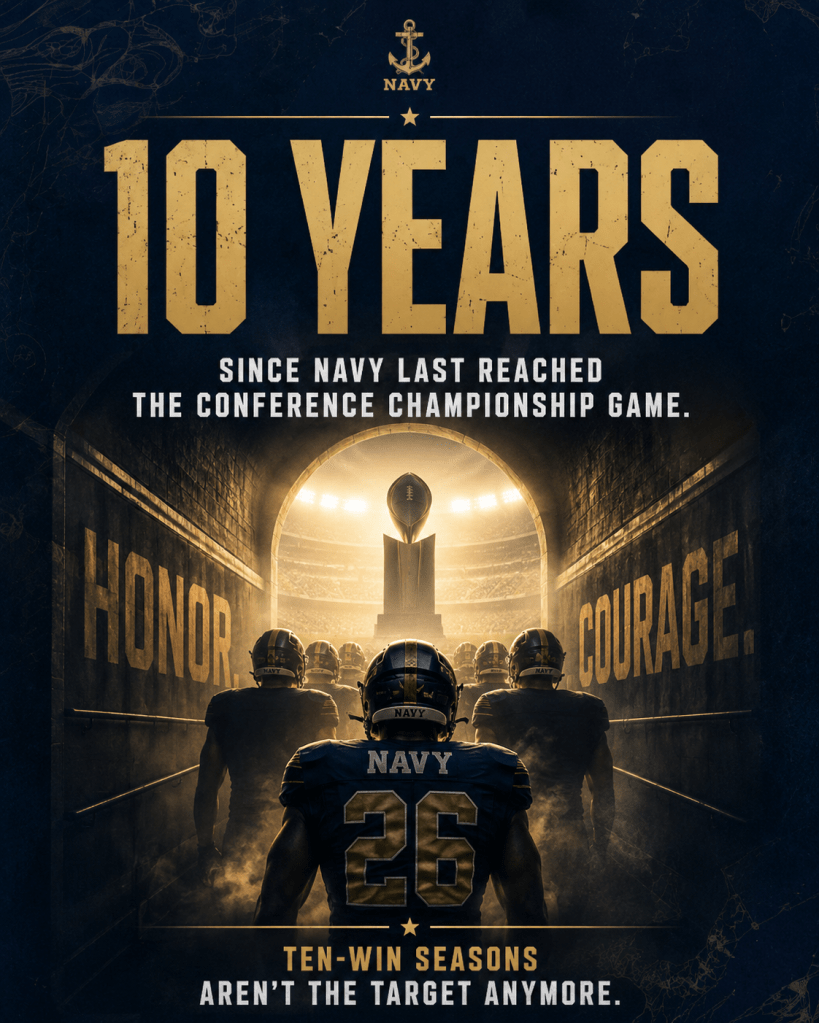
That’s the real 2026 storyline in Annapolis. It’s not whether Navy can be good — this program has proven for two years running that “good” is the floor under Newberry. It’s whether this is finally the year the Midshipmen get past the American’s other contenders and into the game they’ve been circling for a decade, with a Playoff berth theoretically in play if they can pull it off before Army-Navy even kicks off.
The Call
Navy loses more established playmaking than it has in years, breaks in a new quarterback and a new defensive coordinator simultaneously, and still gets a schedule that dodges every team capable of beating it outside of Notre Dame and a road trip to UTSA. That’s the Newberry-era formula, and betting against it hasn’t worked the last two years. The passing/receiving question marks are real, and there will probably be one game — a Friday night at UAB, a trip to UTSA, somewhere in that stretch — where a shorthanded skill group gets exposed. But the margin for error built into this schedule is wide enough to absorb one bad night.
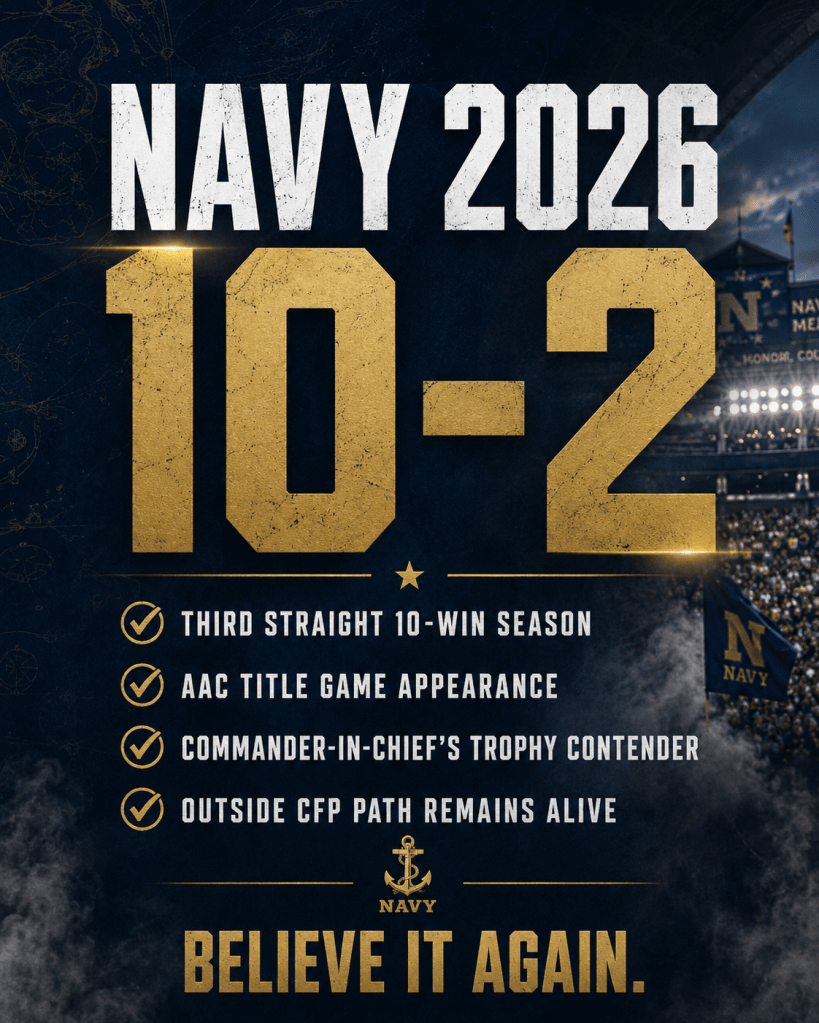
Prediction: 10-2, an American Conference title game appearance, and a third straight ten-win season. Notre Dame stays a loss no matter what. The other loss is a coin flip between UTSA and a bad Friday night somewhere on the road — but for the first time in a decade, Navy has a real shot at getting the thing that’s eluded Newberry’s program even during its best two years: a trip to the American Conference Championship, with the door to something bigger than that still technically open.


Leave a Reply