
Every couple of years, Maryland football finds a new reason to believe. This time it’s a sophomore quarterback with a home-state pedigree, a new offensive coordinator promising a scheme that finally fits him, and a schedule that dodges most of the Big Ten’s actual contenders. It’s a good pitch. It’s also, more or less, the same pitch College Park has been selling since the last bowl trip three years ago — and the product hasn’t changed nearly as much as the marketing suggests.
Maryland enters 2026 off consecutive 4-8 seasons under Mike Locksley, now in year eight, with a fanbase that’s split between “this is finally the year” and “haven’t we heard this before.” Both camps have a point. This is arguably one of the more talented rosters Locksley has fielded in College Park. It’s also a team that hasn’t proven it can finish games, hasn’t fixed the thing that’s been broken for two straight years, and is walking into a season where anything short of a bowl bid puts the head coach’s job in real jeopardy.
The Quarterback Question Everyone’s Ignoring
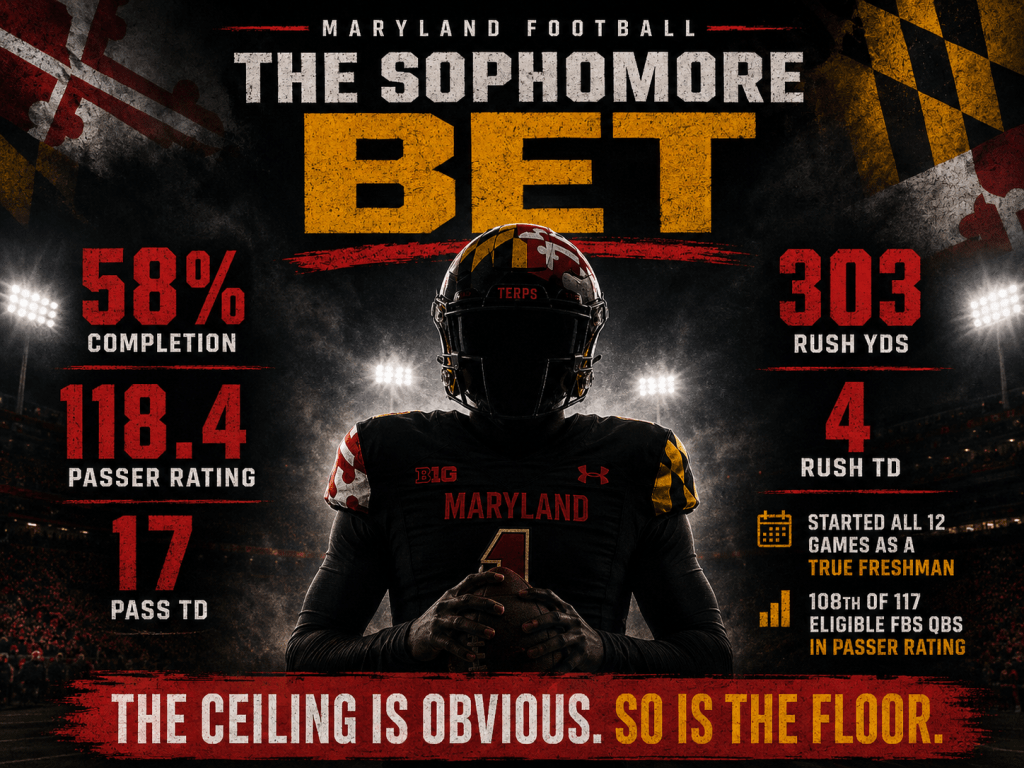
The optimism around Malik Washington is understandable. He’s a 6-foot-5, 231-pound dual-threat who started all 12 games as a true freshman, threw for 17 touchdowns, ran for 303 yards and four scores, and looks the part of a Big Ten quarterback. Maryland fans have latched onto the ceiling and are choosing not to look too hard at the floor.
Here’s the floor: Washington completed 58 percent of his passes and posted a 118.4 passer rating last season — good for 108th out of 117 eligible FBS quarterbacks. That’s not “rookie growing pains with obvious flashes.” That’s bottom-ten-percent production from the position that determines almost everything else about how this season goes.
New offensive coordinator Clint Trickett is bringing in a spread system that’s supposed to be a better fit for Washington’s skill set than whatever Maryland was running in 2025, and there’s a real argument that scheme, not talent, was the problem. But “the system will fix him” is the same bet programs make right before the quarterback doesn’t get fixed. Maryland doesn’t have much of a safety net if it doesn’t work — Kent State transfer Devin Kargman is a career 49 percent passer, and the presumed backup, Justyn Martin, has barely played since a Week 1 injury wiped out his 2025.
A Run Game That Was Actually the Worst Part of the Team
If the quarterback situation is a coin flip, the run game is the actual crisis. Maryland finished 124th nationally in rushing offense last season and had the second-worst ground attack in the entire Big Ten, averaging just 104.3 yards per game. Sophomore DeJuan Williams started nine games and managed only 3.9 yards per carry — respectable receiving numbers (45 catches, 426 yards) don’t make up for a run game that gave opposing defenses nothing to fear.
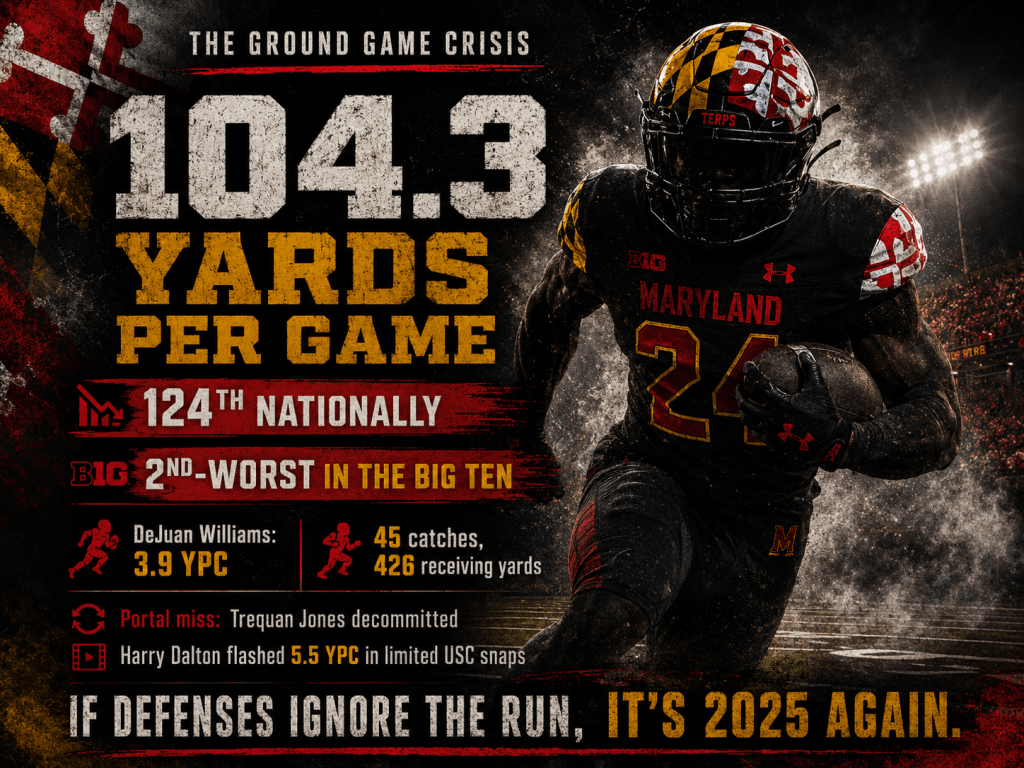
The offseason plan to fix it went sideways almost immediately. Old Dominion transfer Trequan Jones was Maryland’s first big portal commitment at running back, verbally committed, and then backed out to sign with Tulsa instead. That’s not a rounding error — that’s the position group’s best offseason addition walking away, leaving Williams and a genuinely unproven room to try to be better by default rather than by upgrade. USC transfer Harry Dalton flashed a 5.5 yards-per-carry average in limited snaps as a Trojan, but “limited snaps for USC” and “lead back in the Big Ten” are very different jobs.
If Trickett’s spread scheme opens things up for Washington through the air, this offense can be functional. If defenses can sit on the pass because the run game still doesn’t exist, it’s 2025 again with better vibes.
The Schedule Is Doing Locksley a Favor
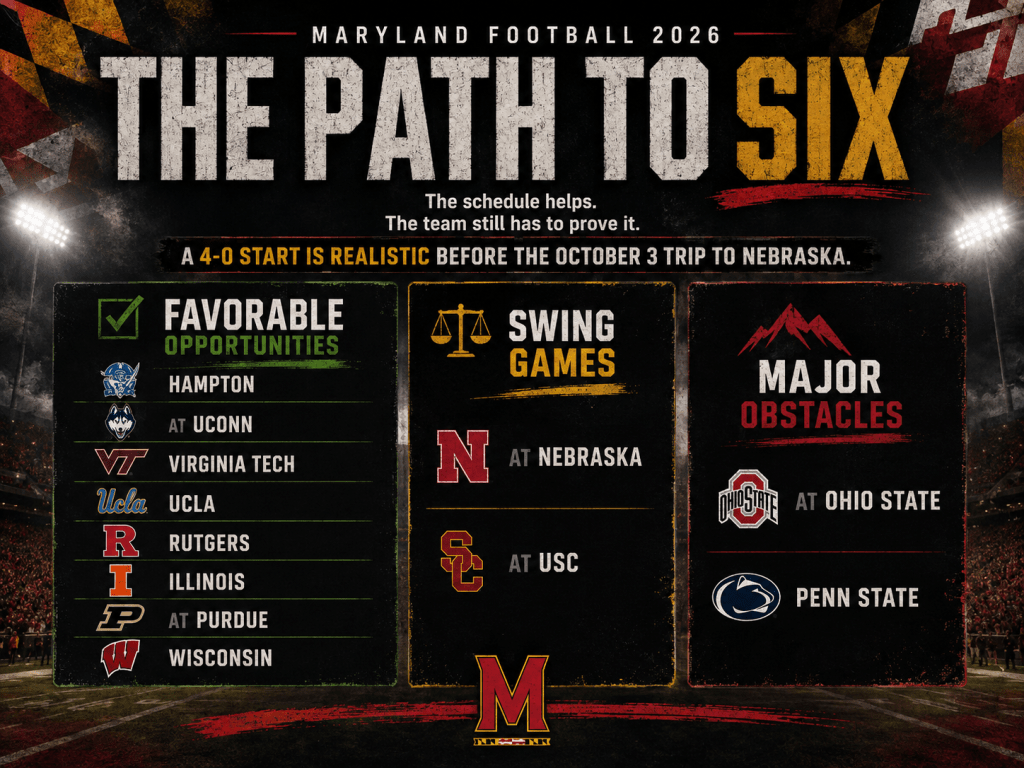
Whatever doubts exist about the roster, the schedule genuinely helps. Maryland avoids Indiana, Michigan, Oregon, Washington, Iowa and Minnesota entirely — essentially ducking the Big Ten’s upper tier outside of the two toughest games on the board. The slate opens soft: Hampton at home, a trip to a rebuilding UConn team, then Virginia Tech and UCLA both in College Park. A 4-0 start before an October 3 trip to Nebraska is realistic, maybe even the expectation.
Then the calendar turns. Back-to-back road games at Nebraska and at Ohio State bookend the first week of October, and neither is winnable in any world where this team’s identity is still “well-meaning offense, shaky trenches.” After that, though, the back half is where the season actually gets decided: Rutgers and Illinois at home, a road trip to a Purdue team that went 0-9 in Big Ten play a year ago, Wisconsin back in College Park, a finale at USC, and a home closer against Penn State. Strip out Ohio State and Penn State as near-certain losses, and Maryland has a legitimate path to seven or eight wins if the offense is even league-average.
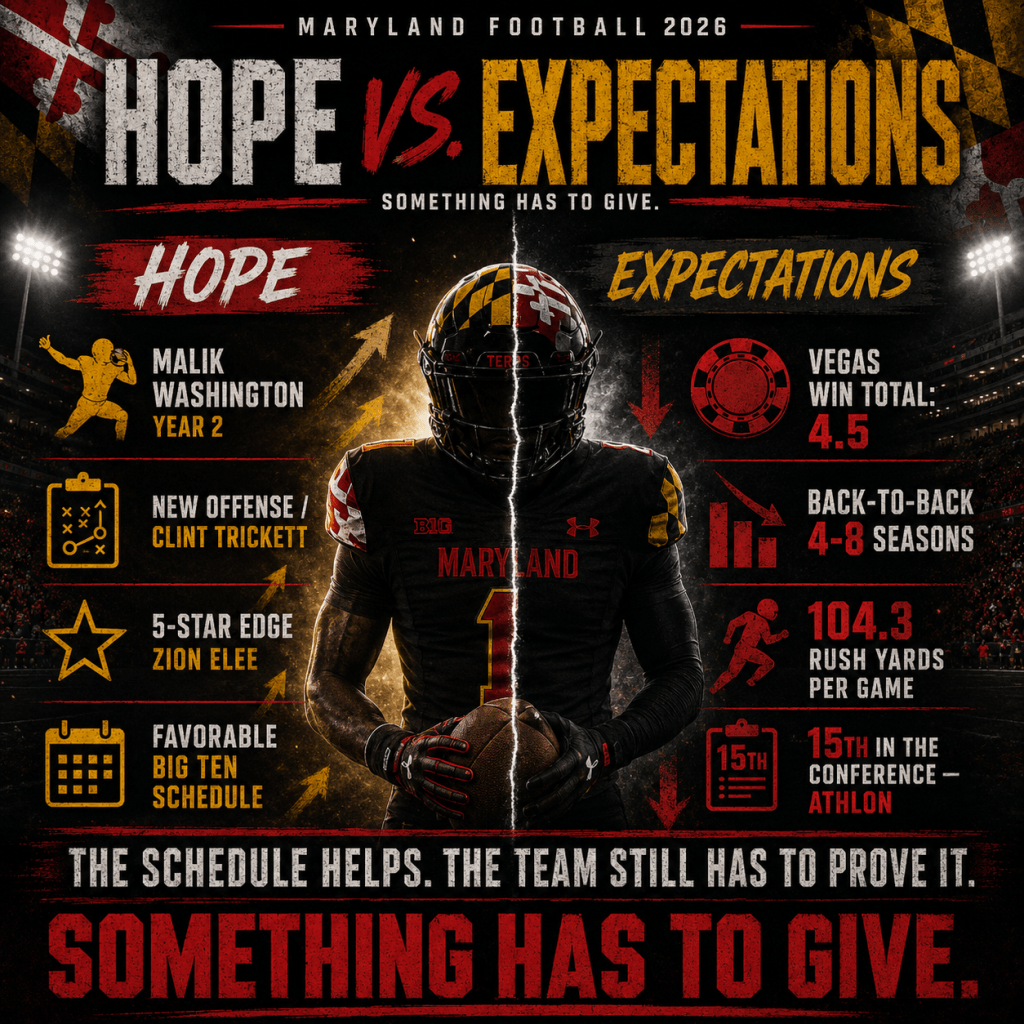
That’s the tension in one sentence: the schedule says bowl game, the tape says 4-8 again. Vegas is closer to the tape — the over/under on Maryland’s win total sits at 4.5, and Athlon Sports’ preseason projection has the Terps 15th in the conference, ahead of only Purdue, Northwestern and Rutgers.
Locksley’s Seat, and the Part Nobody Wants to Say Out Loud
Buried under the offensive storylines is the more uncomfortable one: Mike Locksley is coaching for his job. Two straight 4-8 seasons, one Big Ten win in each of the last two years, and a program that’s gone from three consecutive bowl trips (2021-23) to the bottom third of the conference. One coaching value metric ranks him 59th among Power 5 head coaches and 16th in the Big Ten — a startling number for someone who was, not that long ago, one of the sport’s feel-good rebuilding stories.
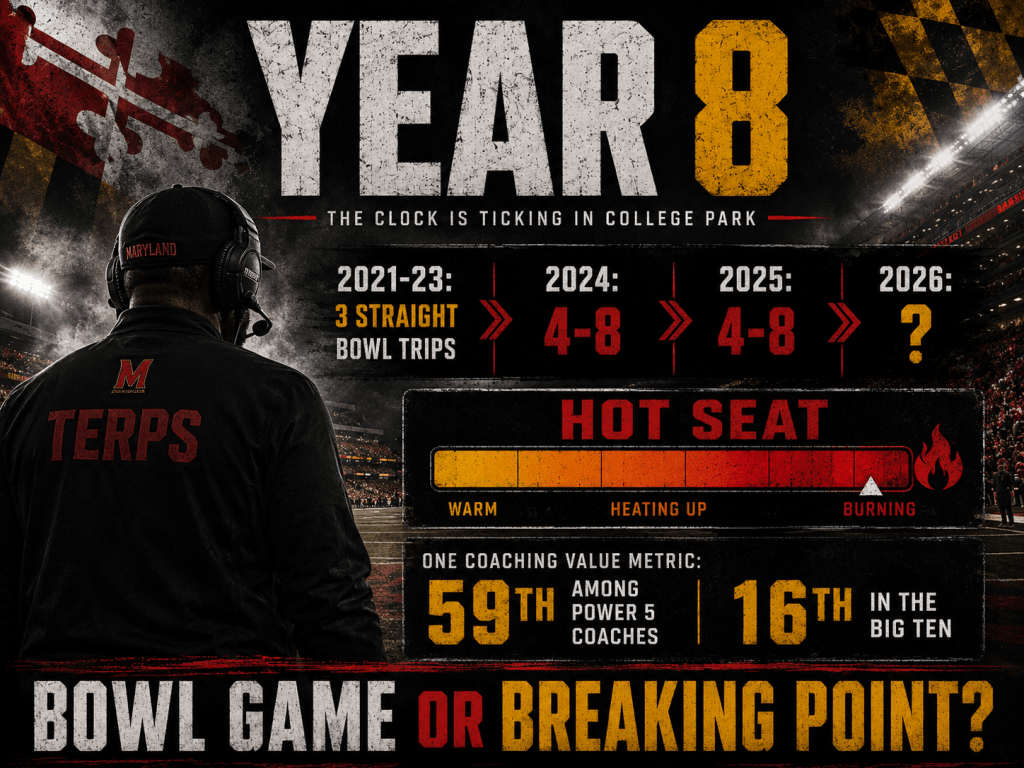
The maddening part for Maryland fans is that the record undersells how close last season actually was. The Terps went 0-3 in one-score games in 2025, including a 24-20 loss to Washington that got away late. Read generously, that’s a team one or two plays from 6-6 or 7-5 last year. Read skeptically, it’s a program that consistently finds ways to lose the games it should win — and that pattern doesn’t disappear just because the schedule got easier.
Defensively, there’s actual reason for cautious optimism. Ted Monachino returns for his second year as defensive coordinator; the secondary should be a strength led by senior safety Lavain Scruggs, and Maryland landed the highest-rated recruit in program history in five-star edge rusher Zion Elee. If the defense takes a real step, it can cover for an offense that’s still figuring itself out.

The Call
Maryland has more talent and an easier schedule than it’s had in years, and neither of those things has translated into wins under Locksley when it’s mattered. The offensive line needs to be better than it’s shown, the quarterback needs to be significantly more efficient than a bottom-ten-percent season, and the run game needs to climb out of the bottom five nationally — all at once, with a first-year coordinator installing a new system. That’s a lot of variables that all need to break in the same direction.
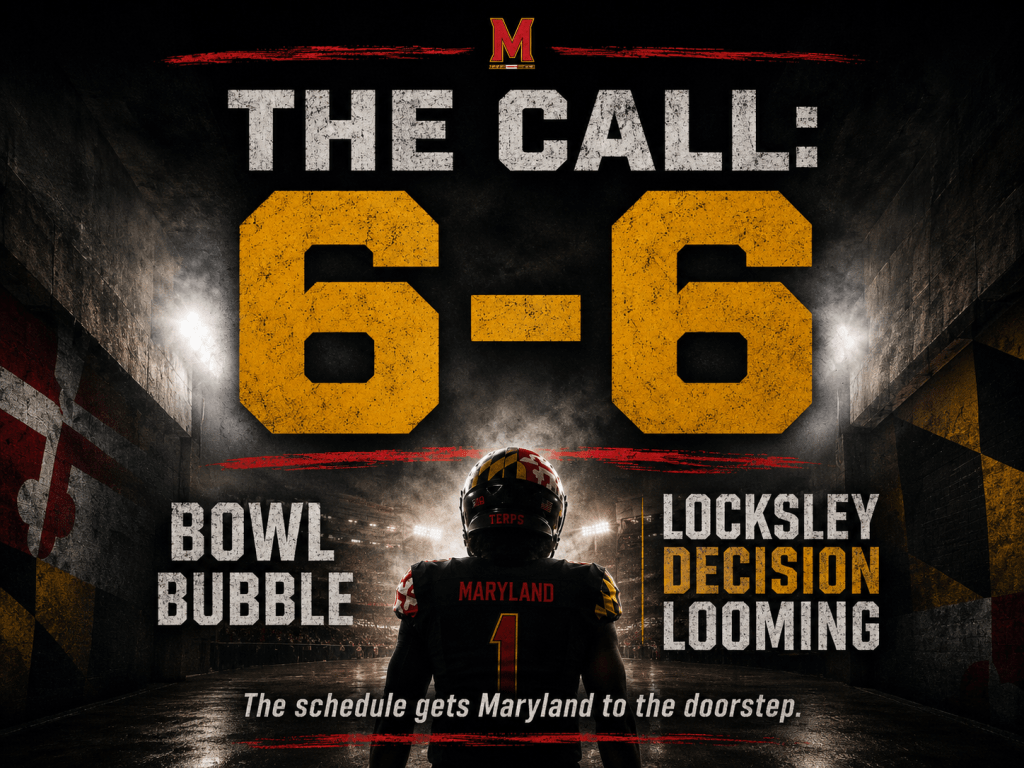
Prediction: 6-6, on the bubble for a bowl bid, with Locksley’s future in College Park decided by how the last month of the season goes. The schedule gets Maryland to the doorstep. Whether they walk through it depends on whether Malik Washington’s sophomore leap is real or just something Terps fans needed to believe in one more time.


Leave a Reply