By Michael Phillips | Sports & Whatever | IndyCar
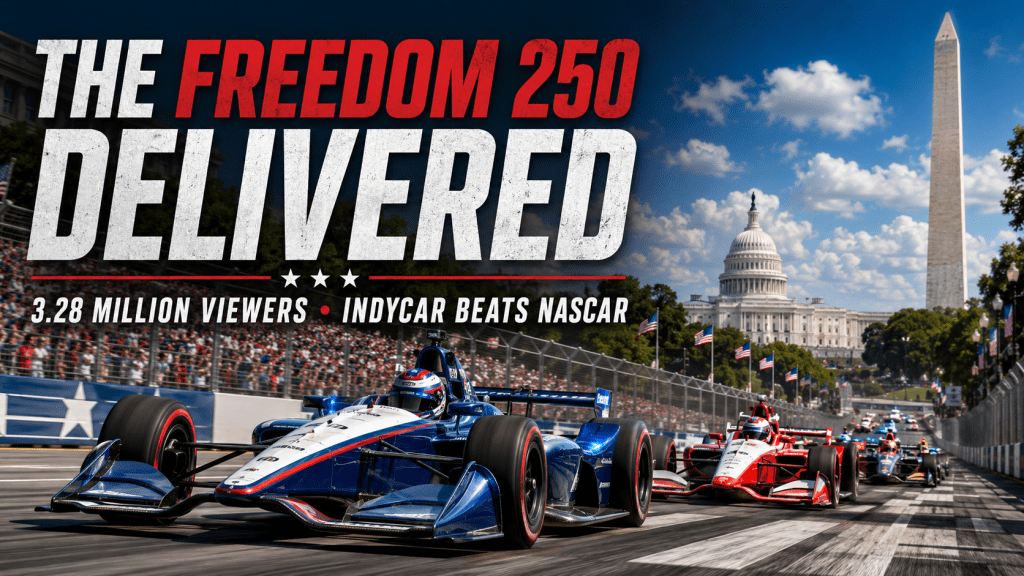
Say whatever you want about the politics behind it — and plenty of people have — the Freedom 250 Grand Prix delivered. Not “exceeded modest expectations” delivered. Not “solid for a first-year event” delivered. The August 23 street race through the National Mall put up numbers IndyCar hasn’t seen outside of the Indy 500 in nearly two decades.
The TV Numbers Are Absurd
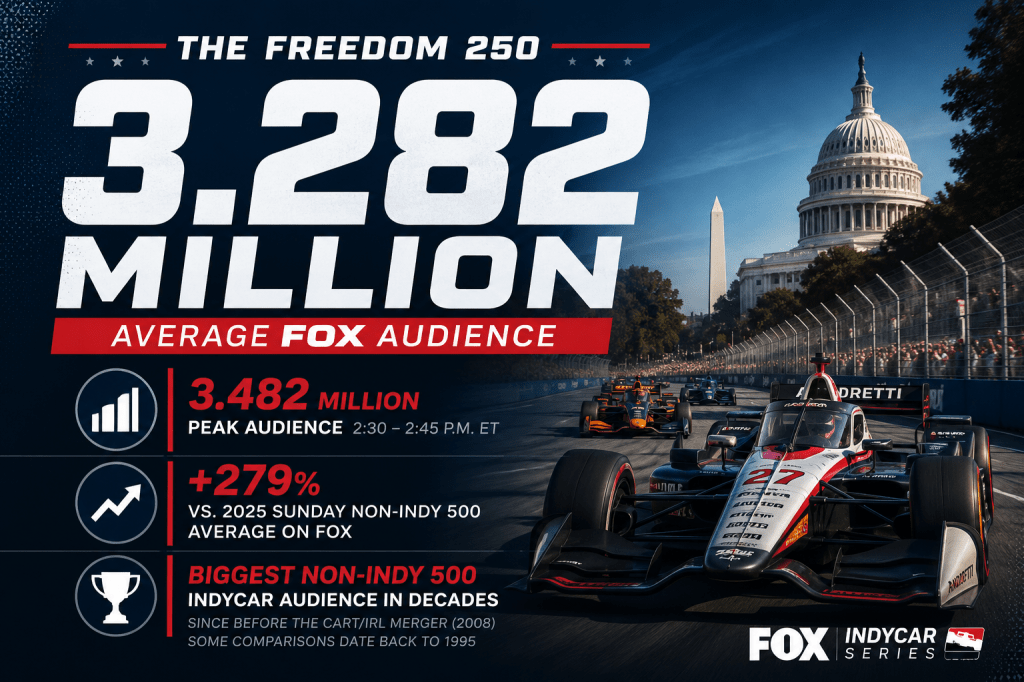
FOX’s broadcast of the Freedom 250 averaged 3,282,000 viewers, peaking at 3,482,000 between 2:30 and 2:45 p.m. ET as Kyle Kirkwood was closing in on the win. That’s the largest audience for a non-Indy 500 IndyCar race since before the CART/IRL merger in 2008 — some outlets are dating the comparison back even further, to 1995.
To put that in context: it’s a 279% increase over the average viewership for Sunday non-Indy 500 races on FOX last season. Not 79%. Two hundred seventy-nine.
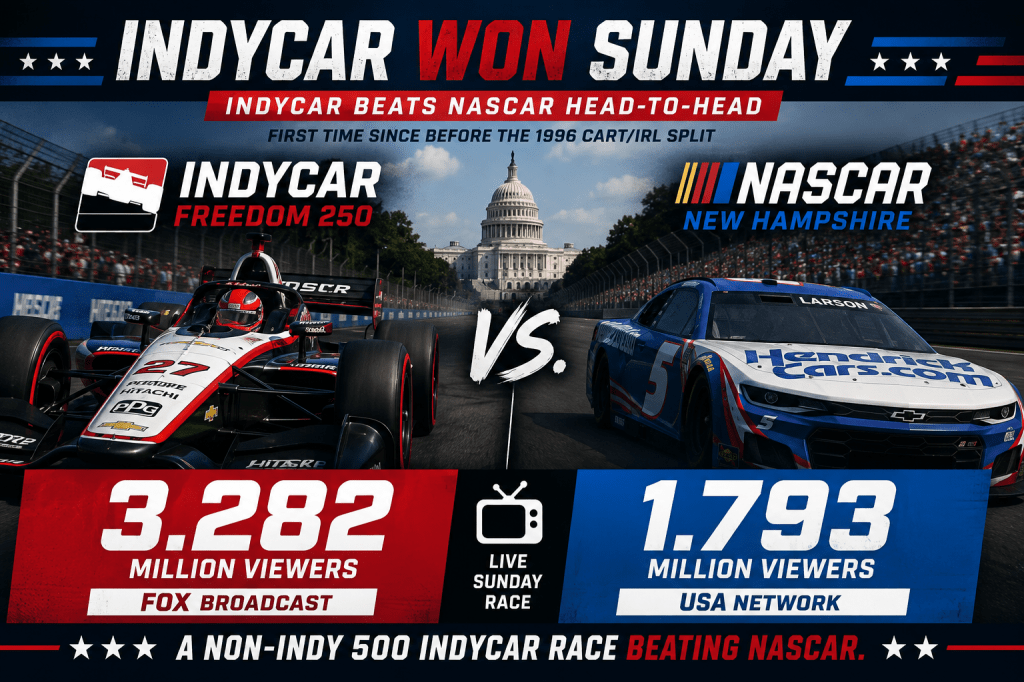
It wasn’t just a good number in isolation, either — it beat NASCAR head-to-head. The Cup Series race in New Hampshire that same Sunday drew 1.793 million viewers on USA Network, well below the Freedom 250’s audience. A non-Indy 500 IndyCar race beating NASCAR straight up hadn’t happened since before the 1996 CART/IRL split.
“A non-Indy 500 IndyCar race beating NASCAR straight up hadn’t happened since before the 1996 CART/IRL split.”
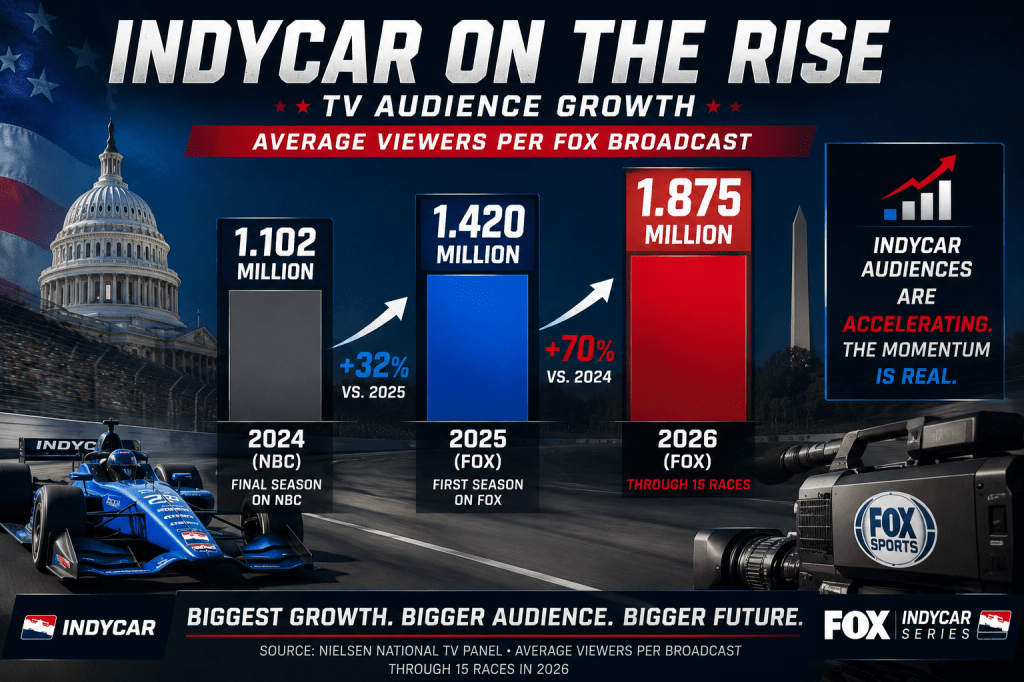
The ripple effect lifted the whole season. Through 15 races, FOX’s IndyCar broadcasts are now averaging 1.875 million viewers — up 32% from FOX’s first year holding the exclusive rights in 2025, and up 70% from NBC’s final season broadcasting the series in 2024.
Attendance and Economic Impact
On the ground, organizers projected roughly 140,000 to 150,000 spectators per day heading into the weekend — a figure that hasn’t been independently verified after the fact, and at least one post-race recap cites “140,000 attendees” without specifying whether that’s a daily or weekend-total number. Treat it as a rough ballpark, not a hard count. Still, for a free event, the scale matters: free admission inflates attendance, but it also genuinely expands who gets exposed to the sport.
“Free admission inflates attendance, but it also genuinely expands who gets exposed to the sport.”
The economic impact projections are wide-ranging depending on who’s doing the estimating. Penske Corporation president Bud Denker put the number at $100 million to $200 million in economic benefit for D.C. Other reporting citing the White House and race organizers has cited north of $200 million. And per Sports Business Journal’s Adam Stern, citing IndyCar’s own figures, the race generated over $2 billion in media exposure value — the most of any event on IndyCar’s books, ahead of even the Indy 500 itself.
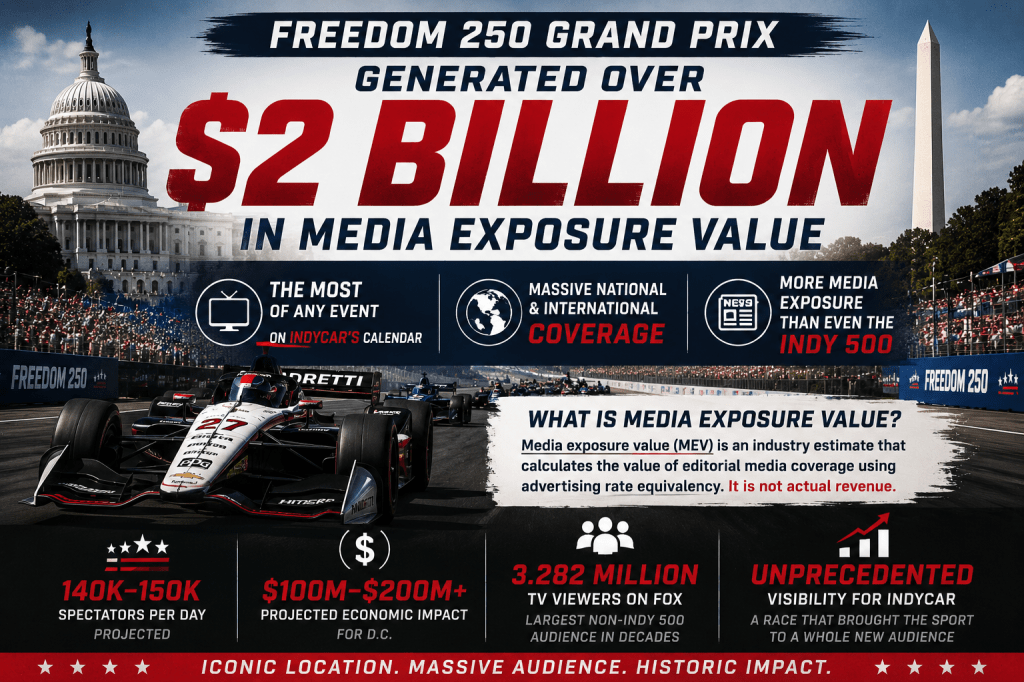
That media-value figure is worth sitting with. It’s a metric IndyCar and its partners have every incentive to report generously, and “media exposure value” as a category is notoriously squishy — it’s usually built from ad-equivalency models applied to editorial coverage, which is a methodology sports marketers love and skeptics love to poke holes in. Still, even discounted, it reflects a race that generated a genuinely unusual volume of coverage: national news, international wire pickup, non-sports outlets covering it as a political and cultural story as much as an athletic one.
The Cost Side Nobody’s Ignoring
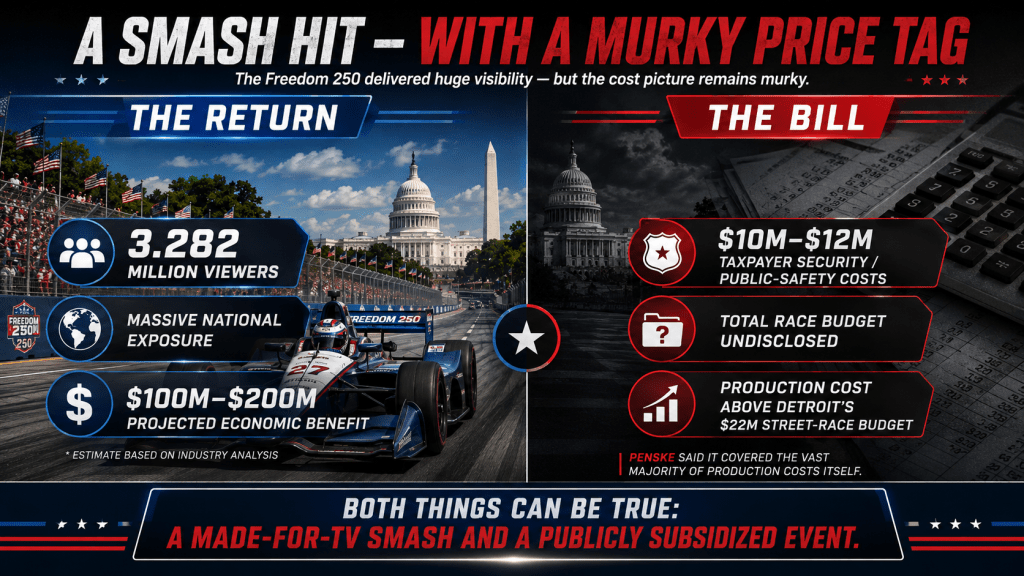
None of this came free, and the accounting isn’t clean. Federal filings and reporting put taxpayer-funded security and public-safety costs at $10 million to $12 million, drawn in part from a separate $90 million special events fund tied to the broader “Freedom 250” 250th-anniversary programming. Penske says it covered the “vast majority” of production costs itself and received no funding from the Freedom 250 Commission, but the race’s total budget — which Denker said “far exceeded” Detroit’s $22 million street race budget — has never been fully disclosed.
“This was a financially murky, publicly subsidized event that also happened to be a made-for-TV smash.”
So the honest framing is: this was a financially murky, publicly subsidized event that also happened to be a made-for-TV smash. Both things are true at once, and depending on your priors, one matters a lot more than the other.
Why It Worked
Strip away the politics and the made-for-cable-news optics — the presidential parade lap, the opening ceremony spectacle, the National Guard presence — and the on-track product actually delivered.
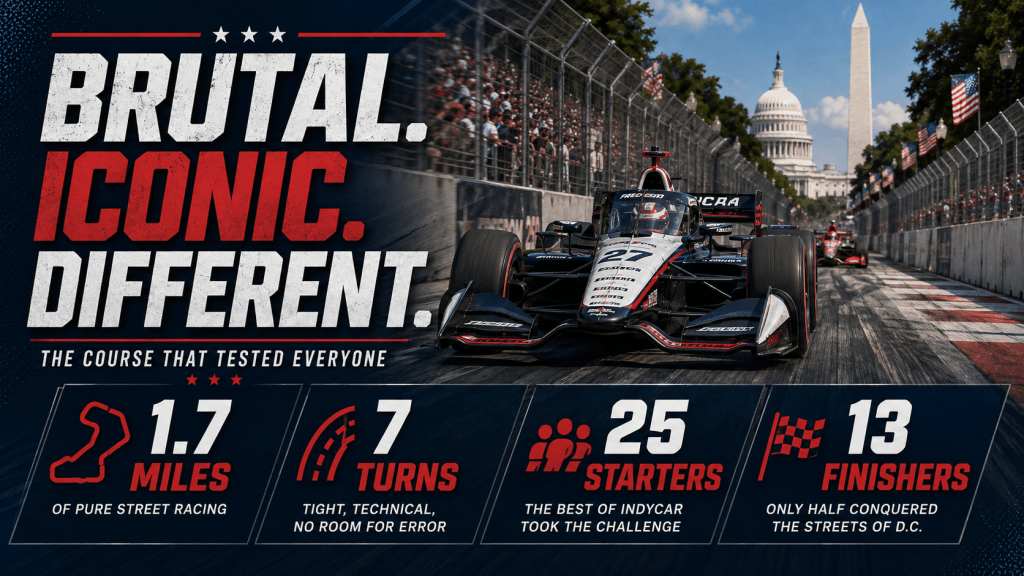
Kirkwood dominated for his second win of the season, only 13 of 25 cars finished on a brutal seven-turn, 1.7-mile circuit carved out of Pennsylvania Avenue, and the visuals (cars ripping past the Capitol and the Washington Monument, an “Owl Cam” perched above the track) gave FOX a broadcast package unlike anything IndyCar has produced.
Novelty, difficulty, and a compelling finish is a formula that works regardless of what’s happening in the opening ceremony.
The Open Question
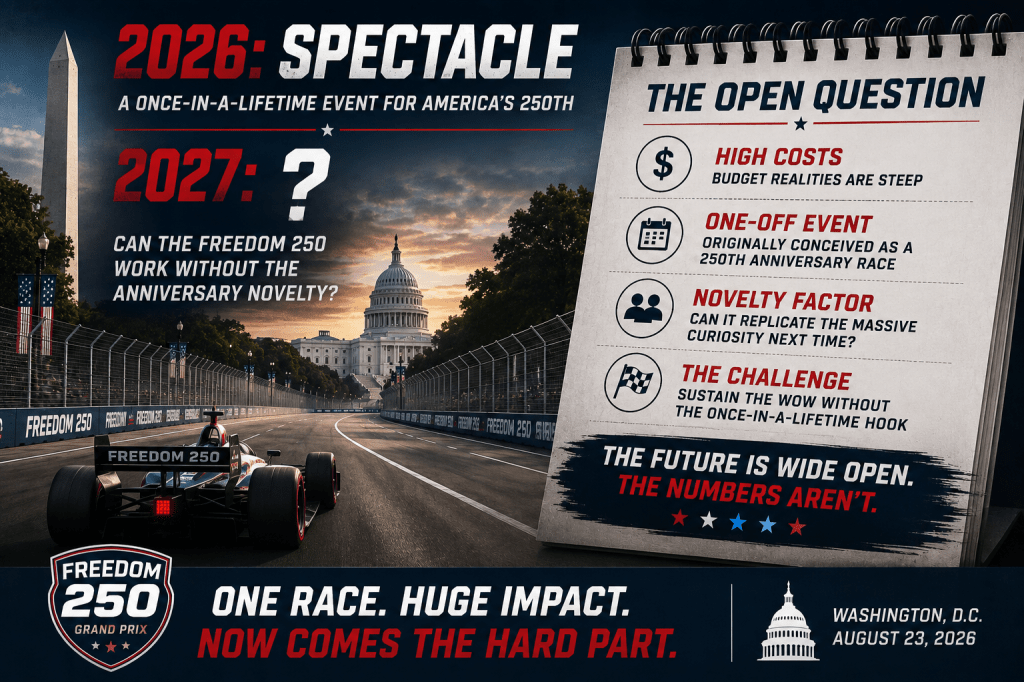
Whether the Freedom 250 becomes an annual fixture is genuinely unresolved. It was originally conceived as a one-off tied to the country’s 250th anniversary; the budget realities are steep, and there’s a real question — raised even by IndyCar-friendly commentators — about whether a second or third running can replicate the “once in a lifetime” curiosity factor that drove a chunk of this year’s audience. Novelty races don’t always sustain their numbers once the novelty wears off.
“For one Sunday in August, IndyCar won that fight outright.”
But as a proof of concept for what an IndyCar street race in a genuinely iconic American setting can do for the sport’s visibility, the Freedom 250 is close to a best-case outcome. The series spent years fighting for relevance against NASCAR and F1’s Drive to Survive-fueled American boom. For one Sunday in August, IndyCar won that fight outright.


Leave a Reply