
By Michael Phillips | Sports & Whatever | LIV Golf
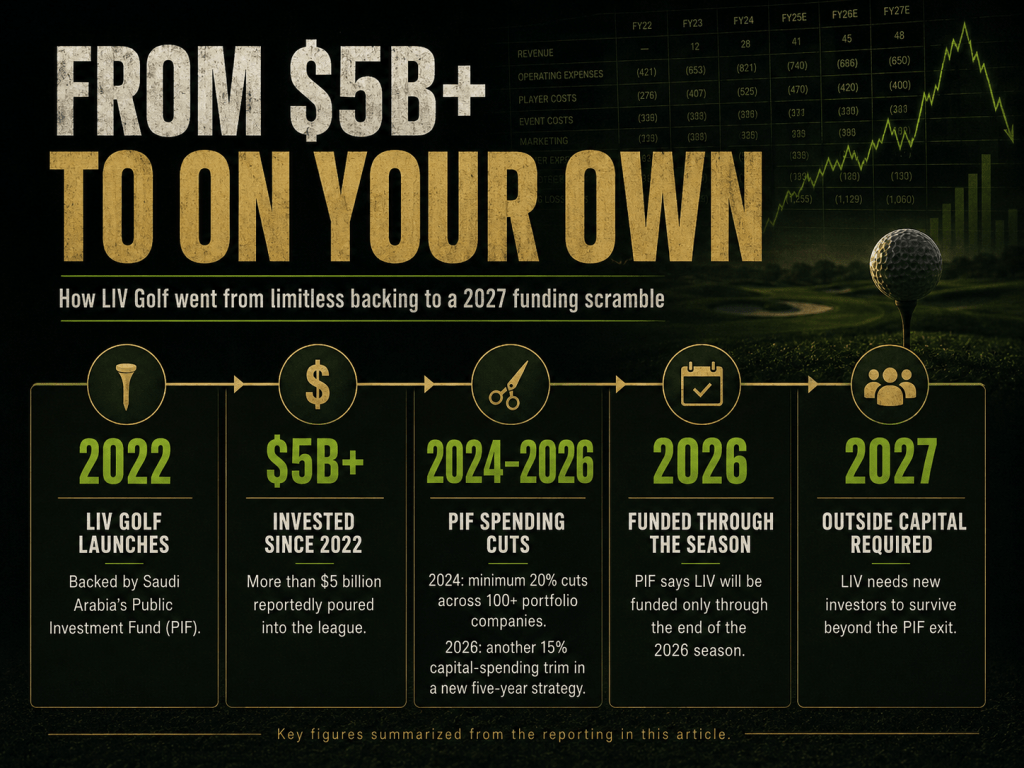
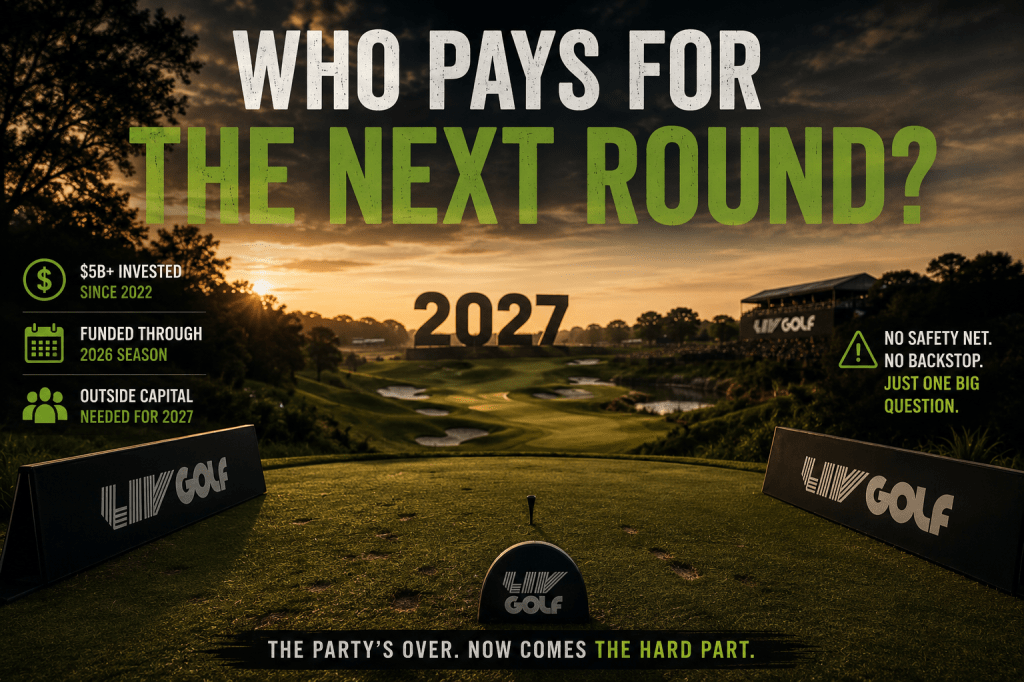
For four years, LIV Golf ran on a simple premise: money solves everything. Enough of it could buy the sport’s biggest stars, build a made-for-TV product from scratch, and eventually force golf’s establishment to fold. This spring, that premise met its limit. Saudi Arabia’s Public Investment Fund — the sovereign wealth juggernaut that had poured more than $5 billion into the league since its 2022 launch — told LIV it would fund the operation only through the end of the 2026 season. After that, the league is on its own.
It’s a stunning reversal for a project that once looked unstoppable simply because its backer seemed to have infinite patience and an even larger checkbook. Understanding how LIV got here — and where it goes next — means looking past the fireworks and shotgun starts and into the spreadsheet.
“Understanding how LIV got here — and where it goes next — means looking past the fireworks and shotgun starts and into the spreadsheet.”
The Retreat Nobody Wanted to Announce
PIF didn’t frame the decision as a verdict on golf. In its official statement, the fund said simply that “the substantial investment required by LIV Golf over a longer term is no longer consistent with the current phase of PIF’s investment strategy,” citing “investment priorities and current macro dynamics.” Translated out of sovereign-wealth-fund language: Saudi Arabia has bigger, less optional bills to pay, and LIV isn’t one of them.
The numbers behind that shift are stark. Saudi Arabia is projecting a budget deficit of roughly $44 billion for 2026, on top of a rough 2025. Aramco, the national oil company PIF partly owns, slashed its dividend by about $40 billion for 2025, and PIF’s own cash reserves fell to their lowest level since 2020. In response, PIF ordered a minimum 20% spending cut across more than 100 portfolio companies back in December 2024 — with some individual project budgets cut by as much as 60% — and followed that in early 2026 with a new five-year strategy trimming capital spending by another 15%, this time reorienting the fund around artificial intelligence infrastructure and two fixed, deadline-driven commitments: Expo 2030 and the 2034 FIFA World Cup.
Those two events get protected because they can’t be delayed — FIFA and the Bureau International des Expositions don’t renegotiate on Saudi Arabia’s fiscal calendar. LIV Golf, with no external deadline forcing anyone’s hand, had no such protection. It also didn’t have LIV CEO Scott O’Neil’s own words working in its favor. Weeks before the announcement, he told reporters at a tournament in Mexico City that LIV was “funded through the season” and would then have to “work like crazy as a business to create a business plan to keep us going” — the kind of admission that tends to look prophetic in hindsight.
A League That Never Quite Became a Business
The core problem PIF is walking away from isn’t complicated: LIV never generated anything close to the revenue required to justify its spending. The league’s non-U.S. operations reportedly lost nearly $600 million in 2024 alone, with net spending averaging roughly $100 million a month across 2024 and 2025. New broadcast deals with Fox, DAZN, IVT and others, along with sponsorships from Rolex, HSBC and Salesforce, have LIV on pace for about $100 million more in revenue in 2026 than the year before — real growth, but nowhere near enough to close a loss that size once the checks from Riyadh stop coming.
Television is where the gap becomes impossible to ignore. Across 17 Fox broadcasts during the 2025 season, LIV averaged 338,000 viewers; PGA Tour final rounds averaged 2.66 million across NBC and CBS that same year — a roughly seven-to-one gap. It got worse in 2026. LIV’s Mexico City final round drew just 49,000 viewers on FS1, compared to 4.35 million for the PGA Tour’s RBC Heritage airing the same week. The season-opening event in Riyadh pulled in about 23,000 U.S. viewers, barely above the 19,000 who tuned in the year before.
“Crowds at the course have never translated into the broadcast audience that actually pays golf’s bills.”
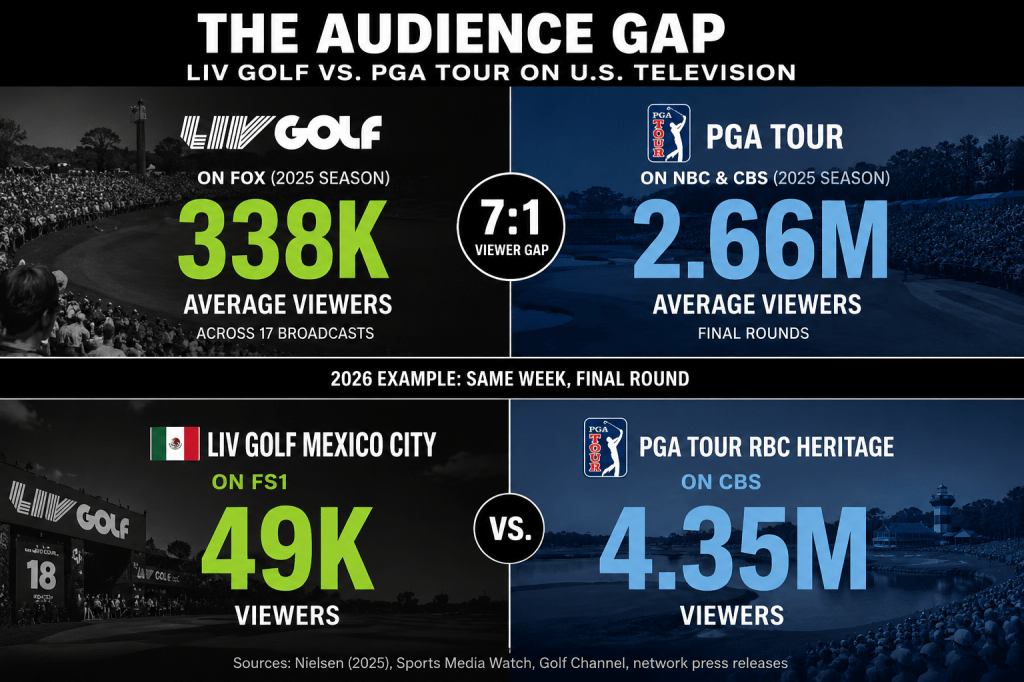
In-person attendance tells a rosier story — LIV has drawn genuinely large, enthusiastic crowds at stops like Adelaide and several U.S. events — but crowds at the course have never translated into the broadcast audience that actually pays golf’s bills. That disconnect between “people showed up” and “nobody watched” is, in miniature, the story of LIV’s entire business model.
The Credibility Problem That Money Couldn’t Fully Buy
LIV’s format — 54-then-72-hole events, no cuts, shotgun starts, fields capped around 57 players split into teams — was built for made-for-TV spectacle, not for the meritocratic structure that golf’s ranking system is designed around. That mismatch cost the league years in its fight for Official World Golf Ranking recognition. When the OWGR finally granted LIV limited points ahead of the 2026 season, the board was explicit about why LIV had fallen short for so long: field sizes below the 75-player minimum, no-cut tournaments, non-merit-based pathways onto the tour, and roster moves driven by player nationality rather than performance.
“For players already in their late 30s or early 40s, that decline isn’t just a bruised ego — it’s a countdown clock on major championship eligibility.”
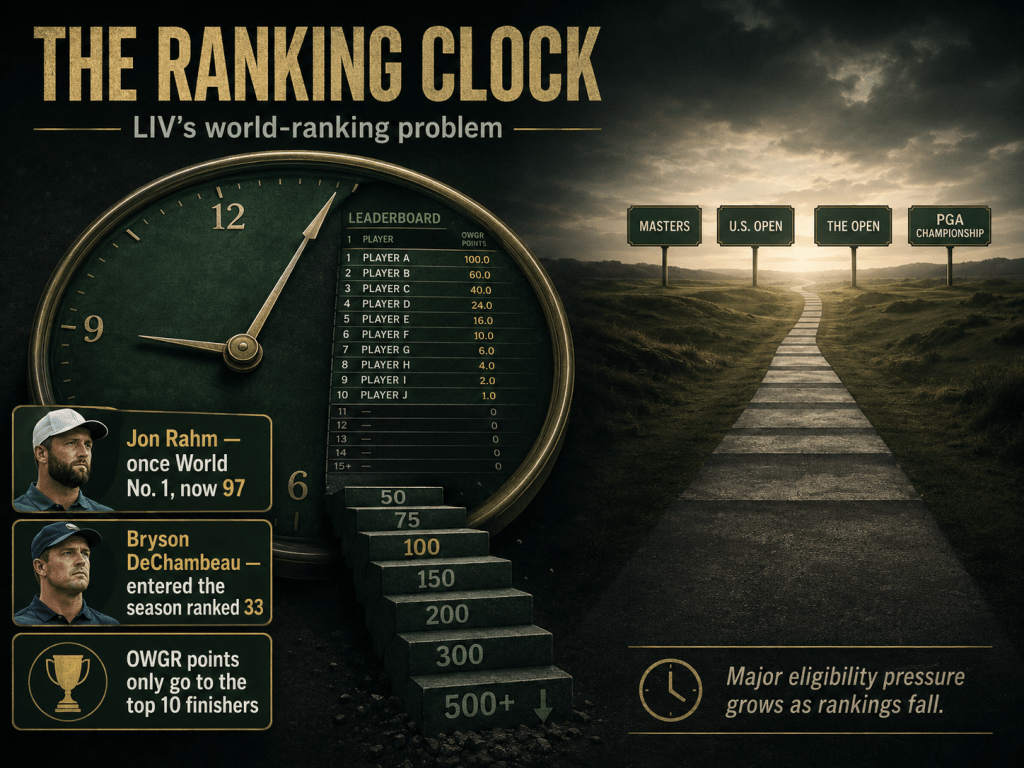
Even the compromise LIV won was a partial one — ranking points go only to the top 10 finishers each week, leaving the rest of the field invisible to the system that determines who gets into the Masters, the U.S. Open, the Open Championship and the PGA Championship. The result has been a slow bleed for LIV’s biggest names. Since points arrived, only a handful of LIV players — Elvis Smylie, David Puig and Peter Uhlein among them — have actually climbed the rankings. Meanwhile, stars who anchored the league’s launch have kept sliding: Bryson DeChambeau entered this season ranked 33rd in the world, and Jon Rahm, once the world No. 1, had fallen to 97th. For players already in their late 30s or early 40s, that decline isn’t just a bruised ego — it’s a countdown clock on major championship eligibility.
To make matters more precarious, reports suggest LIV is considering further structural changes for 2027 that could put its hard-won OWGR recognition at risk all over again — the same trap that’s defined the league from the start. The format changes that would make LIV legible to golf’s traditional ranking and qualification systems cut directly against the guaranteed-money, no-cut spectacle that got players to sign in the first place.
No Way Back, At Least for Now

For the players who bet their careers on LIV, the door back to the PGA Tour isn’t open. Speaking at the Tour Championship in August, PGA Tour CEO Brian Rolapp said flatly that there’s no current plan to revive the Returning Member Program that brought five-time major champion Brooks Koepka back to the Tour in January — a deal that cost Koepka five years of forfeited equity, a season without FedEx Cup bonus eligibility, and a $5 million charity donation as a condition of return. DeChambeau, Rahm and Cameron Smith were all eligible for that same pathway and chose to stay with LIV instead.
The Tour’s locker room is split on what should happen if LIV collapses. Rory McIlroy has been blunt: “Have they brought value to LIV? I think the PGA Tour’s in a really good spot,” he said, suggesting no urgency to welcome anyone back. World No. 1 Scottie Scheffler has taken the opposite position, saying LIV players should be allowed to return, with appropriate penalties. Rolapp himself has framed any future decision around three competing pressures — the Tour’s meritocratic foundation, its status as a membership organization with rules, and what fans actually want to see — without committing to any specific path forward.
A Deal on Paper, a Fire Sale in Practice
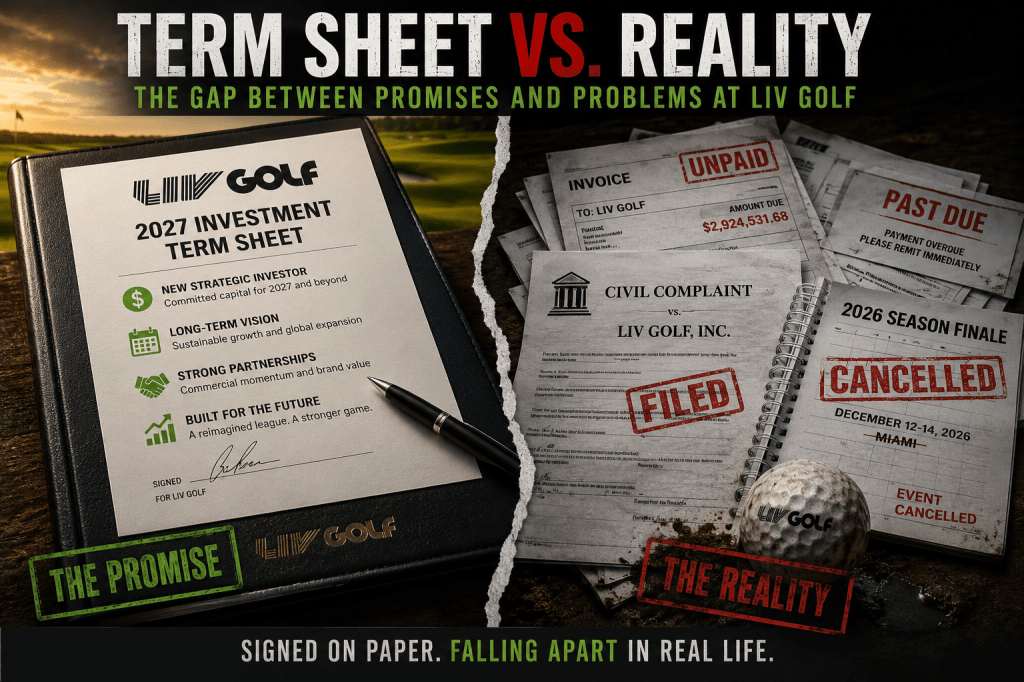
That “diversified, multi-partner” search produced something concrete faster than expected. On Aug. 6, standing at LIV New York in Bedminster, O’Neil announced a signed, board-approved term sheet with an unnamed “lead investor” to fund the league starting in 2027 — with more than a dozen other parties reportedly circling as potential minority investors. The most striking detail: under the proposed structure, LIV’s own players would become majority equity holders in the league, a first for a major global sports property. O’Neil says he’s targeting a closed transaction in September.
“The three weeks since the announcement have looked less like stability and more like a league eating its own furniture to stay warm.”
If that holds, it would be a genuine lifeline. But the three weeks since the announcement have looked less like stability and more like a league eating its own furniture to stay warm. LIV had already scrapped a $30 million New Orleans event back in June. On Aug. 17, it canceled the season-ending Team Championship outright — a $40 million prize pool event that had been scheduled for Aug. 27–30 in Michigan — folding the team and individual titles into the Indianapolis stop instead. Weekend concert programming got cut too. Behind the scenes, Front Office Sports reported LIV owes back pay ranging from a few thousand dollars to nearly $100,000 to multiple vendors across video production, data collection, merchandising, and food and beverage — and one contractor, Mobii Systems Group, is suing for more than $1.1 million over unpaid invoices tied to LIV’s “Any Shot, Any Time” broadcast technology. Asked directly about the possibility of a bankruptcy filing, O’Neil didn’t deny it, calling it “optionality.” No missed paychecks for full-time staff have been reported.
The season itself wrapped in suburban Indianapolis on Aug. 23 — a somewhat fitting, muted finish for a “tumultuous season,” as one outlet put it. Jon Rahm claimed his third consecutive individual season points title and a second straight team crown with Legion XIII, but lost the tournament itself by a shot to 22-year-old Michael La Sasso, the reigning NCAA individual champion, who became the youngest player ever to win a LIV event. Rahm, who’s technically under contract through 2027, called the season “mission accomplished” afterward — cryptic enough to fuel real speculation about whether he sticks around. Bryson DeChambeau’s contract expires this year with no confirmed extension. Patrick Reed has already left outright, regaining PGA Tour eligibility as of Aug. 25.
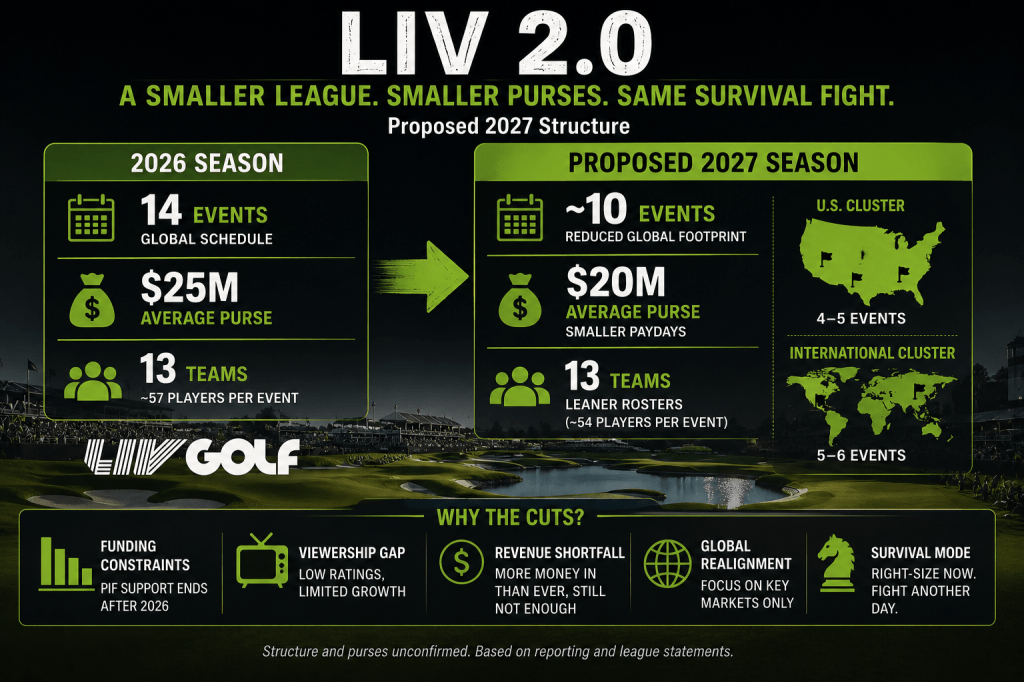
What comes next, if the investor deal closes, is being described internally as “LIV 2.0” — a scaled-back schedule of around 10 events (down from 14), split between international “Team Majors” and U.S. events clustered around the calendar’s major championships, with purses likely trimmed, possibly below $15 million per event.
Where This Leaves Everyone
“The gap between ‘we have a signed term sheet’ and ‘we canceled our season finale and are being sued by our own vendors’ is the real story of where this league stands.”
LIV Golf isn’t disappearing tomorrow, and it now has, at least on paper, a plan to survive past the PIF exit. But the gap between “we have a signed term sheet” and “we canceled our season finale and are being sued by our own vendors” is the real story of where this league stands: a business trying to convince a new financial backer it’s worth saving while visibly unable to pay the people currently keeping the lights on. Whether outside investors are willing to formalize that bet — on a league that lost $600 million in a single year, draws fewer television viewers than a mid-tier PGA Tour event, and still hasn’t fully resolved its standing with the sport’s own ranking system — is the question that will actually define the next few months, not O’Neil’s press-conference optimism.
“The human story, heading into the fall, is a golf league trying to close a rescue deal while its unpaid vendors line up outside the courthouse.”
For the players, the stakes are more personal and more urgent. Every LIV event played under the current format is another week their world ranking can slip further out of major championship range, with no clear off-ramp back to the tour they left and no certainty, even for Rahm, about what team or league they’re playing for come 2027. The macro story here was always Saudi Arabia’s — sportswashing ambitions colliding with a fiscal reality that finally caught up. But the human story, heading into the fall, is a golf league trying to close a rescue deal while its unpaid vendors line up outside the courthouse.
Sources: Reporting and figures in this piece draw on PIF’s official statement and coverage from CNBC, GOLF.com, Sky Sports and ESPN on the funding withdrawal; Gulf International Forum, AGBI, Middle East Briefing and House of Saud on PIF’s broader fiscal position and Vision 2030 strategy shift; ESPN, TSN and Bleacher Report on PGA Tour commissioner Brian Rolapp’s comments regarding LIV golfers’ return; the OWGR’s official ruling and follow-up analysis from Golfmagic and Golf Monthly on world ranking eligibility; Awful Announcing, Golf Digest and National Club Golfer on comparative TV viewership data; and, for the most recent developments, LIV Golf’s own site, Front Office Sports (via Field Level Media, The Japan Times and MG Golf) on canceled events and vendor disputes, Fox Sports, Golf Digest and Pro Golf Weekly on the lead-investor announcement, and AP wire coverage (via ESPN, ABC News and the Journal Gazette) plus The Mirror and The Fried Egg on the Indianapolis season finale.


Leave a Reply