By Michael Phillips | Sports & Whatever | WNBA
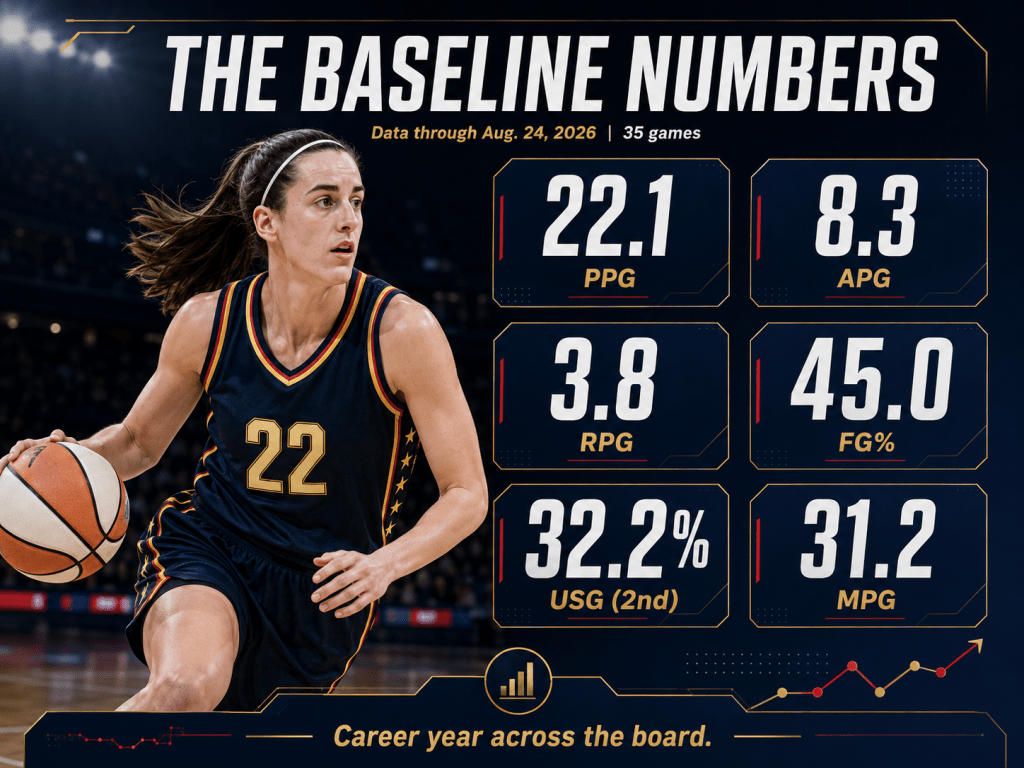
Data through Indiana’s August 24, 2026 win over Chicago (35 games played)
The Baseline Numbers
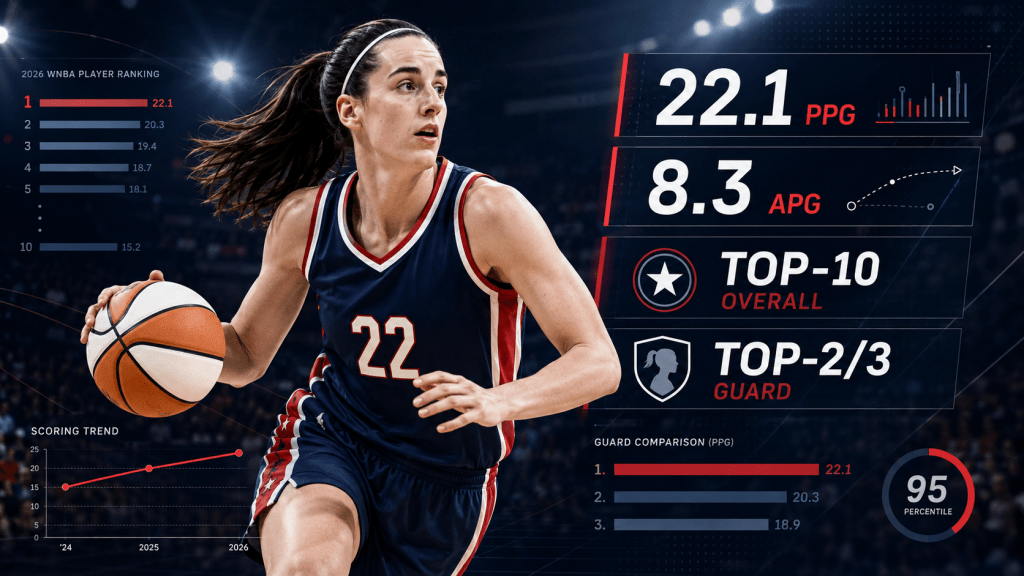
Clark is having a career year: 22.1 points, 3.8 rebounds, and 8.3 assists per game on 45.0% shooting, up across the board from her 2024–25 rookie and sophomore averages. She’s doing it on heavy usage (32.2%, 2nd in the league) and in fewer minutes than most stars (31.2 per game).
Overall League Ranking
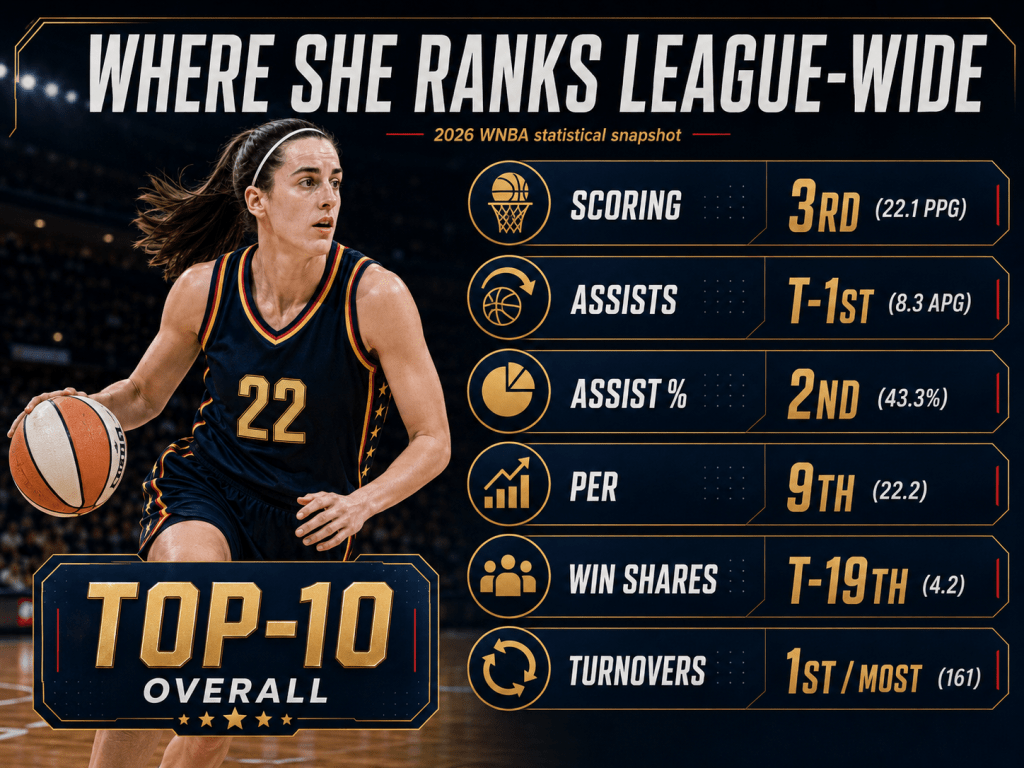
Scoring: 3rd in points per game (22.1), behind A’ja Wilson (26.0) and teammate Kelsey Mitchell (24.8).
Playmaking: Tied for 1st in assists per game (8.3, with Alyssa Thomas) and 2nd in assist percentage (43.3%) — she’s setting up teammates at a rate matched by almost no one in the league.
Efficiency/advanced metrics: This is where the picture gets more mixed.
- Player Efficiency Rating: 22.2, ranked 9th
- Win Shares: 4.2, tied for 19th
- Turnovers: she leads the league outright, with 161 — well ahead of 2nd place (126)
The turnover total is the clearest drag on her overall ranking. Her usage and shot-creation burden are enormous, and some turnover-proneness comes with that territory, but it’s the one category where she’s not just a co-leader or top-five player — she’s the outlier.
Overall placement: Most reasonable statistical rankings (PER, win shares, box-score composites) put Clark in the top 8–10 players in the league, clearly below MVP-tier players like A’ja Wilson, and generally grouped with players like Kelsey Mitchell, Olivia Miles, Breanna Stewart, and Natasha Howard rather than standing alone at the top.
Ranking Among Guards Specifically
The guard position is where Clark’s profile looks strongest relative to peers:
| Category | Clark’s Rank Among Guards |
|---|---|
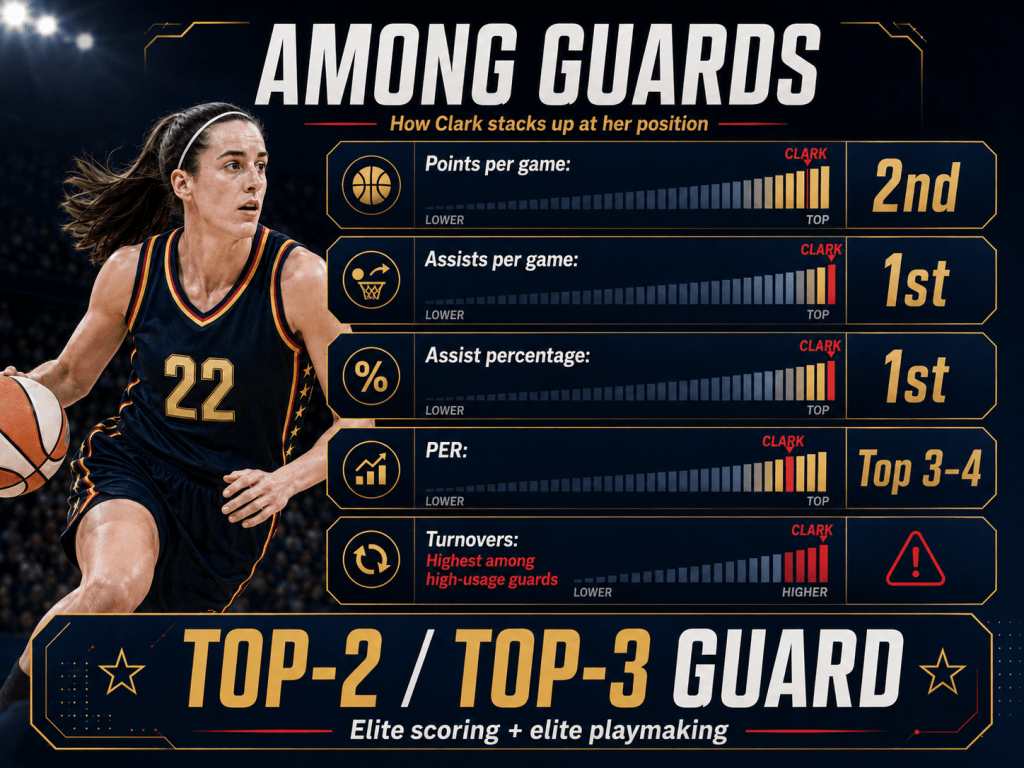
| Points per game | 2nd (behind Mitchell) |
| Assists per game | 1st |
| Assist percentage | 1st |
| PER | Top 3–4 (behind Miles, roughly with Mitchell) |
| Turnovers | Worst among high-usage guards |
Compared directly to the guards putting up the best statistical seasons — Kelsey Mitchell (24.8 PPG, elite efficiency), Olivia Miles (23.4 PER, well-rounded), Paige Bueckers, Jordin Canada, Chelsea Gray — Clark is the only one combining top-tier scoring volume with the league’s best assist rate. No other guard matches that specific combination.
Guard ranking: top 2–3, generally argued as 1st or 2nd behind Mitchell (her own teammate) or Miles depending on how much weight you put on efficiency versus offensive gravity/playmaking.
The Case For and Against a Higher Ranking
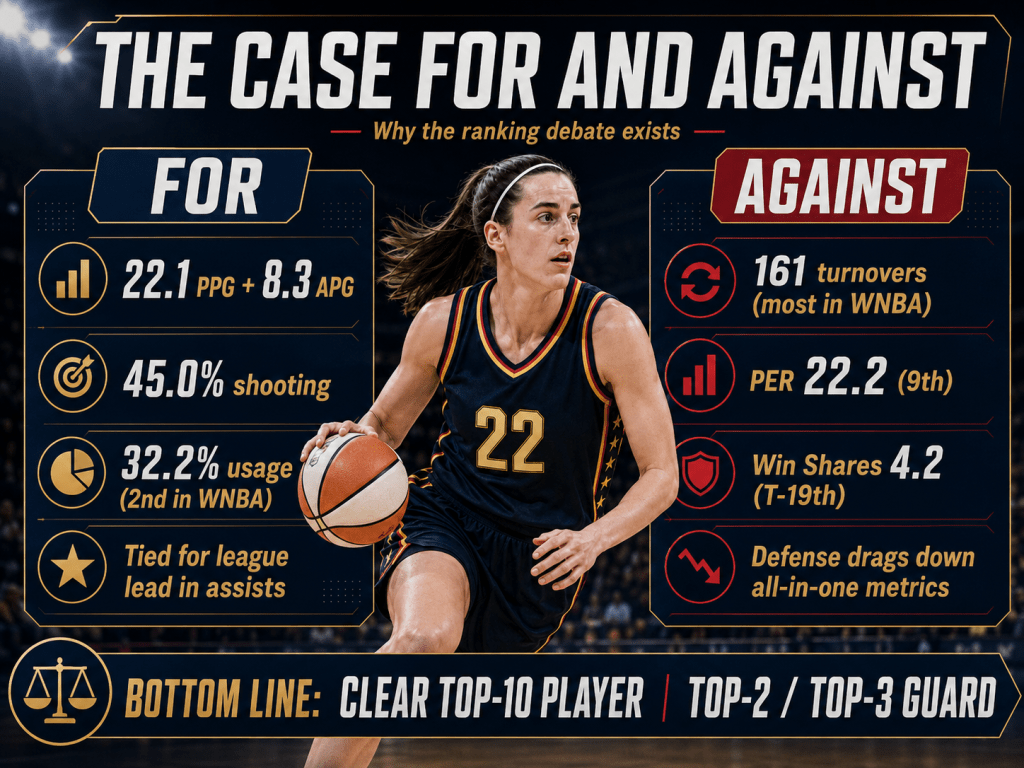
For: No player in the league combines her scoring volume and assist rate. Her usage rate would be unsustainable for most players without a collapse in efficiency, and hers hasn’t collapsed — 45% shooting is a real improvement over her rookie season.
Against: The turnover rate is a genuine statistical weakness, not just a narrative one. Her defensive win shares and defensive rating also lag behind most other top-10 players, since her defensive role is limited. Advanced all-in-one metrics (PER, win shares) rank her outside the true top tier because those models weight turnovers and defense heavily.
Bottom Line
Statistically, Clark grades out as a clear top-10 overall player and a top-2 or top-3 guard in the WNBA in 2026 — elite as a scorer-playmaker combo, but not yet in the tier occupied by A’ja Wilson when judged by the full statistical picture, largely due to turnovers and defensive metrics.


Leave a Reply