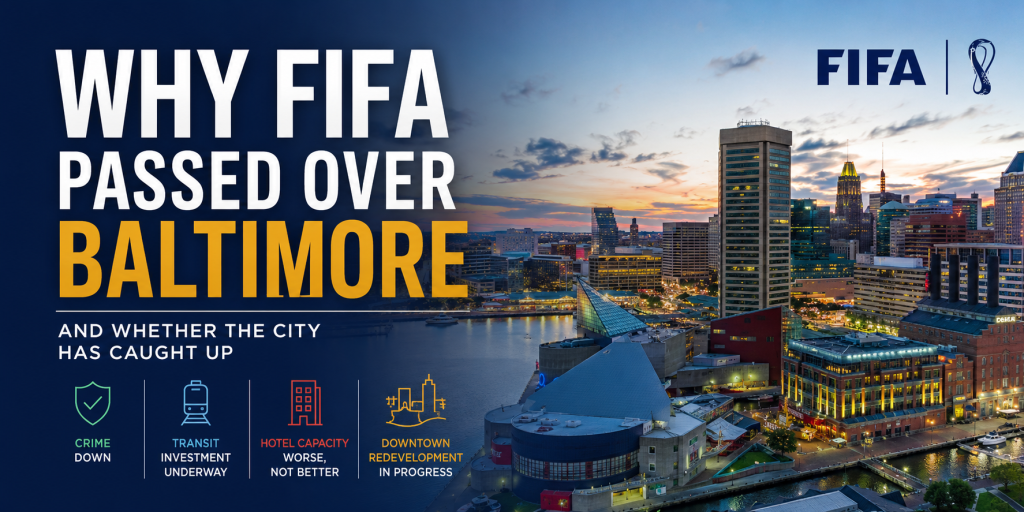
FIFA never gave an official reason. The unofficial ones don’t hold up well, and four years later, Baltimore’s case for hosting is a story of real progress shadowed by real setbacks.
By Michael Phillips | MDBayNews
When FIFA announced its 16 World Cup host cities on June 16, 2022, the Baltimore-Washington bid wasn’t an afterthought eliminated in an early round. It made the final cut of candidates — and lost there, alongside Cincinnati, Denver, Edmonton, Nashville, and Orlando. Terry Hasseltine, who ran Maryland’s bid as executive director of the Maryland Sports Commission, said at the time that nobody from FIFA ever told him why. Four years on, it’s worth asking both what actually sank the bid and whether the city has solved the problems that may have been the real reason.
What FIFA Actually Said — and What Local Leaders Said Back
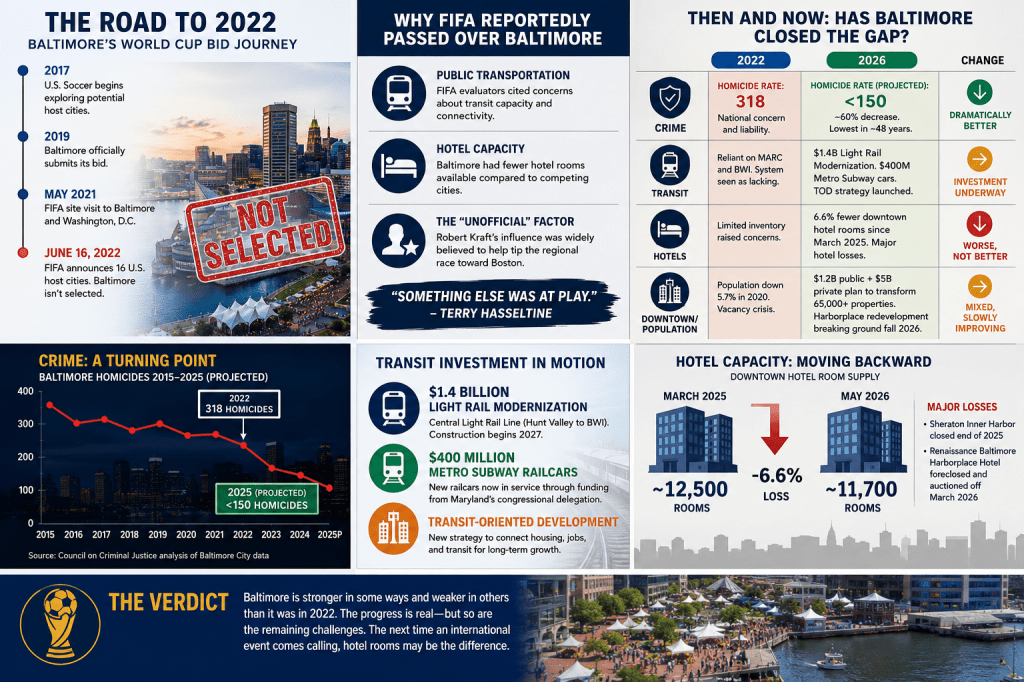
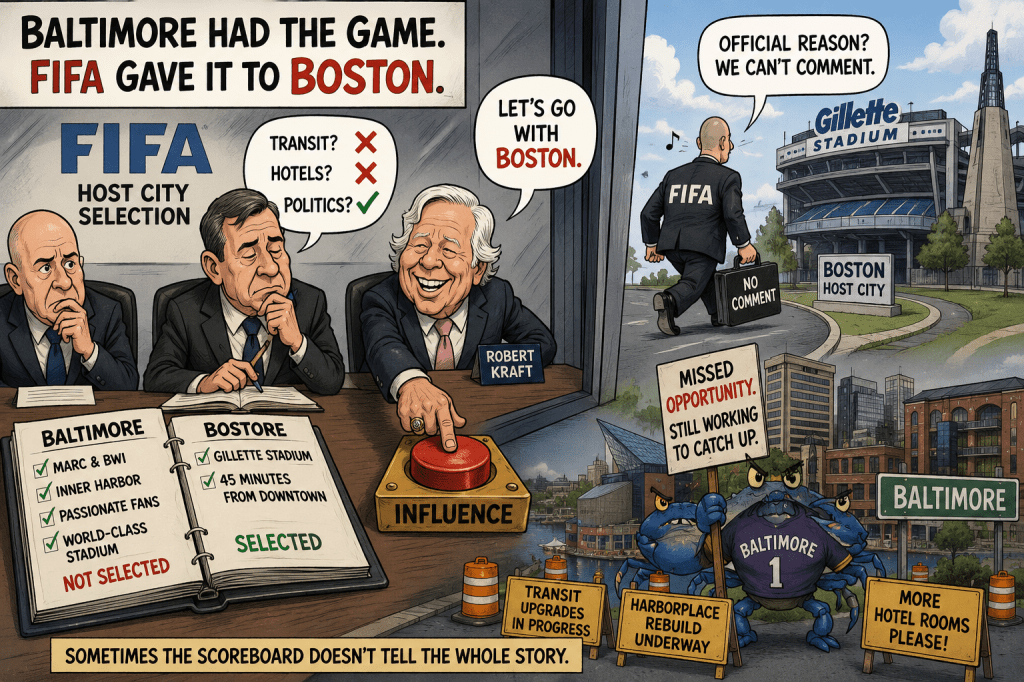
FIFA’s public explanation for its host city selections has always been thin. But reporting in the aftermath pointed to specific concerns raised during the evaluation process: inadequate public transportation and a comparative shortage of hotel rooms to handle World Cup crowds. There was also a less official factor floating around the process — Robert Kraft, owner of the New England Patriots and an honorary chairman of the United bid committee, was widely believed to have used his influence to tip a head-to-head regional competition toward Boston.
Maryland’s own leadership pushed back hard on the transportation rationale specifically. Baltimore Mayor Brandon Scott’s spokesman noted that FIFA officials had said during their site visit that transportation would not be a problem for Baltimore’s bid. Hasseltine made the same point publicly, citing the MARC commuter rail connection between Baltimore and Washington and BWI Thurgood Marshall Airport’s central location as legitimate transportation assets. “I don’t know what other factors came to this result,” he said at the time, “but congratulations to the other cities. They obviously check the box that we missed. Something else was at play.”
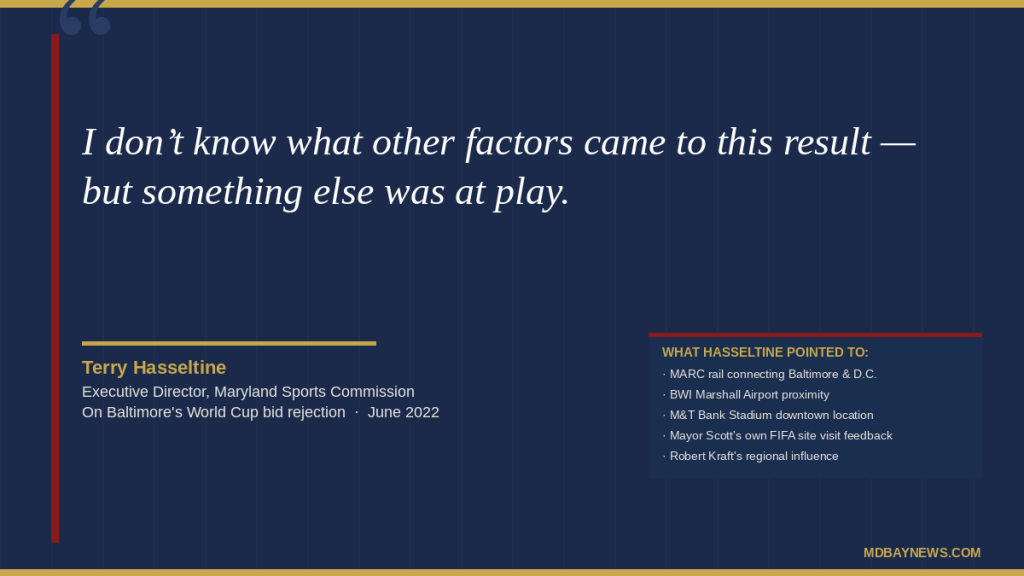
Mayor Scott raised an additional point that’s hard to argue with: Boston’s winning bid plays its games at Gillette Stadium, a stadium in Foxborough that sits a 45-minute drive from downtown Boston. If proximity and transit access were genuinely disqualifying for Baltimore, it’s not clear how a suburban New England stadium cleared that bar instead.
What this suggests is that the stated reasons may have been real factors, but probably weren’t the whole story. A bid evaluation process involving billions of dollars, regional rivalries, and politically connected stakeholders like Kraft does not always reduce cleanly to a checklist of measurable criteria. Hasseltine’s blunt assessment at the time — that “something doesn’t pass the sniff test” — has aged into something closer to consensus among the people who ran the bid.
Then and Now: Has Baltimore Closed the Gap?
If transportation and hotel capacity were genuine sticking points in 2022, the relevant question in 2026 is whether Baltimore has fixed them — and whether the broader case for the city as a host has gotten stronger or weaker. The honest answer is both.
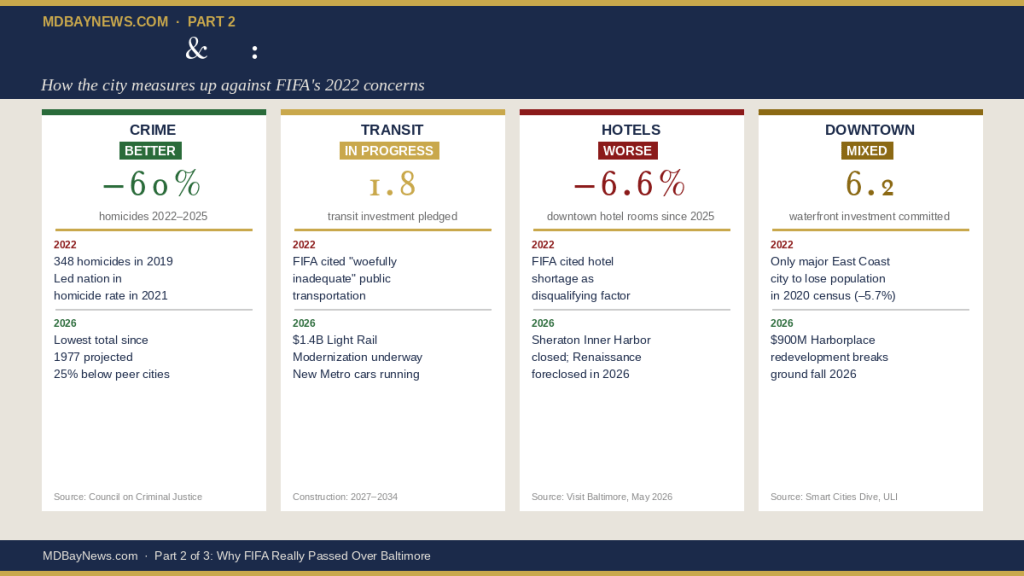
Crime: Dramatically Better
This is the clearest win. Baltimore’s homicide rate has fallen by roughly 60% between 2022 and 2025, one of the steepest and most sustained violent crime declines of any major American city in that period. The city is on pace to finish 2025 with its lowest homicide total in roughly 48 years — fewer than 150 killings, a number not seen since 1977. Carjackings, aggravated assaults, and gun assaults have all dropped sharply alongside it. Researchers at the University of Pennsylvania’s Crime and Justice Policy Lab, working with city data, found that Baltimore’s Group Violence Reduction Strategy was directly responsible for a meaningful share of that decline, and that the drop outpaced comparable cities by roughly 25%.
In 2022, “Baltimore” and “violent crime” were functionally synonymous in the national conversation, and that association was a real argument against the city as an international showcase. That argument has substantially weakened. It hasn’t disappeared — Baltimore’s homicide rate, even after the decline, remains higher than most large American cities — but the trajectory is now a genuine selling point rather than a liability.
Transit: Investment Underway, Not Yet Delivered
Governor Wes Moore’s administration has put real money behind Baltimore transit since the bid was rejected: a $1.4 billion Light Rail Modernization Program covering the Central Light Rail Line from Hunt Valley to BWI, a $400 million Metro Subway railcar replacement funded through Maryland’s congressional delegation, and a newly announced Transit-Oriented Development strategy meant to tie housing and transit investment together.
The catch is timing. The light rail modernization is still in the procurement and design phase as of 2026, with vehicle construction not beginning until 2027 and station work stretching out into the early 2030s. The new Metro Subway cars are real and running, which matters, but the larger infrastructure case Hasseltine made in 2022 — that Baltimore’s transit assets were underrated — is still mostly a case about MARC and BWI’s airport proximity rather than about a transformed in-city transit system. If FIFA’s evaluators were unconvinced by transit in 2022, the system today is meaningfully invested in but not yet meaningfully transformed.
Hotels: Worse, Not Better
This is the most uncomfortable comparison. Far from closing FIFA’s cited hotel-capacity gap, Baltimore’s downtown hotel inventory has gone backward. As of May 2026, the city’s central business district had lost approximately 6.6% of its total hotel room supply since just March 2025. The Sheraton Inner Harbor closed at the end of 2025. The Renaissance Baltimore Harborplace Hotel was foreclosed upon and auctioned off in March 2026. Visit Baltimore’s newly appointed CEO acknowledged the losses directly, while noting downtown hotels can still offer up to 3,000 rooms on a given night for major events.
If hotel capacity was genuinely a factor in 2022 — and several independent accounts suggest it was cited as a concern — Baltimore is not in a stronger position today. It is in a measurably weaker one.
Downtown and Population: A Mixed, Slowly Improving Picture
Baltimore was the only major East Coast city to lose population in the 2020 census, dropping 5.7% while Philadelphia and New York both grew. That decline has not reversed, but the city has made an aggressive bet on fixing the underlying problem: a $1.2 billion public commitment paired with an anticipated $5 billion in private financing to revitalize more than 65,000 vacant or at-risk properties over 15 years, launched in September 2025 as what city leaders called the most ambitious housing program of its kind in the country.
The waterfront itself is mid-transformation rather than finished. The roughly $900 million Harborplace redevelopment — replacing the aging Inner Harbor pavilions with mixed-use buildings, expanded public space, and flood-resilient promenades — is set to break ground in fall 2026, four years after the World Cup bid was rejected and a full nine years before its planned 2031 completion. The photo that sparked this conversation, showing a packed Inner Harbor crowd during a 2026 festival weekend, captures a real and accurate truth: the harbor can still draw a crowd. But it’s drawing that crowd around a redevelopment project that is, as of this writing, still mostly a construction timeline rather than a finished product.
The Verdict
Baltimore’s case for hosting major international events is stronger in some ways and weaker in others than it was when FIFA passed on the city in 2022. The crime decline is real, dramatic, and directly responsive to the kind of safety concerns that quietly shape these decisions even when they’re never stated outright. The transit investment is real but not yet delivered. The hotel capacity that FIFA’s evaluators reportedly flagged as a weakness has gotten worse, not better.
What hasn’t changed is the unresolved question at the center of the whole episode: nobody in Baltimore or Annapolis ever got a straight answer from FIFA about why the bid actually failed. Lieutenant Governor Boyd Rutherford’s verdict — that Baltimore’s omission was a missed opportunity rather than a dodged bullet — still holds up. But if the city wants a different outcome the next time an international event comes calling, the data suggests the fix isn’t just political will. It’s hotel rooms.
Sources: DCist; Baltimore Sun; The Baltimore Banner; Sports Destination Management; SeatGraph; Council on Criminal Justice; Baltimore City government; Smart Cities Dive; Urban Land Magazine; The Daily Record; Maryland Transit Administration; Office of Governor Wes Moore; CBS Baltimore


Leave a Reply