By Michael Phillips | Thunder Report
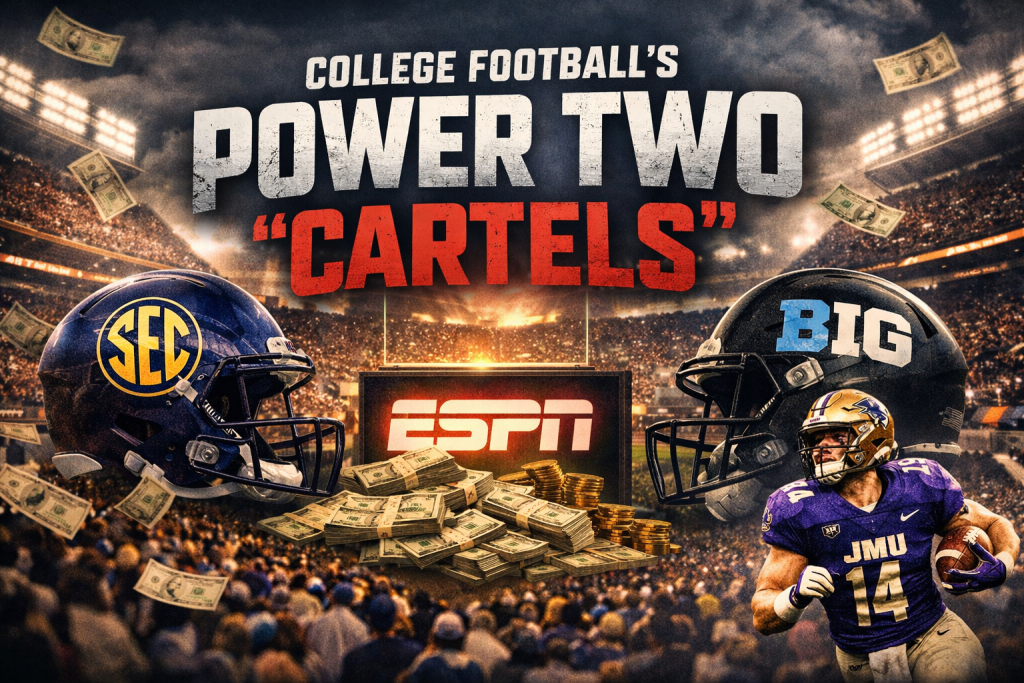
The viral line telling fans to stop referring to “conferences” and start calling them “cartels” struck a nerve because it captured something many already feel: college football has crossed a structural threshold. The sport is no longer organized around amateur competition or regional identity. It is organized around money, leverage, and brand dominance.
The Southeastern Conference and the Big Ten Conference — increasingly described as the “Power Two” — now function less like peer leagues and more like controlling economic blocs inside the NCAA framework. “Cartel” may be rhetorical rather than legal, but the critique behind it is difficult to refute.
Power Two Dominance Is Structural, Not Emotional
Through aggressive realignment and media consolidation, the SEC and Big Ten have absorbed the most valuable brands, locked in massive TV contracts, and secured disproportionate influence over playoff formats and revenue distribution.
Their combined media deals total well over $10 billion, creating a financial gap that no remaining conference — ACC, Big 12, or Group of Six — can realistically close. CFP revenue models increasingly favor these two leagues, while their commissioners openly discuss governance changes and scheduling structures that would further entrench their position.
This is not a conspiracy. It is incentive alignment. When two entities control most of the money, the system bends toward them.
ESPN’s Role: Not Puppet Master, but Accelerator
Critics often lump the Power Two together with ESPN, and while that framing can be overstated, the incentives are real.
ESPN holds exclusive SEC rights and controls the College Football Playoff broadcast through 2031. The network profits most when high-brand programs dominate playoff access and viewership. While the Big Ten deliberately shifted much of its inventory to Fox, CBS, and NBC, ESPN still benefits enormously from Power Two supremacy.
The result is a media ecosystem that rewards consolidation, discourages parity, and treats “student-athlete” rhetoric as legacy branding rather than reality.
The Oregon–James Madison Game: A Necessary Correction
The College Football Playoff first-round matchup between the Oregon Ducks and the James Madison Dukes on December 20, 2025, has become a flashpoint in this debate — and it deserves precise framing.
Oregon won decisively, 51–34, racing to a 34–6 halftime lead and exposing the obvious talent and depth gap between a Big Ten powerhouse and a Group of Six champion. That part is undisputed.
What needs correcting, however, is the idea that Oregon simply benched its entire starting lineup and allowed JMU to score meaningless “garbage time” points.
That is not what happened.
Oregon rotated players, managed snaps, and softened schemes — as most elite programs do with a large lead — but they did not wholesale pull all starters at halftime. Key offensive starters and rotational defensive players remained on the field well into the second half. This was rotation, not surrender.
Why that matters:
- JMU scored 34 points, the most any team scored on Oregon all season
- The Dukes finished with 509 total yards, nearly matching Oregon
- Those points came against a roster built with Power Two money, NIL depth, and NFL-caliber recruiting
This doesn’t change the outcome.
It changes the meaning.
What the Game Actually Proved
The Oregon–JMU game didn’t expose a lack of effort or legitimacy from the underdog. It exposed the economic fault line in modern college football.
James Madison proved it could:
- Compete schematically
- Exploit opportunities
- Belong on the field
What it could not do — and realistically cannot do under the current system — is sustain four quarters against a roster funded at a semi-professional level.
That is not a failure of coaching, culture, or effort.
It is a budget reality.
Moral Victories and the End of Illusion
This is where the “cartel” language gains traction. Non-Power programs are allowed access, exposure, and moments — but not equality. Expanded playoffs showcase them, but do not level the field.
Fans are now openly asking whether Group of Six programs should claim their own national recognition, because the path to a true title is structurally closed. Without dramatic revenue redistribution or a formal split, moral victories may be the ceiling.
College football still has pageantry.
It still has passion.
It still has meaning.
But it no longer has plausible deniability.
Thunder Report Takeaway
Calling the SEC and Big Ten “conferences” suggests shared governance and competitive balance. What exists today is closer to corporate consolidation, with universities serving as brand hosts for a rapidly professionalizing product.
You don’t have to like the word “cartel” to understand why fans are using it.
College football didn’t lose its soul overnight.
It sold it — one media deal at a time.


Leave a comment